



Question: Your (1000-mathrm{kg}) car, moving at (7.0 mathrm{~m} / mathrm{s}), approaches the bottom of a hill that is (20 mathrm{~m}) high (Figure P9.60). To save gas,
Your \(1000-\mathrm{kg}\) car, moving at \(7.0 \mathrm{~m} / \mathrm{s}\), approaches the bottom of a hill that is \(20 \mathrm{~m}\) high (Figure P9.60). To save gas, you use on average only \(3.3 \mathrm{~kW}\) of engine power, realizing that half of the energy delivered by the engine and half of the initial kinetic energy will be dissipated. If you calculated correctly, your car will just barely make it over the hill. What time interval is required for your car to travel from the bottom to the top of the hill?
Data from Figure P9.60
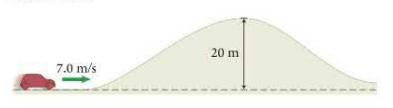
20 m 7.0 m/s
Step by Step Solution
3.42 Rating (146 Votes )
There are 3 Steps involved in it
To solve this problem we need to consider the conservation of energy At the bottom of the hill the c... View full answer

Get step-by-step solutions from verified subject matter experts