







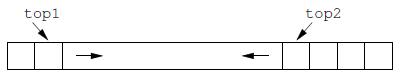
Question: Modify the code of Figure 4.18 to implement two stacks sharing the same array, as shown in Figure 4.20 . Figure 4.18 Figure 4.20 /**
Modify the code of Figure 4.18 to implement two stacks sharing the same array, as shown in Figure 4.20 .
Figure 4.18
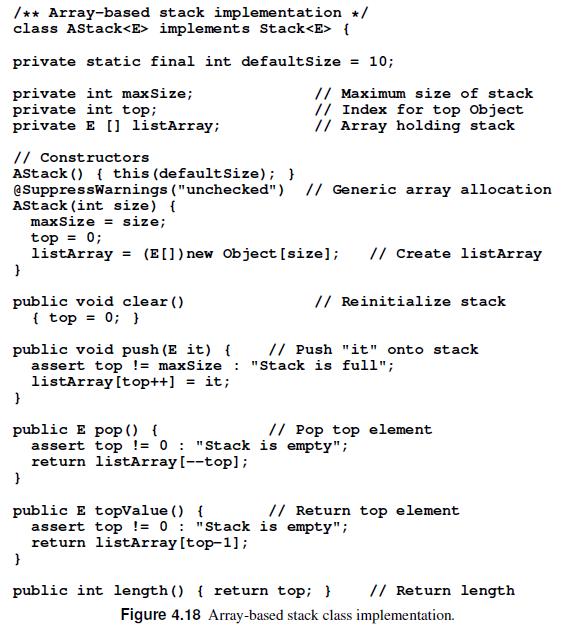
Figure 4.20
/** Array-based stack implementation */ class AStack implements Stack { private static final int defaultSize = 10; private int maxSize; private int top; private E [] listArray; // Constructors AStack() { this (defaultSize); } @SuppressWarnings ("unchecked") // Generic array allocation AStack (int size) { } public void clear() { top = 0; } public void push (E it) { assert top != maxSize : listArray [top++] = it; } maxSize = size; top = 0; listArray = (E[]) new Object [size]; // Create listArray public E pop() { assert top != 0 "Stack return listArray [--top]; } // Maximum size of stack // Index for top Object // Array holding stack } // Reinitialize stack // Push "it" onto stack "Stack is full"; // Pop top element is empty"; public E topValue () { assert top != 0: "Stack is empty"; return listArray [top-1]; // Return top element public int length() { return top; } // Return length Figure 4.18 Array-based stack class implementation.
Step by Step Solution
3.36 Rating (149 Votes )
There are 3 Steps involved in it
java Arraybased stack implementation class AStack implements Stack private static final int defaultS... View full answer

Get step-by-step solutions from verified subject matter experts
 Study Help