







Question: Radix Sort is typically implemented to support only a radix that is a power of two. This allows for a direct conversion from the radix
Radix Sort is typically implemented to support only a radix that is a power of two. This allows for a direct conversion from the radix to some number of bits in an integer key value. For example, if the radix is 16, then a 32-bit key will be processed in 8 steps of 4 bits each. This can lead to a more efficient implementation because bit shifting can replace the division operations shown in the implementation of Section 7.7. Reimplement the Radix Sort code given in Section 7.7 to use bit shifting in place of division. Compare the running time of the old and new Radix Sort implementations.
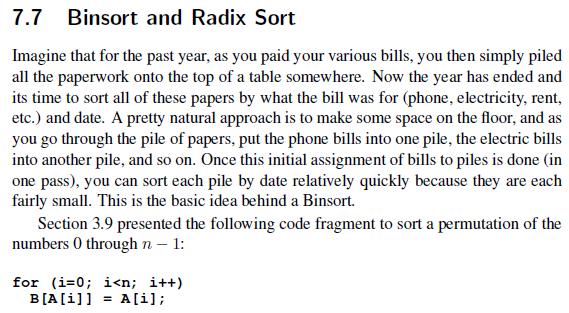
7.7 Binsort and Radix Sort Imagine that for the past year, as you paid your various bills, you then simply piled all the paperwork onto the top of a table somewhere. Now the year has ended and its time to sort all of these papers by what the bill was for (phone, electricity, rent, etc.) and date. A pretty natural approach is to make some space on the floor, and as you go through the pile of papers, put the phone bills into one pile, the electric bills into another pile, and so on. Once this initial assignment of bills to piles is done (in one pass), you can sort each pile by date relatively quickly because they are each fairly small. This is the basic idea behind a Binsort. Section 3.9 presented the following code fragment to sort a permutation of the numbers 0 through n - 1: for (i=0; i
Step by Step Solution
3.41 Rating (170 Votes )
There are 3 Steps involved in it
public static void radixSortint A int n int m int B new int... View full answer

Get step-by-step solutions from verified subject matter experts
 Study Help