







Question: The implementation for Mergesort given in Section 7.4 takes an array as input and sorts that array. At the beginning of Section 7.4 there is
The implementation for Mergesort given in Section 7.4 takes an array as input and sorts that array. At the beginning of Section 7.4 there is a simple pseudocode implementation for sorting a linked list using Mergesort. Implement both a linked list-based version of Mergesort and the array-based version of Mergesort, and compare their running times.
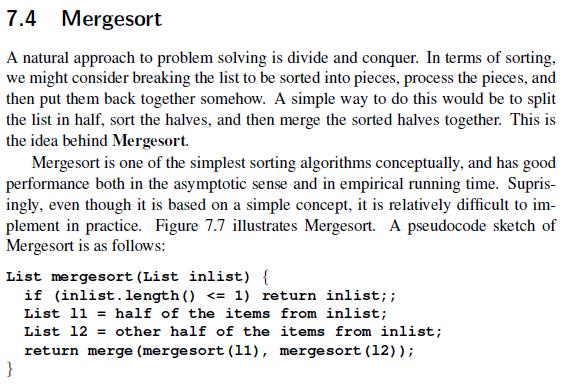
7.4 Mergesort A natural approach to problem solving is divide and conquer. In terms of sorting, we might consider breaking the list to be sorted into pieces, process the pieces, and then put them back together somehow. A simple way to do this would be to split the list in half, sort the halves, and then merge the sorted halves together. This is the idea behind Mergesort. Mergesort is one of the simplest sorting algorithms conceptually, and has good performance both in the asymptotic sense and in empirical running time. Supris- ingly, even though it is based on a simple concept, it is relatively difficult to im- plement in practice. Figure 7.7 illustrates Mergesort. A pseudocode sketch of Mergesort is as follows: List mergesort (List inlist) { from inlist; if (inlist.length()
Step by Step Solution
3.45 Rating (152 Votes )
There are 3 Steps involved in it
I can help you with that Here are possible implementations of both a linked listbased version of Mergesort and the arraybased version of Mergesort in Python along with their running times on some samp... View full answer

Get step-by-step solutions from verified subject matter experts
 Study Help