



Question: How do rented housing units differ from units occupied by their owners? Here are the distributions of the number of rooms for owner-occupied units and
How do rented housing units differ from units occupied by their owners? Here are the distributions of the number of rooms for owner-occupied units and renter-occupied units in San José, California:
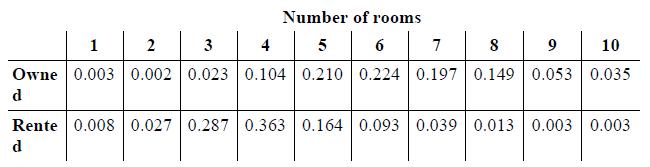
Let X = the number of rooms in a randomly selected owner-occupied unit and Y = the number of rooms in a randomly chosen renter occupied unit.
a. Here are histograms comparing the probability distributions of X and Y. Describe any differences you observe.
b. Find the expected number of rooms for both types of housing unit. Explain why this difference makes sense.
c. The standard deviations of the two random variables are σX = 1.640 and σY=1.308 . Explain why this difference makes sense.

Number of rooms 1 2 3 4 5 6 7 8 9 10 Owne 0.003 0.002 0.023 0.104 0.210 0.224 0.197 0.149 0.053 0.035 d Rente 0.008 0.027 0.287 0.363 0.164 0.093 0.039 0.013 0.003 0.003 d
Step by Step Solution
3.40 Rating (162 Votes )
There are 3 Steps involved in it
a X the number of rooms in a randomly selected owner occupied unit Y the number of rooms in a random... View full answer

Get step-by-step solutions from verified subject matter experts