







Question: Consider the function defined by (a) Find fx(x, y) and fy(x, y) for (x, y) (0, 0). (b) Use the definition of partial derivatives
Consider the function defined by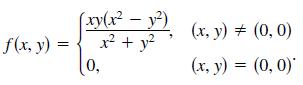
(a) Find fx(x, y) and fy(x, y) for (x, y) ≠ (0, 0).
(b) Use the definition of partial derivatives to find fx(0, 0) and fy(0, 0).
(c) Use the definition of partial derivatives to find fxy(0, 0) and fyx(0, 0).
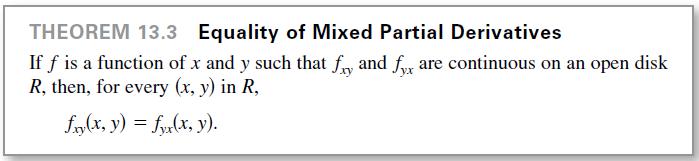
(d) Using Theorem 13.3 and the result of part (c), what can be said about fxy or fyx?
f(x, y) = (xy(x - y) x + y 0, (x, y) = (0,0) (x, y) = (0, 0)*
Step by Step Solution
★★★★★
3.41 Rating (160 Votes )
There are 3 Steps involved in it
1 Expert Approved Answer
Step: 1 Unlock

a b f x 0 0 0 f y 0 0 0 c f x... View full answer
Question Has Been Solved by an Expert!
Get step-by-step solutions from verified subject matter experts
Step: 2 Unlock
Step: 3 Unlock
 Study Help