







Question: How much work would it take to pump oil from the tank in Example 5 to the level of the top of the tank if
How much work would it take to pump oil from the tank in Example 5 to the level of the top of the tank if the tank were completely full?
In Example 5
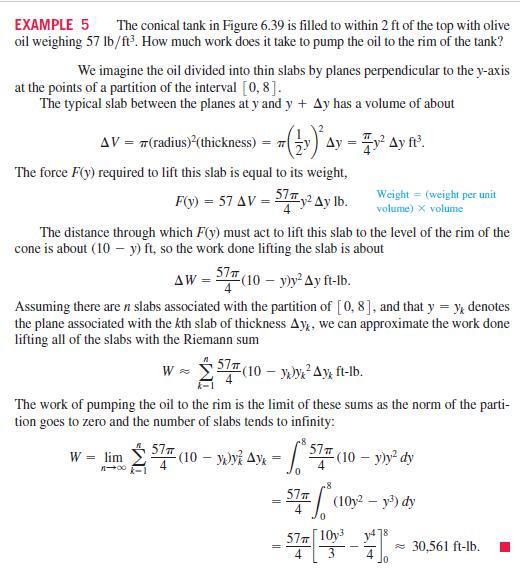
In Figure 6.39
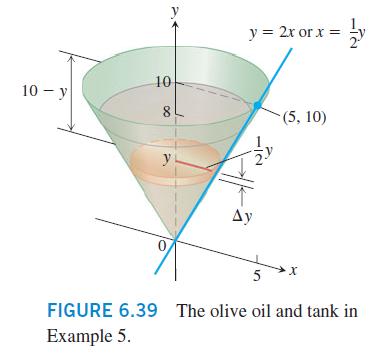
EXAMPLE 5 The conical tank in Figure 6.39 is filled to within 2 ft of the top with olive oil weighing 57 lb/ft. How much work does it take to pump the oil to the rim of the tank? We imagine the oil divided into thin slabs by planes perpendicular to the y-axis at the points of a partition of the interval [0,8]. The typical slab between the planes at y and y + Ay has a volume of about 2 AV = (radius) (thickness) = (y) ay = y ay ft. The force F(y) required to lift this slab is equal to its weight, F(y) = 57 AV = 57my2 Ay lb. The distance through which F(y) must act to lift this slab to the level of the rim of the cone is about (10-y) ft, so the work done lifting the slab is about AW = 57 (10-y)y Ay ft-lb. Assuming there are n slabs associated with the partition of [0, 8], and that y = y denotes the plane associated with the kth slab of thickness Ay, we can approximate the work done lifting all of the slabs with the Riemann sum W = 57 (10-Ay; ft-lb. The work of pumping the oil to the rim is the limit of these sums as the norm of the parti- tion goes to zero and the number of slabs tends to infinity: W = lim T - $ 57 (10 vi Ay * 577 (10 y)y dy = - 577 = Weight (weight per unit volume) x volume =: 8 (10y - y) dy 57 103 1478 Jo 30,561 ft-lb.
Step by Step Solution
3.48 Rating (165 Votes )
There are 3 Steps involved in it
To calculate the work required to pump the oil from the current level to the top of the tank we need ... View full answer

Get step-by-step solutions from verified subject matter experts
 Study Help