







Question: In calculus you will learn that, if is a polynomial function, then the derivative of P(x) is Newton's Method is an efficient method for approximating
In calculus you will learn that, if

is a polynomial function, then the derivative of P(x) is

Newton's Method is an efficient method for approximating the x-intercepts (or real zeros) of a function, such as p(x). The following steps outline Newton's Method.
STEP 1: Select an initial value that is somewhat close to the x-intercept being sought.
STEP 2: Find values for x using the relation
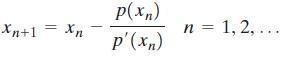
until you get two consecutive values xn and xn+1 that agree to whatever decimal place accuracy you desire.
STEP 3: The approximate zero will be xn+1.
Consider the polynomial p(x) = x3 - 7x - 40.
(a) Evaluate p(5) and p(-3).
(b) What might we conclude about a zero of p? Explain.
(c) Use Newton's Method to approximate an x-intercept, r, -3
(d) Use a graphing utility to graph p(x) and verify your answer in part (c).
(e) Using a graphing utility, evaluate p(r) to verify your result.
() %3D ," + ,-1x"-1 +. + ajx + ao '() (x) %3D , "-1 + ( 1), *"-2 + 2z + j
Step by Step Solution
3.46 Rating (169 Votes )
There are 3 Steps involved in it
a b Since p is continuous and p3 0 p5 there must be at lea... View full answer

Get step-by-step solutions from verified subject matter experts
 Study Help