







Question: (a) Which is larger: (b) For a fixed n, consider (n k) as a function of k. Figure out for which k it is increasing
(a) Which is larger: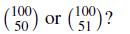
(b) For a fixed n, consider (n k) as a function of k. Figure out for which k it is increasing and for which it is decreasing. Where does it attain its maximal value for an even n, for an odd n? In what sense is the picture symmetric? (Advice: Compare the values for k and k + 1.)
(c) If you toss a coin 100 times, which is more likely: getting 50 heads or 49 heads; 50 heads or 51 heads; 49 heads or 51 heads; 41 heads or 59 tails?
Step by Step Solution
★★★★★
3.34 Rating (160 Votes )
There are 3 Steps involved in it
1 Expert Approved Answer
Step: 1 Unlock

a The inequality 100 1900 is equivalent to 5050 4951 or 50 51 50 b The inequa... View full answer
Question Has Been Solved by an Expert!
Get step-by-step solutions from verified subject matter experts
Step: 2 Unlock
Step: 3 Unlock
 Study Help