







Question: Find the solution to the Dirichlet problem in dimension (d=1: u^{prime prime}(x)=0) for all (x in(0,1), u(0)=a, u(1)=b) and (u) is continuous in [0,1]. Compare
Find the solution to the Dirichlet problem in dimension \(d=1: u^{\prime \prime}(x)=0\) for all \(x \in(0,1), u(0)=a, u(1)=b\) and \(u\) is continuous in [0,1]. Compare your findings with Wald's identities, cf. Theorem 5.10 and Corollary 5.11.
Data From Theorem 5.10
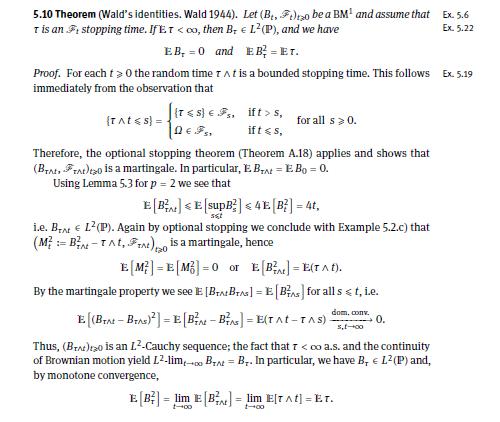
Data From Corollary 5.11
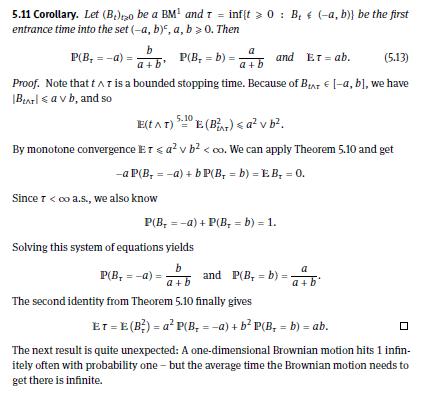
5.10 Theorem (Wald's identities. Wald 1944). Let (B, F)o be a BM and assume that Ex. 5.6 T is an F, stopping time. If ET s, ifts, for all s > 0. Therefore, the optional stopping theorem (Theorem A.18) applies and shows that (BTA) is a martingale. In particular, E. Brt = E. Bo = 0. Using Lemma 5.3 for p = 2 we see that E[B]E[supB] 4E[B]=4t, i.e. B+ L(P). Again by optional stopping we conclude with Example 5.2.c) that (MBA-TAL, FA) is a martingale, hence E[M]=E[M]=0 or E[B] = E(TA). By the martingale property we see E [BABTAS] =E[B] for all s
Step by Step Solution
3.35 Rating (155 Votes )
There are 3 Steps involved in it

Get step-by-step solutions from verified subject matter experts
 Study Help