





Question: Problem 3. (40 points): For this problem, we consider a bounded domain ? = (0, 1) C R and u: 0 - R solving the

Problem 3. (40 points): For this problem, weProblem 3. (40 points): For this problem, we
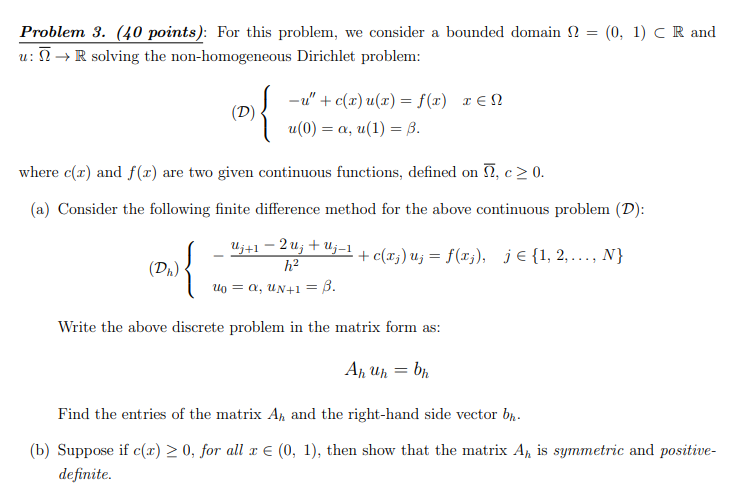
Problem 3. (40 points): For this problem, we consider a bounded domain ? = (0, 1) C R and u: 0 - R solving the non-homogeneous Dirichlet problem: (D) -u" + c(x) u(x) = f(x) IEn "(0) = 0, u(1) = B. where c(x) and f(x) are two given continuous functions, defined on ?, c > 0. (a) Consider the following finite difference method for the above continuous problem (D): will-20j+ "j- + c(x,) uj = f(x;), je {1, 2,..., N} (Dh) h2 10 = 0, UN+1 = B. Write the above discrete problem in the matrix form as: An Un = bh Find the entries of the matrix An and the right-hand side vector br. (b) Suppose if c(x) 2 0, for all x E (0, 1), then show that the matrix A, is symmetric and positive- definite.(HINT: A, = An and for any v E R" show that (An v, v) > 0) (c) Suppose u E C', then the finite difference scheme (D, ) is consistent and second-order accurate for the norm | . loo

Step by Step Solution

There are 3 Steps involved in it

1 Expert Approved Answer
Step: 1 Unlock blur-text-image

Question Has Been Solved by an Expert!

Get step-by-step solutions from verified subject matter experts

Step: 2 Unlock
Step: 3 Unlock

Students Have Also Explored These Related Mathematics Questions!