







Question: Let ((A, mathfrak{D}(A))) be the generator of a diffusion process in the sense of Definition 23.1 and denote by (a, b) the diffusion and drift
Let \((A, \mathfrak{D}(A))\) be the generator of a diffusion process in the sense of Definition 23.1 and denote by \(a, b\) the diffusion and drift coefficients. Show that \(a \in \mathcal{C}\left(\mathbb{R}^{d}, \mathbb{R}^{d \times d}\right)\) and \(b \in \mathcal{C}\left(\mathbb{R}^{d}, \mathbb{R}^{d}\right)\).
Data From 23.1 Definition
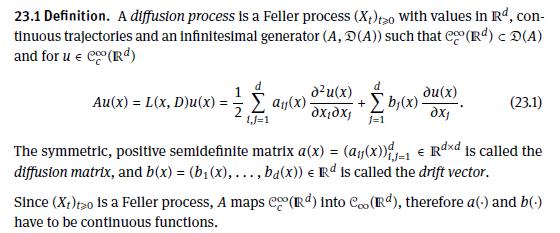
23.1 Definition. A diffusion process is a Feller process (X+)20 with values in Rd, con- tinuous trajectories and an infinitesimal generator (A,(A)) such that eco (Rd) c (A) and for u e eco (Rd) () Au(x) = L(x, D)u(x) = ay(x) d au(x) +b(x). 1,j=1 (23.1) The symmetric, positive semidefinite matrix a(x) = (a(x)) = Rdxd is called the diffusion matrix, and b(x) = (b(x),..., bd(x)) e Rd is called the drift vector. Since (X)tao is a Feller process, A maps eco(Rd) into Co. (Rd), therefore a(-) and b(-) have to be continuous functions.
Step by Step Solution
3.43 Rating (162 Votes )
There are 3 Steps involved in it

Get step-by-step solutions from verified subject matter experts
 Study Help