



Question: Show that Example 22.7 remains valid if we assume that (sigma(0)=0) and (sigma(x)>0) for (x eq 0). 22.7 Example. Let (Bt)to be a BM and
Show that Example 22.7 remains valid if we assume that \(\sigma(0)=0\) and \(\sigma(x)>0\) for \(x eq 0\).
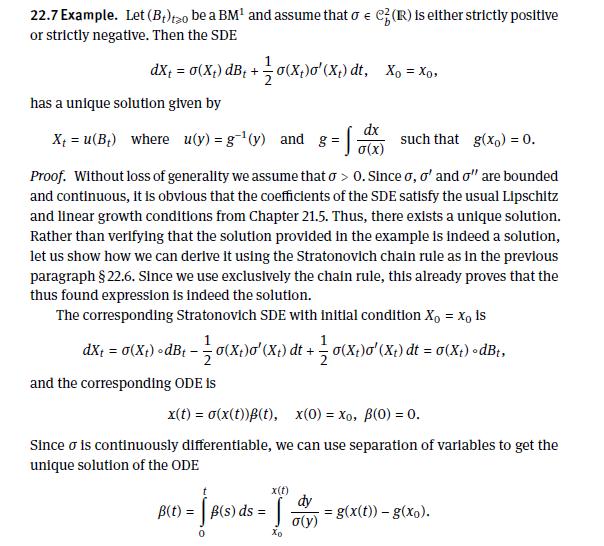
22.7 Example. Let (Bt)to be a BM and assume that = c(R) is either strictly positive or strictly negative. Then the SDE dx+= (X+) dB++ (X+)'(x+) dt, X = xo, has a unique solution given by X = u(B+) where u(y) = g(y) and g = 10(x) dx such that g(x) = 0. Proof. Without loss of generality we assume that > 0. Since , o' and " are bounded and continuous, it is obvious that the coefficients of the SDE satisfy the usual Lipschitz and linear growth conditions from Chapter 21.5. Thus, there exists a unique solution. Rather than verifying that the solution provided in the example is indeed a solution, let us show how we can derive it using the Stratonovich chain rule as in the previous paragraph 22.6. Since we use exclusively the chain rule, this already proves that the thus found expression is indeed the solution. The corresponding Stratonovich SDE with initial condition X = Xo Is dxt = (X+) dBt-(X+)' (X+) dt + (X)'(X+) dt = (X+) dB, and the corresponding ODE is x(t) = (x(t))(t), x(0) = xo, B(0) = 0. = Since is continuously differentiable, we can use separation of variables to get the unique solution of the ODE = = x(t) B(t) = [ B(s) ds = [ Xo dy = g(x(t)) - g(xo). ()
Step by Step Solution
3.43 Rating (169 Votes )
There are 3 Steps involved in it

Get step-by-step solutions from verified subject matter experts