







Question: Let X be a random variable, not necessarily positive. (a) Using Markovs inequality, show that for x > 0 and t > 0, assuming that
(a) Using Markov€™s inequality, show that for x > 0 and t > 0,
![E[e=] = e -t=m(t), P(X > x) < etr (9.5)](https://dsd5zvtm8ll6.cloudfront.net/si.question.images/images/question_images/1539/9/4/9/6815bc9c471f0de41539932131733.jpg)
assuming that E[etx] exists, where m is the mgf of X.
(b) For the case when X has a standard normal distribution, give the upper bound in Equation 9.5. Note that the bound holds for all t > 0.
(c) Find the value of t that minimizes your upper bound. If Z ˆ¼ Norm(0,1), show that for z > 0,
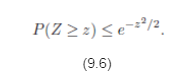
The upper bounds in Equations 9.5 and 9.6 are called Chernoff bounds.
E[e=] = e -t=m(t), P(X > x) < etr (9.5) P(Z > =)
Step by Step Solution
★★★★★
3.48 Rating (151 Votes )
There are 3 Steps involved in it
1 Expert Approved Answer
Step: 1 Unlock

Let X Binomn n Then The limit is t... View full answer
Question Has Been Solved by an Expert!
Get step-by-step solutions from verified subject matter experts
Step: 2 Unlock
Step: 3 Unlock
 Study Help