







Question: Consider the simple block diagram for the feedback control of circadian rhythms (i.e., 24 h) in Fig. 24.5.To simplify things considerably, assume that transcription obeys
(a) Calculate the frequency response characteristics for all the elements in this feedback loop. Be careful with your time units.
(b) In order to generate sustained circadian rhythms, how much time delay is required in the translation/degradation step? (requires a numerical answer)
(c) At this oscillation condition, what is the gain of the translation/degradation process?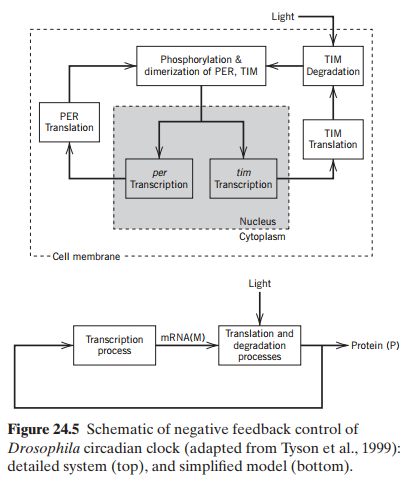
Light Phosphorylation & dimerization of PER, TIM TIM Degradation PER Translation TIM Translation tim per Transcription Transcription Nucleus Cytoplasm -Cell membrane Light Translation and MRNA(M) Transcription process Protein (P) degradation processes Figure 24.5 Schematic of negative feedback control of Drosophila circadian clock (adapted from Tyson et al., 1999): detailed system (top), and simplified model (bottom).
Step by Step Solution
3.34 Rating (172 Votes )
There are 3 Steps involved in it
G transcription G 1 5 s 1 G transcription G 2 Ke s a We calculate the frequency response measures ... View full answer

Get step-by-step solutions from verified subject matter experts
Document Format (2 attachments)

1602_606321ef1b344_683260.pdf
180 KBs PDF File

1602_606321ef1b344_683260.docx
120 KBs Word File
 Study Help