



Question: Harrys Hardware does a brisk business during the year. During Christmas, Harrys Hardware sells Christmas trees for a substantial profit. Unfortunately, any trees not sold
Harry’s Hardware does a brisk business during the year. During Christmas, Harry’s Hardware sells Christmas trees for a substantial profit. Unfortunately, any trees not sold at the end of the season are totally worthless. Thus, the number of trees to stock for a given season is a very important decision. The following table reveals the demand for Christmas trees: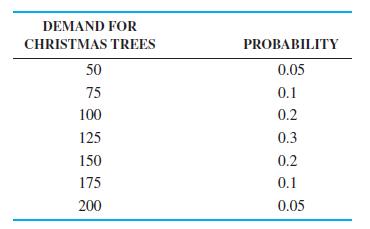
Harry sells trees for $80 each, but his cost is only $20.
(a) Use marginal analysis to determine how many trees Harry should stock at his hardware store.
(b) If the cost increases to $35 per tree and Harry continues to sell trees for $80 each, how many trees should Harry stock?
(c) Harry is thinking about increasing the price to $100 per tree. Assume that the cost per tree is $20. With the new price, it is expected that the probability of selling 50, 75, 100, or 125 trees will be 0.25 each. Harry does not expect to sell more than 125 trees with this price increase.
What do you recommend?
DEMAND FOR CHRISTMAS TREES PROBABILITY 50 0.05 75 0.1 100 0.2 125 0.3 150 0.2 175 0.1 200 0.05
Step by Step Solution
There are 3 Steps involved in it

Get step-by-step solutions from verified subject matter experts