







Question: Project A requires an initial outlay at t = D of $4,000, and its cash flows are the same in Years 1 through 10. Its

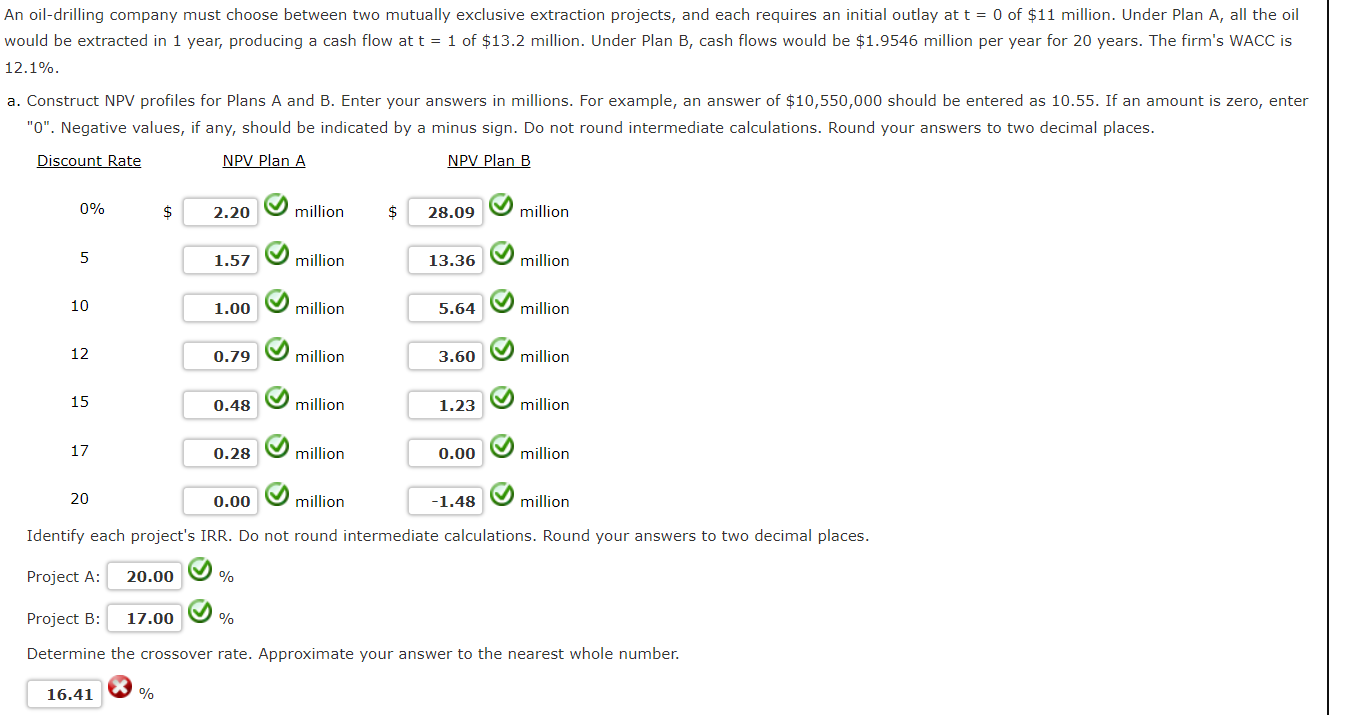
Project A requires an initial outlay at t = D of $4,000, and its cash flows are the same in Years 1 through 10. Its IRR is 14%, and its WACC is 12%. What is the project's MIRR? Do not round intermediate calculations. Round your answer to two dECimal places. 10.57 0 % An oil-drilling company must choose between two mutually exclusive extraction projects, and each requires an initial outlay at t = 0 of $11 million. Under Plan A, all the oil would be extracted in 1 year, producing a cash flow at t = 1 of $13.2 million. Under Plan B, cash flows would be $1.9546 million per year for 20 years. The firm's WACC is 12.1%. a. Construct NPV profiles for Plans A and B. Enter your answers in millions. For example, an answer of $10,550,000 should be entered as 10.55. If an amount is zero, enter "O". Negative values, if any, should be indicated by a minus sign. Do not round intermediate calculations. Round your answers to two decimal places. Discount Rate NPV Plan A NPV Plan B 0% $ 2.20 million $ 28.09 million 5 1.57 million 13.36 million 10 1.00 million 5.64 million 12 0.79 million 3.60 million 15 0.48 million 1.23 million 17 0.28 million 0.00 million 20 0.00 million -1.48 million Identify each project's IRR. Do not round intermediate calculations. Round your answers to two decimal places. Project A: 20.00 Project B: 17.00 Determine the crossover rate. Approximate your answer to the nearest whole number. 16.41 X %
Step by Step Solution
There are 3 Steps involved in it

Get step-by-step solutions from verified subject matter experts
 Study Help