







Question: Consider the two-period problem with income risk and quadratic preferences we studied in class. Assume that there're more than two states of the world,
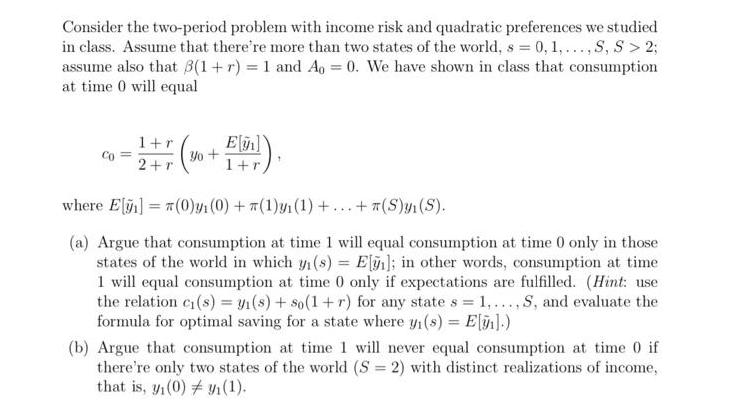
Consider the two-period problem with income risk and quadratic preferences we studied in class. Assume that there're more than two states of the world, s = 0, 1, ..., S, S > 2; assume also that 3(1+r) = 1 and Ao = 0. We have shown in class that consumption at time 0 will equal Co= 1 + r 2+r 3/0+ Eli!), 1+r where E[] = 7(0) (0)+7(1)y (1) +...+(S)y (S). (a) Argue that consumption at time I will equal consumption at time 0 only in those states of the world in which y (s) = E[y]; in other words, consumption at time 1 will equal consumption at time 0 only if expectations are fulfilled. (Hint: use the relation c(s) = y(s) +So(1+r) for any state s = 1, ..., S, and evaluate the formula for optimal saving for a state where y(s) = E[].) (b) Argue that consumption at time 1 will never equal consumption at time 0 if there're only two states of the world (S= 2) with distinct realizations of income, that is, y (0) yn (1).
Step by Step Solution
3.32 Rating (149 Votes )
There are 3 Steps involved in it
The image contains a question about consumption under income risk with quadratic preferences The given formula for consumption at time 0 c0 is a funct... View full answer

Get step-by-step solutions from verified subject matter experts
 Study Help