



Question: 0. (18 points) Consider we want to use Bloom filter (BF) to have a proactive checking of malicious phishing email addresses. There are 3 phishing
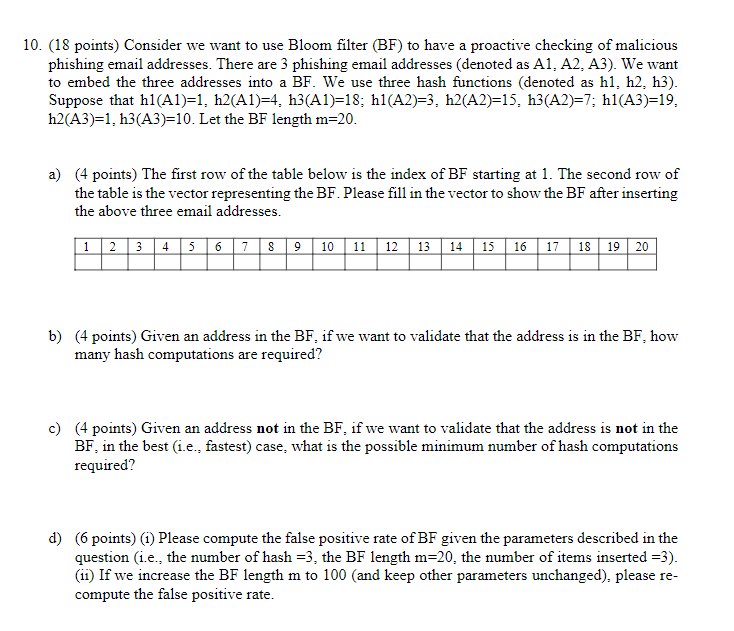
0. (18 points) Consider we want to use Bloom filter (BF) to have a proactive checking of malicious phishing email addresses. There are 3 phishing email addresses (denoted as A1, A2, A3). We want to embed the three addresses into a BF. We use three hash functions (denoted as h1, h2, h3). Suppose that h1(A1)=1,h2(A1)=4,h3(A1)=18;h1(A2)=3,h2(A2)=15,h3(A2)=7;h1(A3)=19, h2(A3)=1,h3(A3)=10. Let the BF length m=20. a) (4 points) The first row of the table below is the index of BF starting at 1 . The second row of the table is the vector representing the BF. Please fill in the vector to show the BF after inserting the above three email addresses. b) (4 points) Given an address in the BF, if we want to validate that the address is in the BF, how many hash computations are required? c) (4 points) Given an address not in the BF, if we want to validate that the address is not in the BF, in the best (i.e., fastest) case, what is the possible minimum number of hash computations required? d) (6 points) (i) Please compute the false positive rate of BF given the parameters described in the question (i.e., the number of hash =3, the BF length m=20, the number of items inserted =3). (ii) If we increase the BF length m to 100 (and keep other parameters unchanged), please recompute the false positive rate
Step by Step Solution
There are 3 Steps involved in it

Get step-by-step solutions from verified subject matter experts