



Question: Consider a plurality rule election like we discussed in lecture, with three candidates, J = A, B, C, and four voters, i = 1,
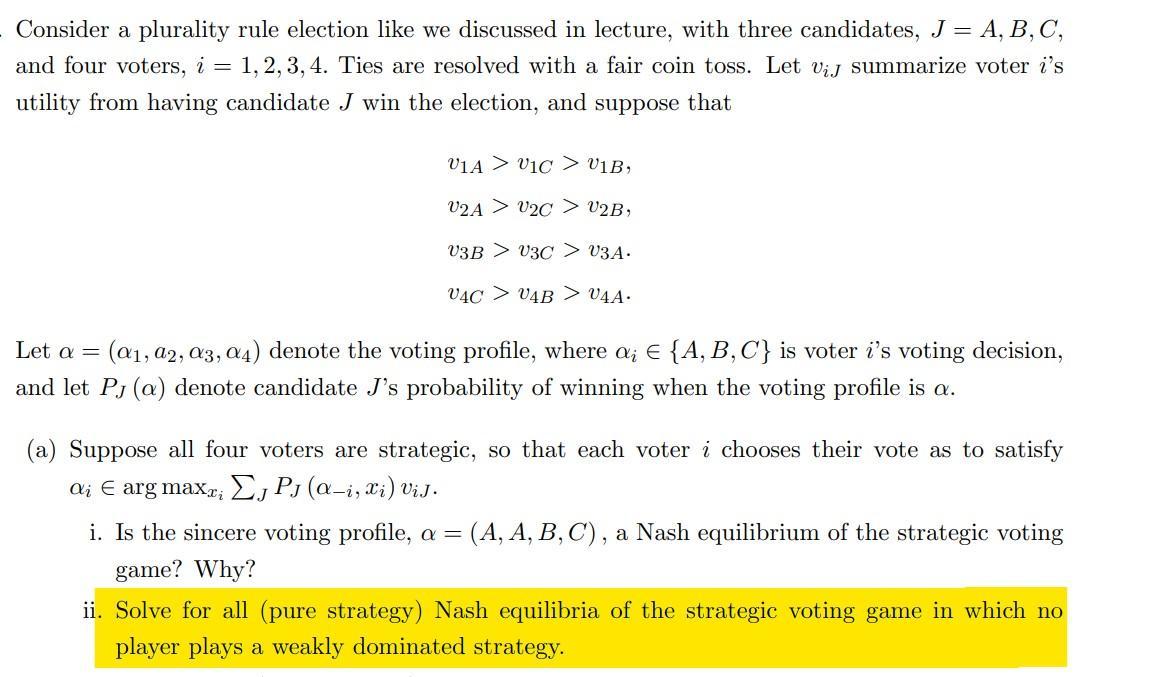
Consider a plurality rule election like we discussed in lecture, with three candidates, J = A, B, C, and four voters, i = 1, 2, 3, 4. Ties are resolved with a fair coin toss. Let vij summarize voter i's utility from having candidate J win the election, and suppose that VIA > VIC > V1B, V2A > VC > V2B, V3B > V3C > V3A. VAC > VAB > V4A. Let a = (a1, a2, a3, a4) denote the voting profile, where a; {A, B, C) is voter i's voting decision, and let PJ (a) denote candidate J's probability of winning when the voting profile is a. (a) Suppose all four voters are strategic, so that each voter i chooses their vote as to satisfy ai e arg maxx, EJ PJ (a-i, xi) viJ. i. Is the sincere voting profile, a = (A, A, B, C), a Nash equilibrium of the strategic voting game? Why? ii. Solve for all (pure strategy) Nash equilibria of the strategic voting game in which no player plays a weakly dominated strategy.
Step by Step Solution
3.38 Rating (160 Votes )
There are 3 Steps involved in it
ANSWER To determine the Nash equilibria of the strategic voting game we need to find the voting profiles in which no player has an incentive to deviate from their chosen strategy given the strategies ... View full answer

Get step-by-step solutions from verified subject matter experts