







Question: 0 In this question, you will use the basic (one period) consumption-leisure framework to consider some labor market issues. Suppose the representative consumer has the
 0
0
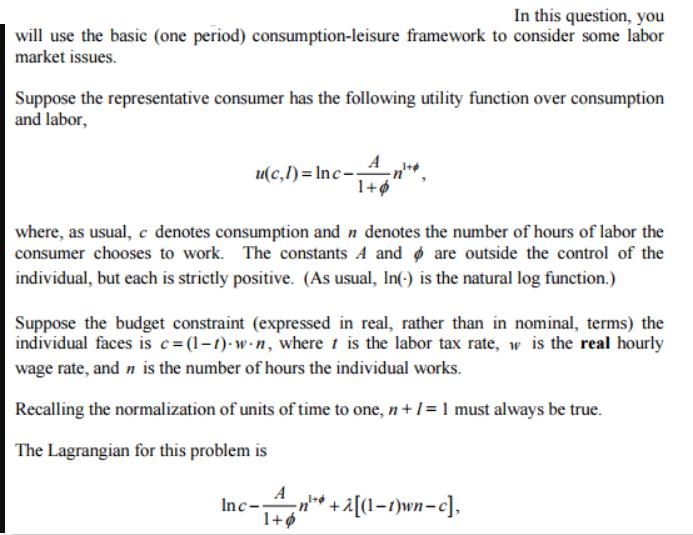
In this question, you will use the basic (one period) consumption-leisure framework to consider some labor market issues. Suppose the representative consumer has the following utility function over consumption and labor, A u(c,1)=Inc-n**, 1+ where, as usual, c denotes consumption and in denotes the number of hours of labor the consumer chooses to work. The constants A and are outside the control of the individual, but each is strictly positive. (As usual, In() is the natural log function.) Suppose the budget constraint (expressed in real, rather than in nominal, terms) the individual faces is c=(1-1)-w-n, where is the labor tax rate, w is the real hourly wage rate, and n is the number of hours the individual works. Recalling the normalization of units of time to one, n+1 = 1 must always be true. The Lagrangian for this problem is Inc- A 1+ n**+^[(1-1)wn-c],
Step by Step Solution
3.41 Rating (148 Votes )
There are 3 Steps involved in it
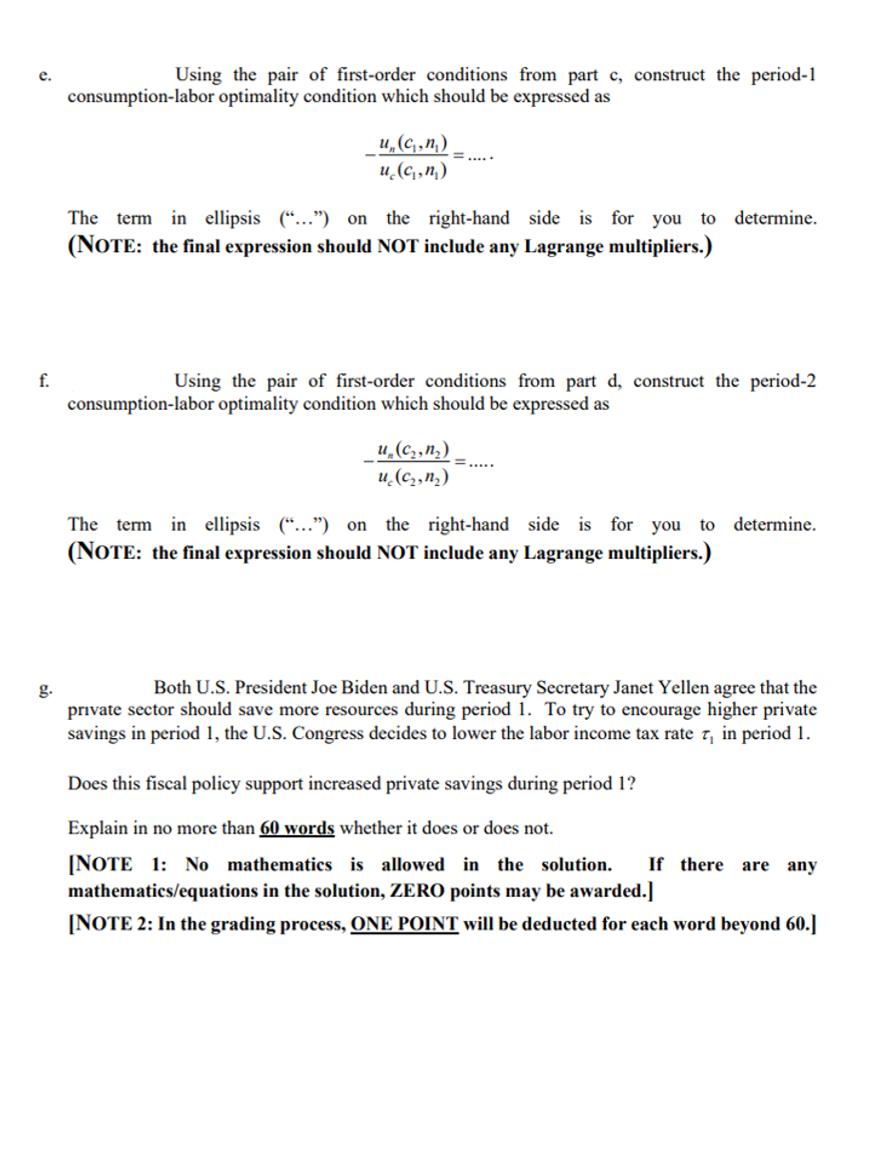
e Solution The consumptionlabor optimality condition i... View full answer

Get step-by-step solutions from verified subject matter experts
 Study Help