







Question: 0 Question 15 v This problem will guide you through several different scenarios, to help you recognize when to apply the CLT and when not
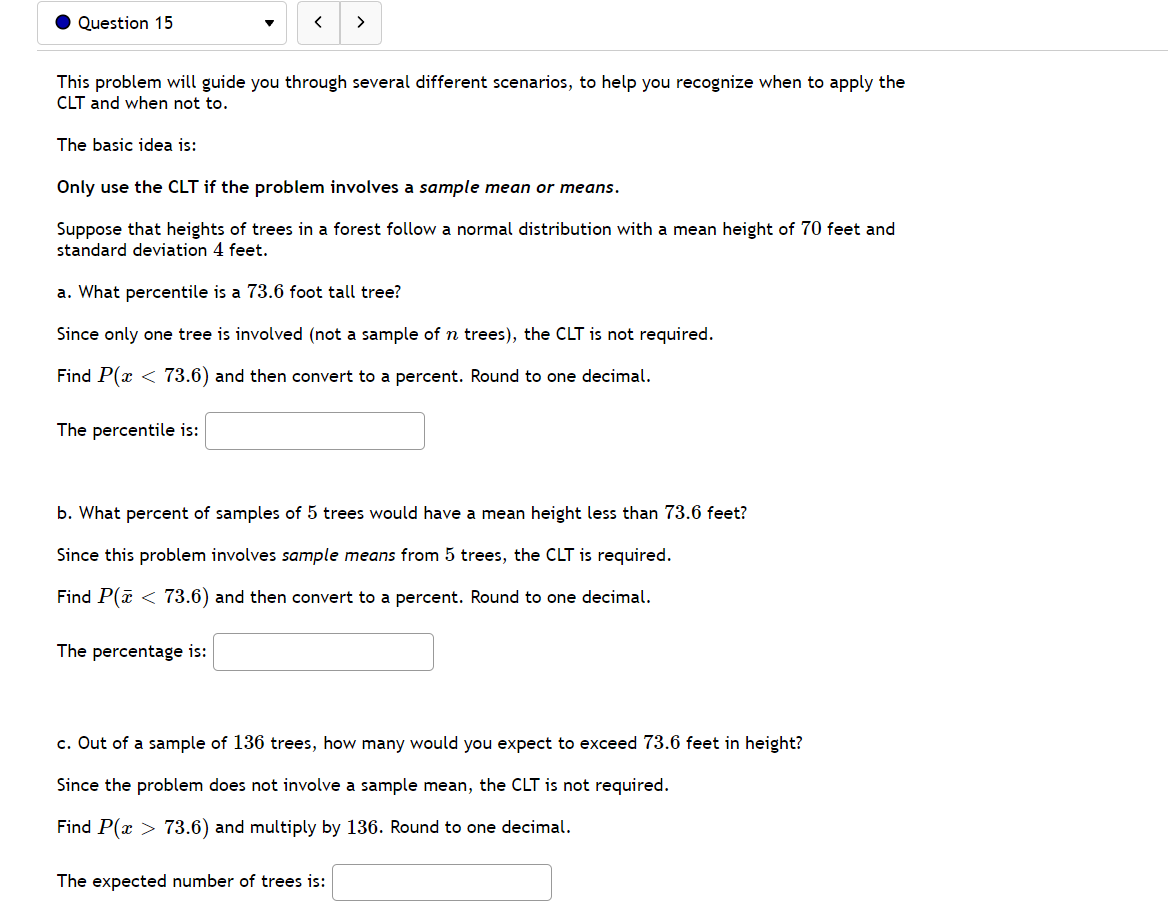
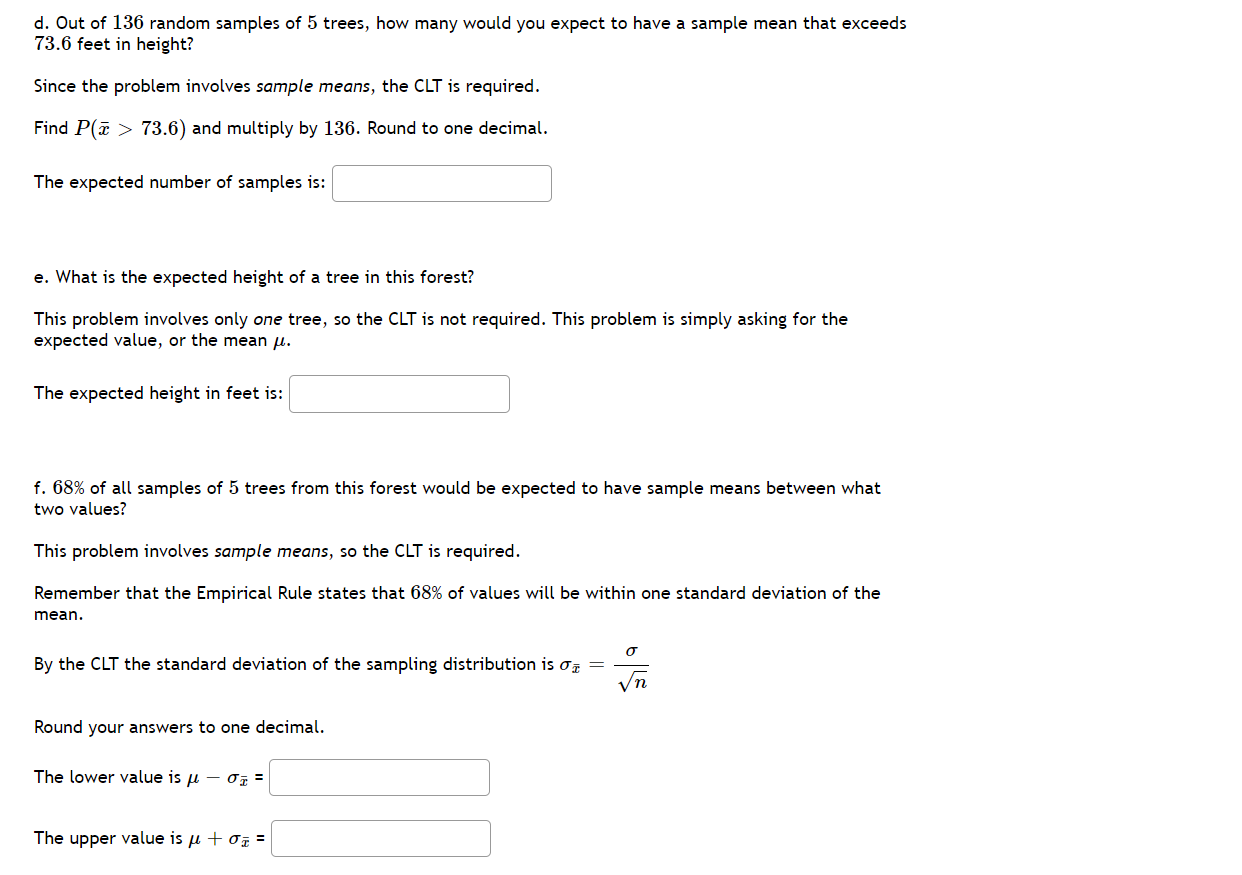
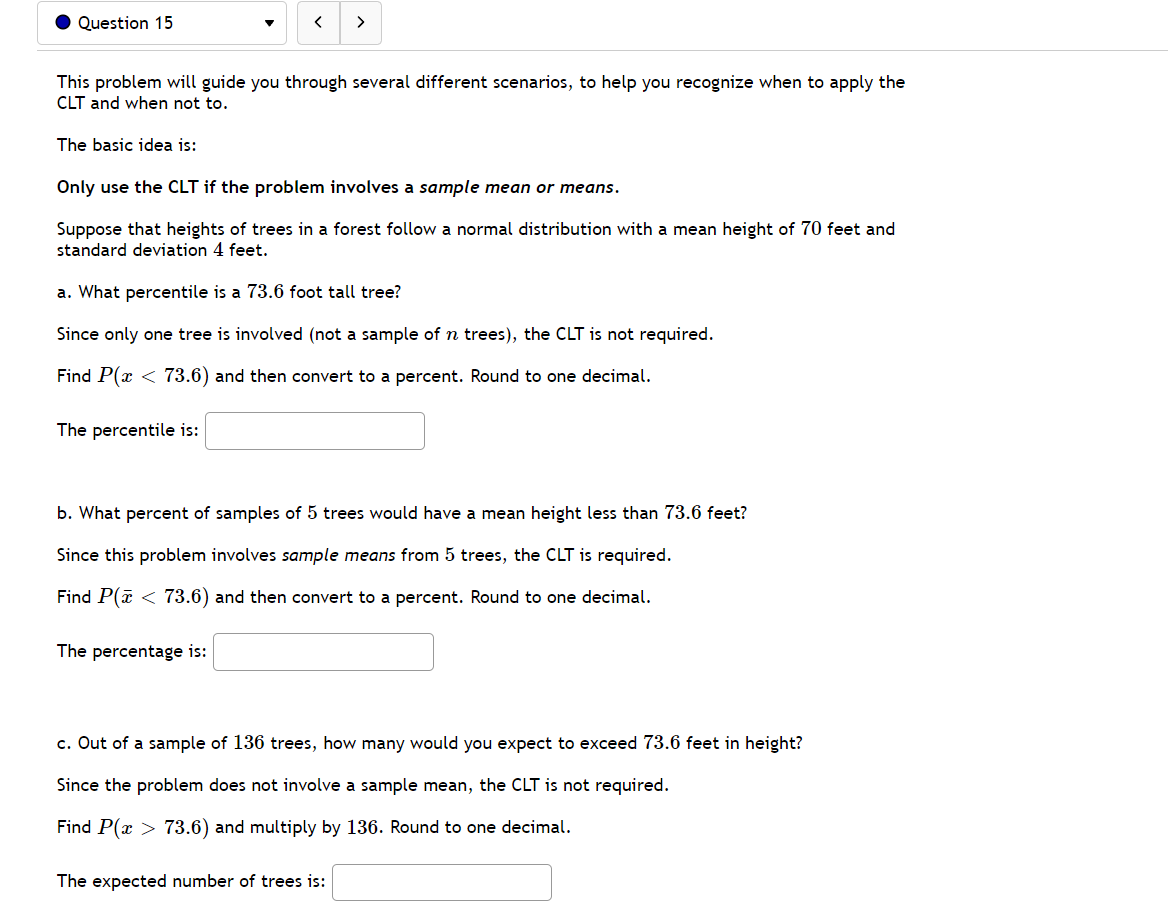
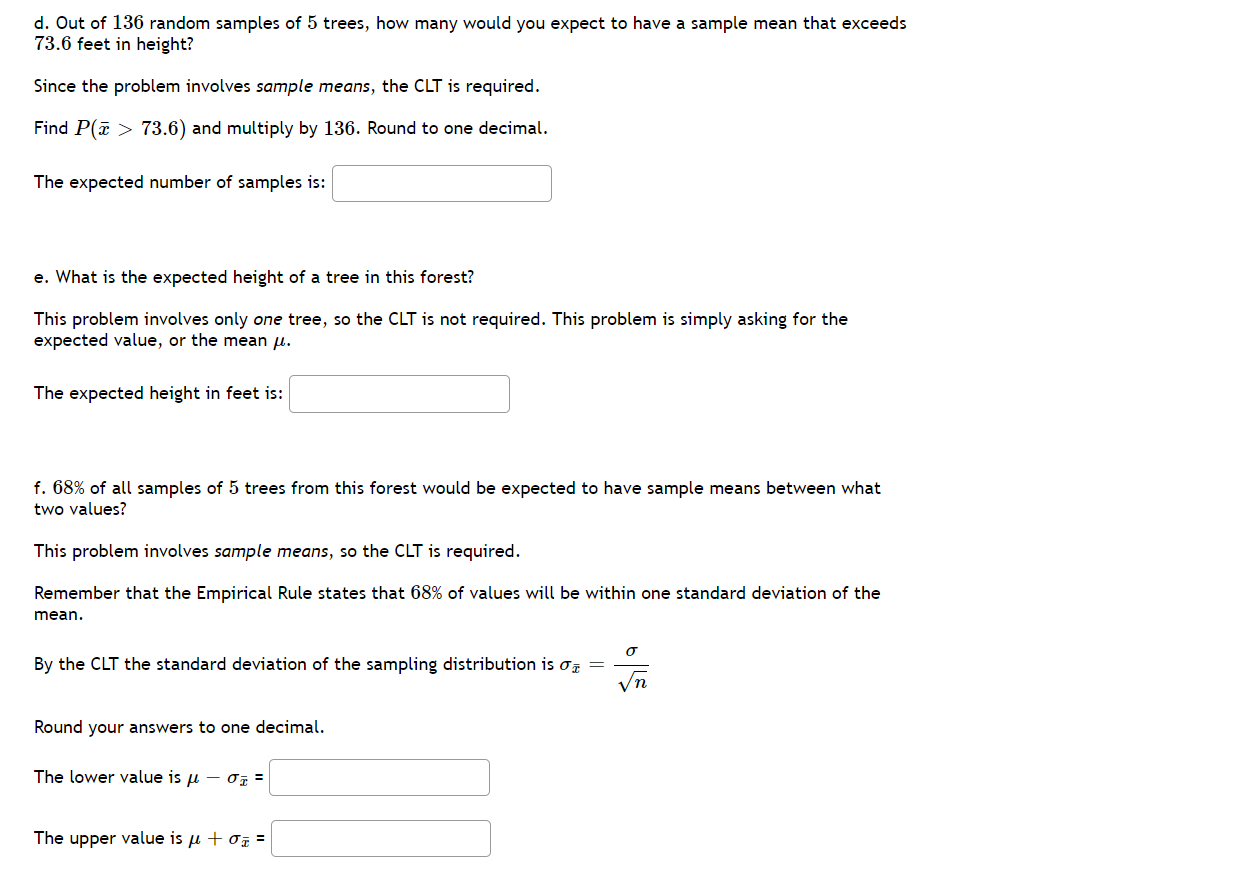
0 Question 15 v This problem will guide you through several different scenarios, to help you recognize when to apply the CLT and when not to. The basic idea is: Only use the CLT if the problem involves a sample mean or means. Suppose that heights of trees in a forest follow a normal distribution with a mean height of 70 feet and standard deviation 4 feet. a. What percentile is a 73.6 foot tall tree? Since only one tree is involved {not a sample of 73 trees}, the CLT is not required. Find PW ~ 73.6) and multiply by 136. Round to one decimal. The expected number of samples is: e. What is the expected height of a tree in this forest? This problem involves only one tree, so the CLT is not required. This problem is simply asking for the expected value, or the mean p. The expected height in feet is: f. 68% of all samples of 5 trees from this forest would be expected to have sample means between what two values? This problem involves sample means, so the CLT is required. Remember that the Empirical Rule states that 6896 of values will be within one standard deviation of the mean. By the CLT the standard deviation of the sampling distribution is 0'5 = i ya Round your answers to one decimal. The lower value is ,u 0'5 = The upper value is u -l 0f =
Step by Step Solution
There are 3 Steps involved in it

Get step-by-step solutions from verified subject matter experts
 Study Help