Question: 0.1. Find the sample size and stratum sample sizes that gives this bound at minimum cost. Solution: Exercise: A local council is interested in expanding
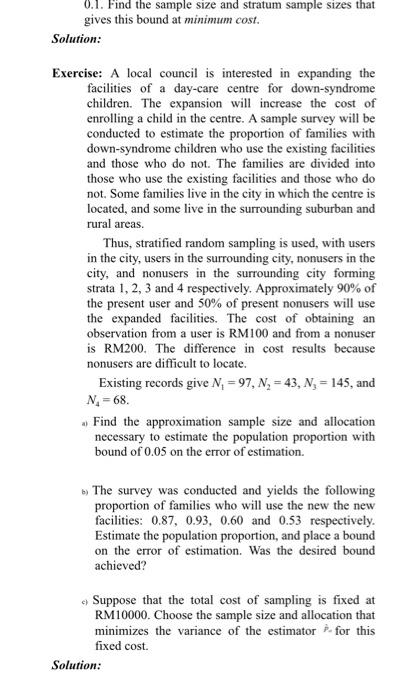
0.1. Find the sample size and stratum sample sizes that gives this bound at minimum cost. Solution: Exercise: A local council is interested in expanding the facilities of a day-care centre for down-syndrome children. The expansion will increase the cost of enrolling a child in the centre. A sample survey will be conducted to estimate the proportion of families with down-syndrome children who use the existing facilities and those who do not. The families are divided into those who use the existing facilities and those who do not, Some families live in the city in which the centre is located, and some live in the surrounding suburban and rural areas. Thus, stratified random sampling is used, with users in the city, users in the surrounding city, nonusers in the city, and nonusers in the surrounding city forming strata 1, 2, 3 and 4 respectively. Approximately 90% of the present user and 50% of present nonusers will use the expanded facilities. The cost of obtaining an observation from a user is RM100 and from a nonuser is RM200. The difference in cost results because nonusers are difficult to locate. Existing records give No = 97, N, = 43, N, = 145, and N = 68. Find the approximation sample size and allocation necessary to estimate the population proportion with bound of 0.05 on the error of estimation bThe survey was conducted and yields the following proportion of families who will use the new the new facilities: 0.87, 0.93, 0.60 and 0.53 respectively. Estimate the population proportion, and place a bound on the error of estimation. Was the desired bound achieved? Suppose that the total cost of sampling is fixed at RM10000. Choose the sample size and allocation that minimizes the variance of the estimator for this fixed cost. Solution: 0.1. Find the sample size and stratum sample sizes that gives this bound at minimum cost. Solution: Exercise: A local council is interested in expanding the facilities of a day-care centre for down-syndrome children. The expansion will increase the cost of enrolling a child in the centre. A sample survey will be conducted to estimate the proportion of families with down-syndrome children who use the existing facilities and those who do not. The families are divided into those who use the existing facilities and those who do not, Some families live in the city in which the centre is located, and some live in the surrounding suburban and rural areas. Thus, stratified random sampling is used, with users in the city, users in the surrounding city, nonusers in the city, and nonusers in the surrounding city forming strata 1, 2, 3 and 4 respectively. Approximately 90% of the present user and 50% of present nonusers will use the expanded facilities. The cost of obtaining an observation from a user is RM100 and from a nonuser is RM200. The difference in cost results because nonusers are difficult to locate. Existing records give No = 97, N, = 43, N, = 145, and N = 68. Find the approximation sample size and allocation necessary to estimate the population proportion with bound of 0.05 on the error of estimation bThe survey was conducted and yields the following proportion of families who will use the new the new facilities: 0.87, 0.93, 0.60 and 0.53 respectively. Estimate the population proportion, and place a bound on the error of estimation. Was the desired bound achieved? Suppose that the total cost of sampling is fixed at RM10000. Choose the sample size and allocation that minimizes the variance of the estimator for this fixed cost. Solution









 Study Help