







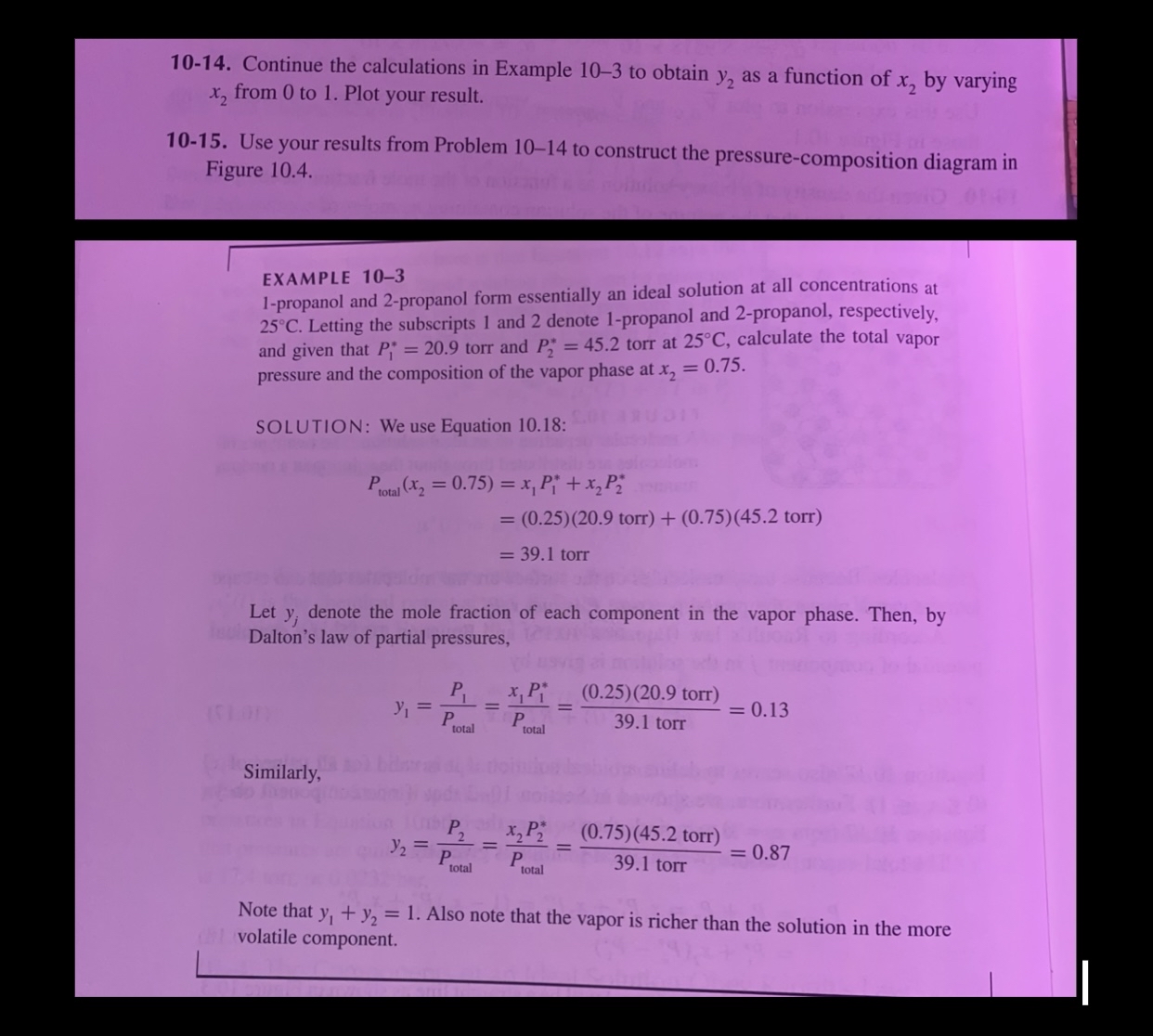
Question: 1 0 - 1 4 . Continue the calculations in Example 1 0 - 3 to obtain y 2 as a function of x 2
Continue the calculations in Example to obtain as a function of by varying from to Plot your result.
Use your results from Problem to construct the pressurecomposition diagram in Figure
EXAMPLE
propanol and propanol form essentially an ideal solution at all concentrations at Letting the subscripts and denote propanol and propanol, respectively, and given that torr and torr at calculate the total vapor pressure and the composition of the vapor phase at
SOLUTION: We use Equation :
Let denote the mole fraction of each component in the vapor phase. Then, by Dalton's law of partial pressures,
Similarly,
Note that Also note that the vapor is richer than the solution in the more volatile component.
Step by Step Solution
There are 3 Steps involved in it
1 Expert Approved Answer
Step: 1 Unlock

Question Has Been Solved by an Expert!
Get step-by-step solutions from verified subject matter experts
Step: 2 Unlock
Step: 3 Unlock
 Study Help