







Question: 1 - 1 -2 + (b) An FIR filter has transfer-function 1 G(2) +=2 4 with associated sampling period of 10-4 sec. Calculate the amplitude
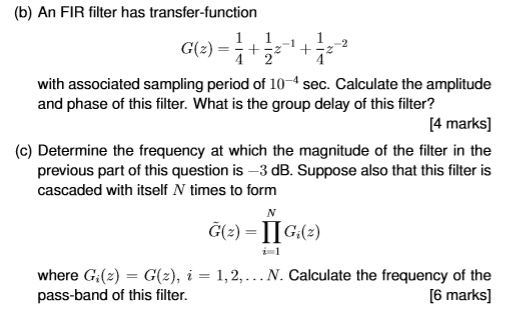
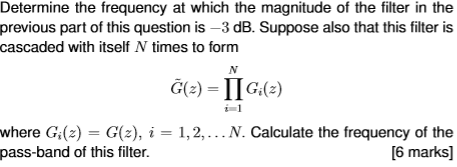
1 - 1 -2 + (b) An FIR filter has transfer-function 1 G(2) +=2 4 with associated sampling period of 10-4 sec. Calculate the amplitude and phase of this filter. What is the group delay of this filter? [4 marks] (c) Determine the frequency at which the magnitude of the filter in the previous part of this question is 3 dB. Suppose also that this filter is cascaded with itself N times to form N (z) = IIG:(z) where G (2) = G(2), i = 1,2,...N. Calculate the frequency of the pass-band of this filter. [6 marks] Determine the frequency at which the magnitude of the filter in the previous part of this question is -3 dB. Suppose also that this filter is cascaded with itself N times to form N () = II Gi(z) where G:() = G(2), i = 1,2,... N. Calculate the frequency of the pass-band of this filter. [6 marks) 1 - 1 -2 + (b) An FIR filter has transfer-function 1 G(2) +=2 4 with associated sampling period of 10-4 sec. Calculate the amplitude and phase of this filter. What is the group delay of this filter? [4 marks] (c) Determine the frequency at which the magnitude of the filter in the previous part of this question is 3 dB. Suppose also that this filter is cascaded with itself N times to form N (z) = IIG:(z) where G (2) = G(2), i = 1,2,...N. Calculate the frequency of the pass-band of this filter. [6 marks] Determine the frequency at which the magnitude of the filter in the previous part of this question is -3 dB. Suppose also that this filter is cascaded with itself N times to form N () = II Gi(z) where G:() = G(2), i = 1,2,... N. Calculate the frequency of the pass-band of this filter. [6 marks)
Step by Step Solution
There are 3 Steps involved in it

Get step-by-step solutions from verified subject matter experts
 Study Help