







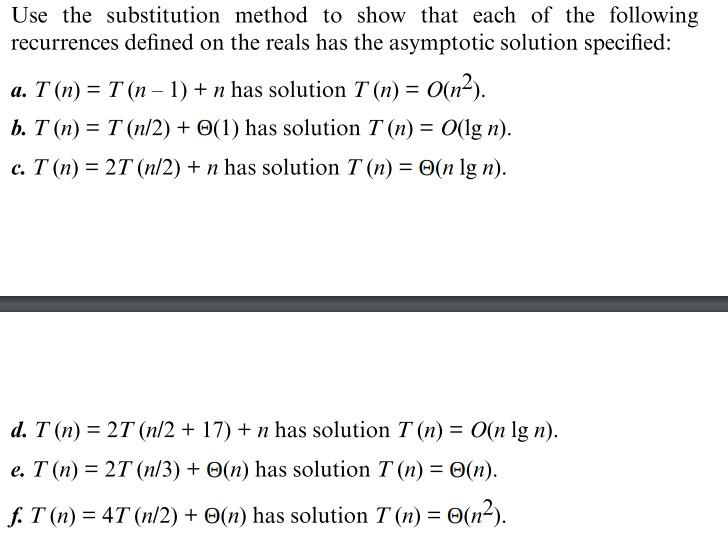
Question: 1 . ( 1 2 pts ) Use the substitution method to show that each of the following recurrences defined has the asymptotic solution specified:
pts Use the substitution method to show that each of the following recurrences defined has
the asymptotic solution specified:
a Tn Tn n has solution Tn On
b Tn TnTheta has solution Tn O lg n
c TnTn n has solution TnTheta n lg n
d TnT n n has solution Tn O n lg n
e TnTnTheta n has solution TnTheta n
f TnTnTheta n has solution TnTheta n
pts For each of the following recurrences, sketch its recursion tree, and guess a good
asymptotic upper bound on its solution. Use the substitution method to verify your answer.
a Tn Tn n
b TnTn n
c TnTn n
d TnTn
pts Use the master method to give tight asymptotic bounds for the following recurrences.
a TnTn
b TnTn
c TnTn lg n
d TnTn n
e TnTn n
pt Give the asymptotically tight upper and lower bounds for Tn in each of the following
algorithmic recurrences. Justify your answers.
a TnTn n
b Tn Tn n
c TnTn n
Step by Step Solution
There are 3 Steps involved in it
1 Expert Approved Answer
Step: 1 Unlock

Question Has Been Solved by an Expert!
Get step-by-step solutions from verified subject matter experts
Step: 2 Unlock
Step: 3 Unlock
 Study Help