



Question: 1. 1. Identify the ethical issues involved in the case from a consequentialist and deontological perspective. 2.Identify the management issues involved in the case. For
1.
1. Identify the ethical issues involved in the case from a consequentialist and deontological perspective.
2.Identify the management issues involved in the case. For example, think about the case in terms of multiple ethical selves, norms, reward systems, diffusion of responsibility, and obedience to authority. What factors contributed the most to the alleged unethical conduct on the part of service advisors and mechanics?
3. How would you evaluate Sears' response to the allegations and the changes the company made? Has Sears resolved its problems? Why or why not?
4. ) What do you think is the impact of the scandal on Sears' reputation for quality and service?
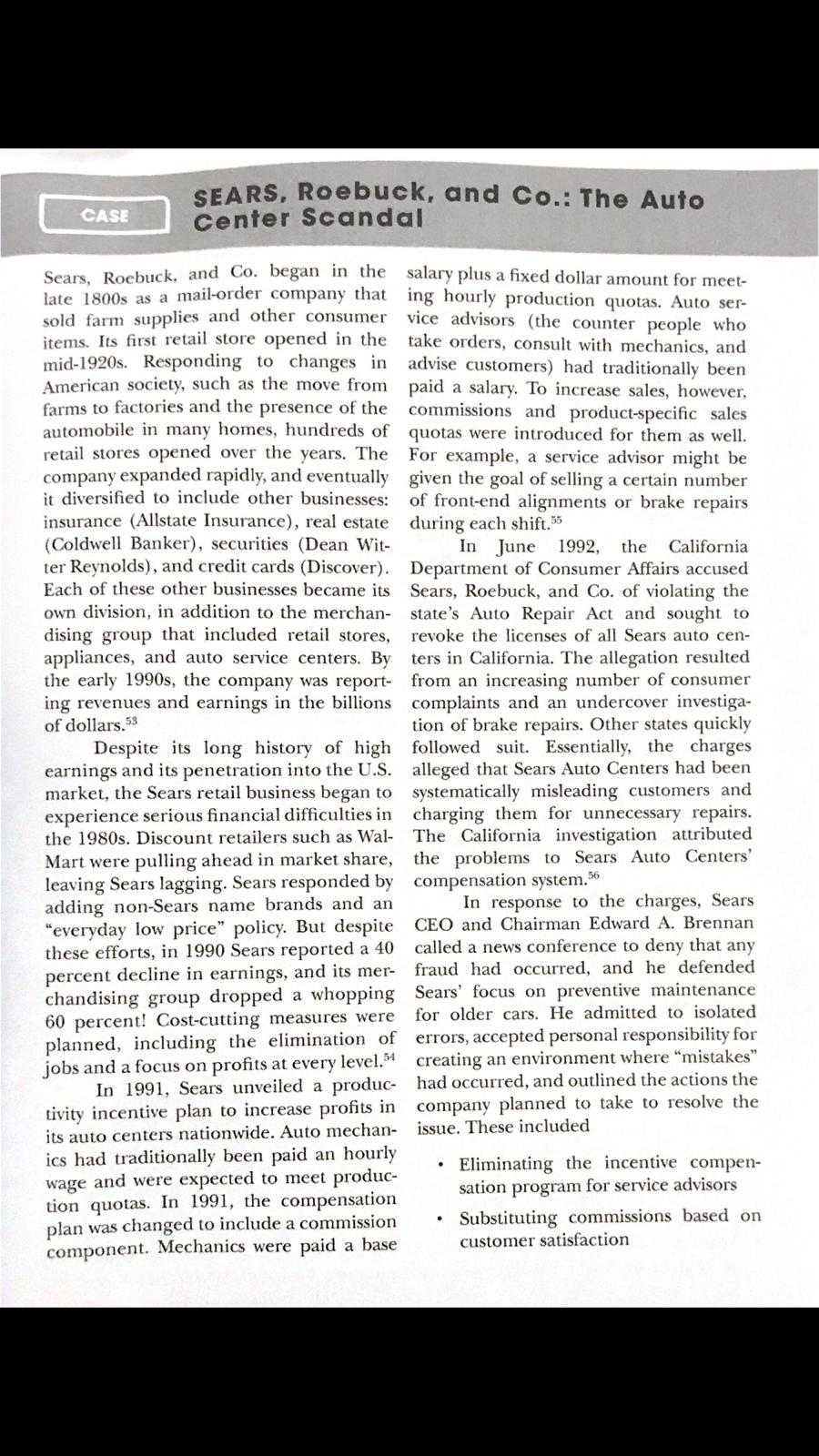
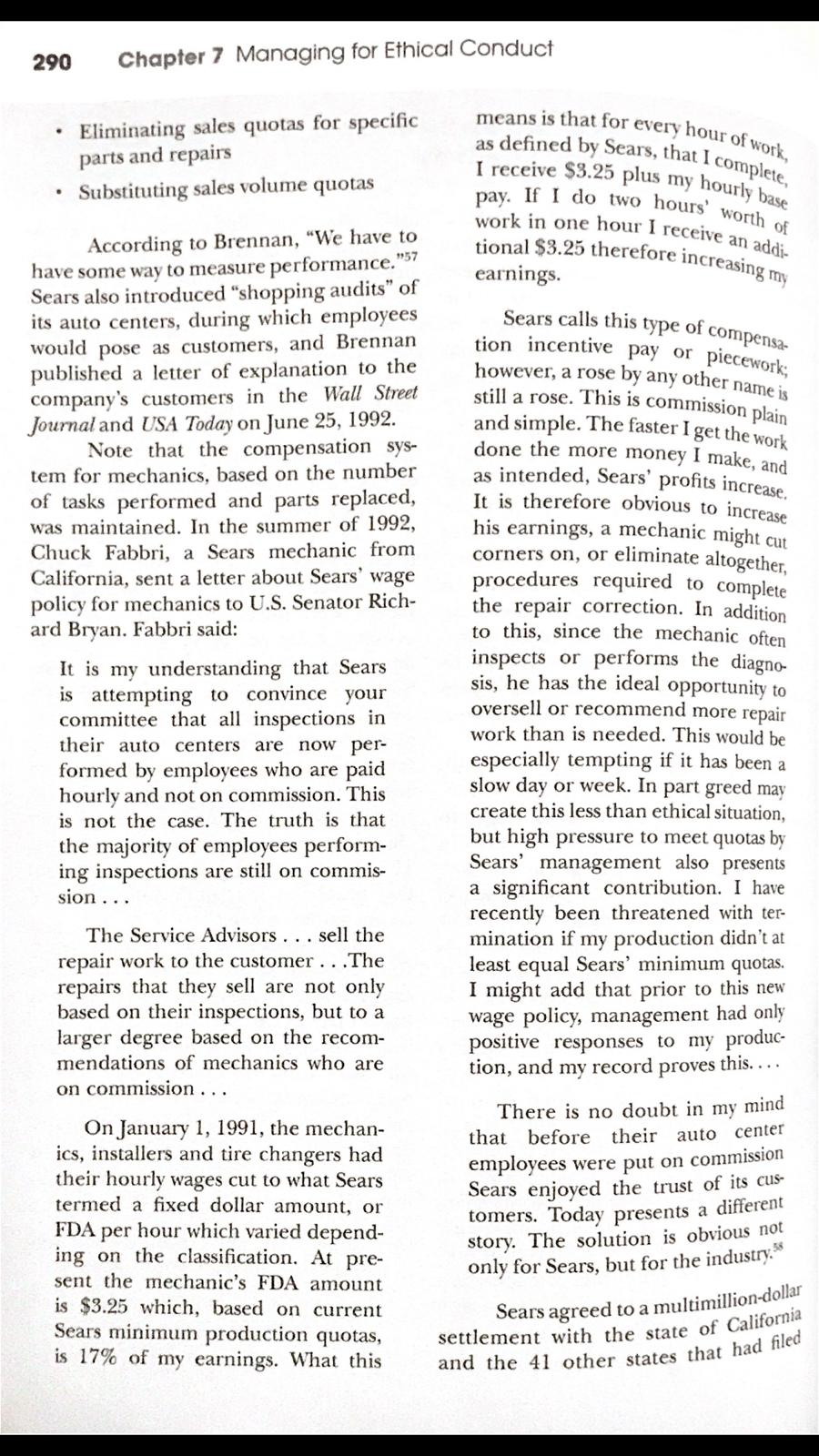
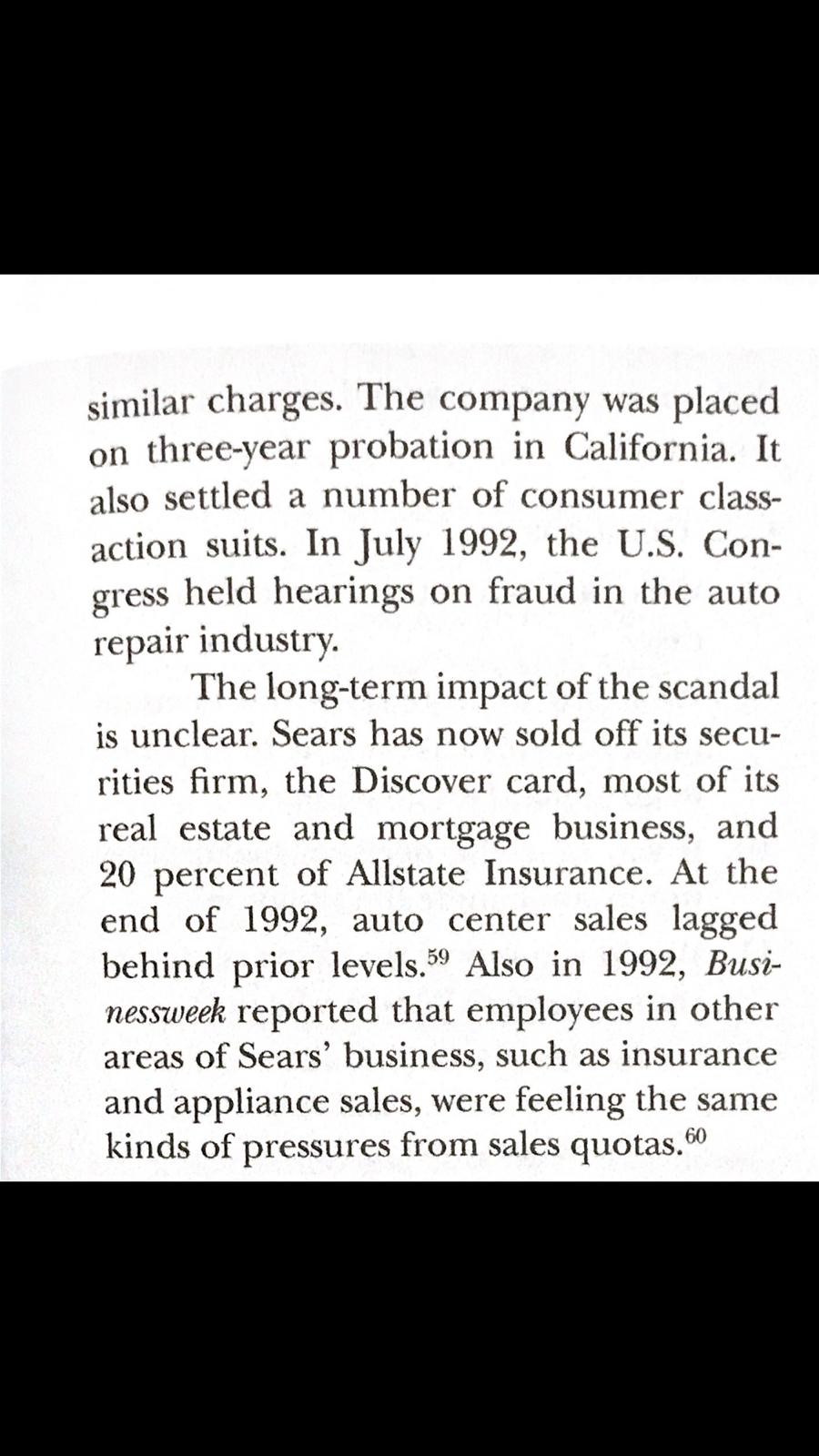
SEARS, Roebuck, and Co.: The Auto ASE 1 Center Scandal buck and Co. began in the salary plus a fixed dollar amount for meet- late 1800s as a mail-order company that ing hourly production quotas sold farm supplies and other consumer vice advisors (the counter items. Its first retail store opened in the take orders, consult with mechanics, and mid-1920s. Responding to changes in advise customers) had traditionally been American society, such as the move from paid a salary. To increase sales, however, farms to factories and the presence of the commissions and product-specific sales automobile in many homes, hundreds of quotas were introduced for them as well. retail stores opened over the years. The For example, a service advisor might be company expanded rapidly, and eventually given the goal of selling a certain number it diversified to include other businesses: of front-end alignments or brake repairs insurance (Allstate Insurance), real estate during each shift. (Coldwell Banker), securities (Dean Wit- In June 1992, the California ter Reynolds), and credit cards (Discover). Department of Consumer Affairs accused Each of these other businesses became its Sears, Roebuck, and Co. of violating the own division, in addition to the merchan- state's Auto Repair Act and sought to dising group that included retail stores, revoke the licenses of all Sears auto cen- appliances, and auto service centers. By ters in California. The allegation resulted the early 1990s, the company was report- from an increasing number of consumer ing revenues and earnings in the billions complaints and an undercover investiga- of dollars.53 tion of brake repairs. Other states quickly Despite its long history of high followed suit. Essentially, the charges earnings and its penetration into the U.S. alleged that Sears Auto Centers had been market, the Sears retail business began to systematically misleading customers and experience serious financial difficulties in charging them for unnecessary repairs. the 1980s. Discount retailers such as Wal- The California investigation attributed Mart were pulling ahead in market share, the problems to Sears Auto Centers' leaving Sears lagging. Sears responded by compensation system.36 adding non-Sears name brands and an In response to the charges, Sears "everyday low price policy. But despite CEO and Chairman Edward A. Brennan these efforts, in 1990 Sears reported a 40 called a news conference to deny that any percent decline in earnings, and its mer- fraud had occurred, and he defended chandising group dropped a whopping Sears' focus on preventive maintenance 60 percent! Cost-cutting measures were for older cars. He admitted to isolated planned, including the elimination of errors, accepted personal responsibility for jobs and a focus on profits at every level.64 creating an environment where "mistakes." In 1991, Sears unveiled a produc- had occurred, and outlined the actions the tivity incentive plan to increase profits in company planned to take to resolve the its auto centers nationwide. Auto mechan- issue. These included ics had traditionally been paid an hourly Eliminating the incentive compen- wage and were expected to meet produc- sation program for service advisors tion quotas. In 1991, the compensation plan was changed to include a commission Substituting commissions based on component. Mechanics were paid a base customer satisfaction 290 Chapter 7 Managing for Ethical Conduct Eliminating sales quotas for specific parts and repairs Substituting sales volume quotas means is that for every hour as defined by Sears, that I I receive $3.25 plus my hour pay. If I do two work in one hour I receis very hour of work, rs, that I complete, is my hourly base I do two hours' worth of ou I receive an addi- tional $3.25 therefore increasing CedshPerfoe have According to Brennan, "We have to have some way to measure performance."57 Sears also introduced "shopping audits of its auto centers, during which employees would pose as customers, and Brennan published a letter of explanation to the company's customers in the Wall Street Journal and USA Today on June 25, 1992. Note that the compensation sys- tem for mechanics, based on the number of tasks performed and parts replaced, was maintained. In the summer of 1992, Chuck Fabbri, a Sears mechanic from California, sent a letter about Sears' wage policy for mechanics to U.S. Senator Rich- ard Bryan. Fabbri said: It is my understanding that Sears is attempting to convince your committee that all inspections in their auto centers are now per- formed by employees who are paid hourly and not on commission. This is not the case. The truth is that the majority of employees perform- ing inspections are still on commis- sion... The Service Advisors ... sell the repair work to the customer ...The repairs that they sell are not only based on their inspections, but to a larger degree based on the recom- mendations of mechanics who are on commission ... earnings. Sears calls this type of compensa tion incentive pay or piecework however, a rose by any other name is still a rose. This is commission plain and simple. The faster I get the work done the more money I make, and as intended, Sears' profits increase It is therefore obvious to increase his earnings, a mechanic might cut corners on, or eliminate altogether. procedures required to complete the repair correction. In addition to this, since the mechanic often inspects or performs the diagno- sis, he has the ideal opportunity to oversell or recommend more repair work than is needed. This would be especially tempting if it has been a slow day or week. In part greed may create this less than ethical situation, but high pressure to meet quotas by Sears' management also presents a significant contribution. I have recently been threatened with ter- mination if my production didn't at least equal Sears' minimum quotas. I might add that prior to this new wage policy, management had only positive responses to my produc- tion, and my record proves this.... On January 1, 1991, the mechan- ics, installers and tire changers had their hourly wages cut to what Sears termed a fixed dollar amount, or FDA per hour which varied depend- ing on the classification. At pre- sent the mechanic's FDA amount is $3.25 which, based on current Sears minimum production quotas, is 17% of my earnings. What this There is no doubt in my mind that before their auto center employees were put on commission Sears enjoyed the trust of its cus- tomers. Today presents a different story. The solution is obvious not only for Sears, but for the industry. Sears agreed to a multimillion-dollar settlement with the state of Califo and the 41 other states that ha e state of California states that had filed similar charges. The company was placed on three-year probation in California. It also settled a number of consumer class- action suits. In July 1992, the U.S. Con- gress held hearings on fraud in the auto repair industry. The long-term impact of the scandal is unclear. Sears has now sold off its secu- rities firm, the Discover card, most of its real estate and mortgage business, and 20 percent of Allstate Insurance. At the end of 1992, auto center sales lagged behind prior levels.59 Also in 1992, Busi- nessweek reported that employees in other areas of Sears' business, such as insurance and appliance sales, were feeling the same kinds of pressures from sales quotas.60Step by Step Solution
There are 3 Steps involved in it

Get step-by-step solutions from verified subject matter experts