







Question: 1 1. Introduction: Introduce your case analysis. Help the reader understand what you are going to discuss. 2. Problem Definition: What is the problem(s) to
1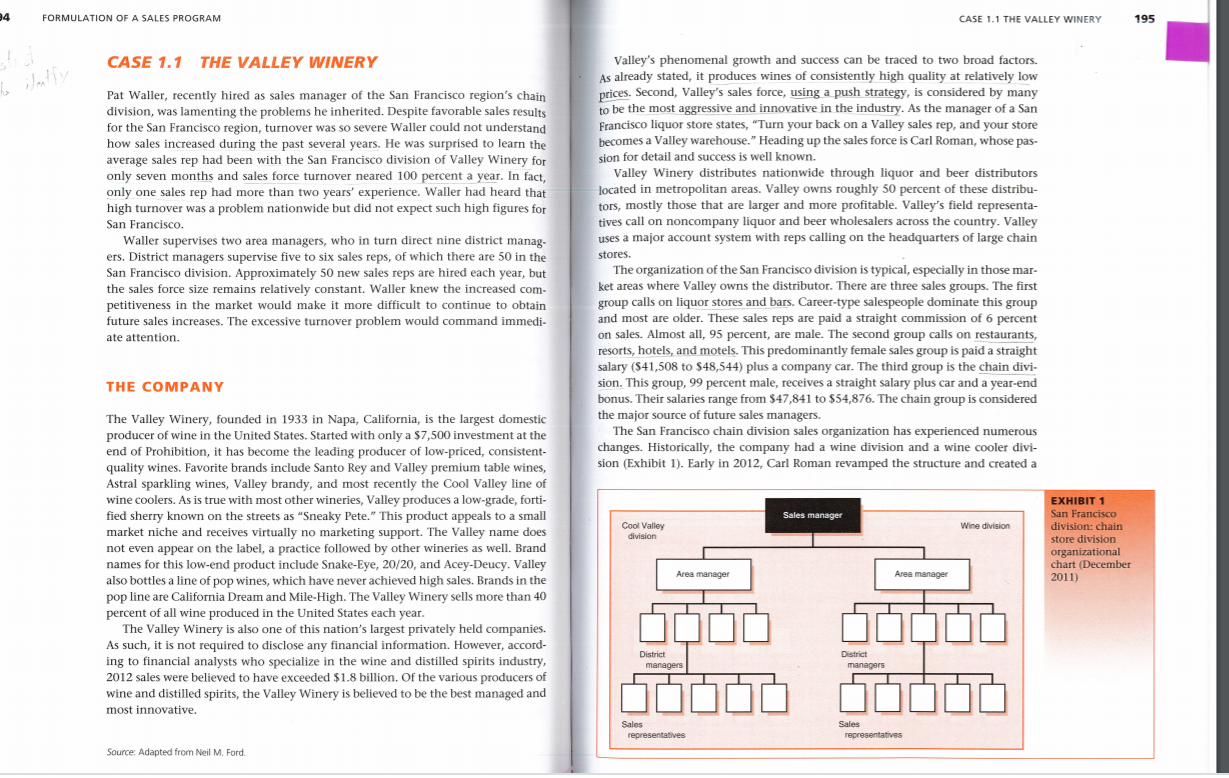 1. Introduction: Introduce your case analysis. Help the reader understand what you are going to discuss.
2. Problem Definition: What is the problem(s) to be solved? This section should include a definition of the problem as you see it. Be careful not confuse symptoms with problems. This should be exhaustive of the problems you plan to solve (Do not include problems you are not going to solve with your recommendations), but also extremely concise. If this is longer than a few sentences you are doing it wrong
known on 24 FORMULATION OF A SALES PROGRAM CASE 1.1 THE VALLEY WINERY 195 CASE 1.1 THE VALLEY WINERY Pat Waller, recently hired as sales manager of the San Francisco region's chain division, was lamenting the problems he inherited. Despite favorable sales results for the San Francisco region, turnover was so severe Waller could not understand how sales increased during the past several years. He was surprised to learn the average sales rep had been with the San Francisco division of Valley Winery for only seven months and sales force turnover neared 100 percent a year. In fact, only one sales rep had more than two years' experience. Waller had heard that turnover was a problem nationwide but did not expect such high figures for San Francisco San Francisco Waller supervises two area managers, who in turn direct nine district manag- ers. District managers supervise five to six sales reps, of which there are 50 in the San Francisco division. Approximately 50 new sales reps are hired each year, but the sales force size remains relatively constant. Waller knew the increased com- petitiveness in the market would make it more difficult to continue to obtain future sales increases. The excessive turnover problem would command immedi- ate attention. Valley's phenomenal growth and success can be traced to two broad factors. As already stated, it produces wines of consistently high quality at relatively low prices. Second, Valley's sales force, using a push strategy, is considered by many to be the most aggressive and innovative in the industry. As the manager of a San Francisco liquor store states, Turn your back on a Valley sales rep, and your store becomes a Valley warehouse." Heading up the sales force is Carl Roman, whose pas- sion for detail and success is well known. Valley Winery distributes nationwide through liquor and beer distributors located in metropolitan areas. Valley owns roughly 50 percent of these distribu- tors, mostly those that are larger and more profitable. Valley's field representa- tives call on Ion noncompany liquor and beer wholesalers across the country. Valley uses a major account system with reps calling on the headquarters large chain stores. STORES The organization of the San Francisco division is typical, especially in those mar- ket areas where Valley owns the distributor. There are three sales groups. The first group calls on liquor stores and bars. Career-type salespeople dominate this group and most are older. These sales reps are paid a straight commission of 6 percent on sales. Almost all, 95 percent, are male. The second group calls on restaurants, resorts, hotels, and motels. This predominantly female sales group is paid a straight salary (541,508 to $48,544) plus a company car. The third group is the chain divi- sion. This group, 99 percent male, receives a straight salary plus car and a year-end bonus. Their salaries range from $47,841 to $54,876. The chain group is considered the major source of future sales managers. The San Francisco chain division sales organization has experienced numerous changes. Historically, the company had a wine division and wine cooler divi- sion (Exhibit 1). Early in 2012, Carl Roman revamped the structure and created a THE COMPANY table wines, fied sherry Sales manager Cool Valley division Wine division The Valley Winery, founded in 1933 in Napa, California, is the largest domestic producer of wine in the United States. Started with only a $7,500 investment at the end of Prohibition, it has become the leading producer of low-priced, consistent- quality wines. Favorite brands include Santo Rey and Valley premium table Astral sparkling wines, Valley brandy, and most recently the Cool Valley line of wine coolers. As is true with most other wineries, Valley produces al on the streets as "Sneaky Pete." This product appeals to a small market niche and receives virtually no marketing support. The Valley name does not even appear on the label, a practice followed by other wineries as well. Brand names for this low-end product include Snake-Eye, and Acey-Deucy. Valley also bottles a line of pop wines, which have never achieved high sales. Brands in the pop line are California Dream and Mile-High. The Valley Winery sells more than 40 percent of all wine produced in the United States each The Valley Winery is also one of this nation's i's largest privately held companies. As such, it is not required to disclose any financial information. However, accord- ing to to financial analysts who specialize in the wine and distilled spirits industry, 2012 sales were believed to have exceeded $1.8 billion. Of the various producers of wine and distilled spirits, the Valley Winery is believed to be the best managed and EXHIBIT 1 San Francisco division: chain store division organizational chart (December 2011) 20/20, Area manager Area manager District managers District managers most innovative. Sales representatives Sales representatives Source: Adapted from Neil M. FordStep by Step Solution
There are 3 Steps involved in it
1 Expert Approved Answer
Step: 1 Unlock

Question Has Been Solved by an Expert!
Get step-by-step solutions from verified subject matter experts
Step: 2 Unlock
Step: 3 Unlock
 Study Help