







Question: 1 1.06 Modeling with Simulation 1. We have a die (one of a pair of dine} and believe that there is an equal probability for
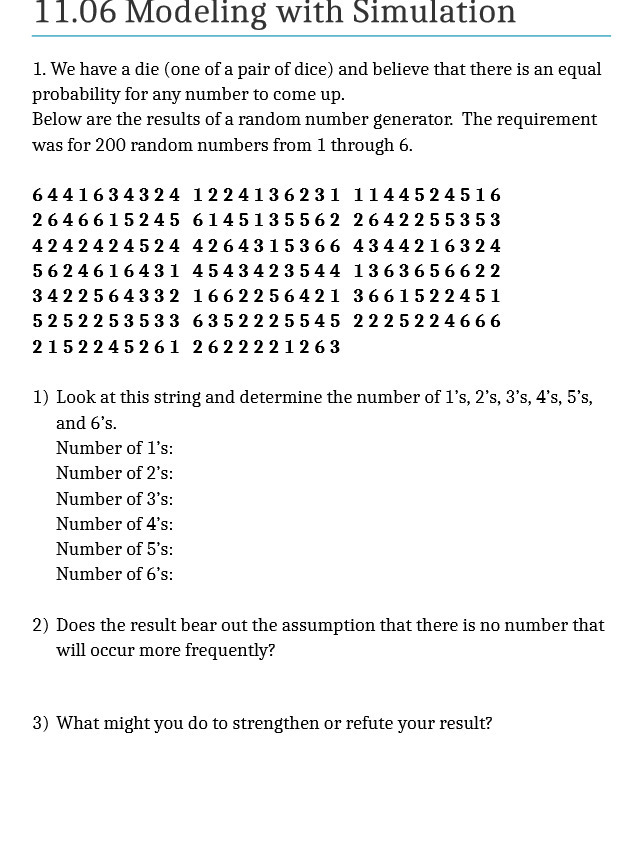
1 1.06 Modeling with Simulation 1. We have a die (one of a pair of dine} and believe that there is an equal probability for any number to some 1111. Below are the results of a random number generator. The requirement was for 230 random numbers from 1 through 6. 6441634324 1224136231 1144524516 2646615245 6145135562 2642255353 4242424524 4264315366 4344216324 5624616431 4543423544 1363656622 3422564332 1662256421 3661522451 5252253533 6352225545 2225224666 2152245261 2622221263 1) Look at this string and determine the number of 1's, 2'sIr 3's, 4's, 5's, and 6's. Number of 1's: Number of 2's: Number of 3's: Number of 4's: Number of 5's: Number of 6's: 2) Does the result bear out the assumpon that there is no number that will occur more frequently? 3) What might you do to strengthen or refute your result
Step by Step Solution
There are 3 Steps involved in it

Get step-by-step solutions from verified subject matter experts
 Study Help