Question: 1. 11 children are given a math test; after 3 weeks' special tuition they are given a further test of equal difficulty. Their marks in
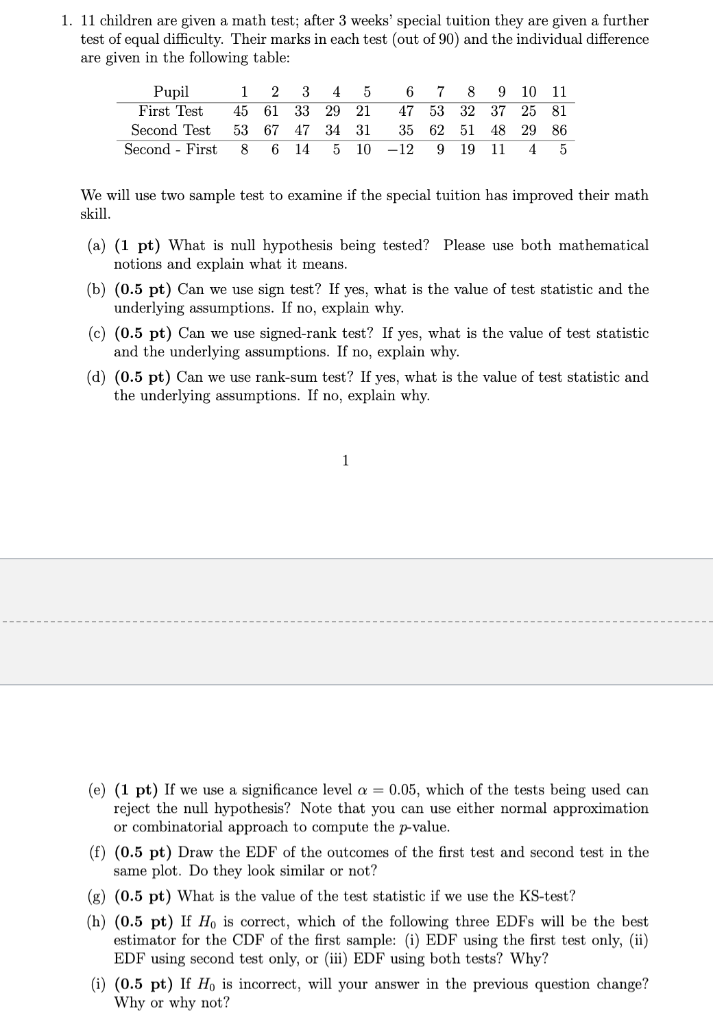
1. 11 children are given a math test; after 3 weeks' special tuition they are given a further test of equal difficulty. Their marks in each test (out of 90) and the individual difference are given in the following table: 7 53 Pupil First Test Second Test Second - First 1 2 3 4 5 45 61 33 29 21 53 67 47 34 31 8 6 14 5 10 6 47 35 -12 8 9 10 11 32 37 25 81 51 48 29 86 19 11 4 5 62 9 We will use two sample test to examine if the special tuition has improved their math skill. (a) (1 pt) What is null hypothesis being tested? Please use both mathematical notions and explain what it means. (b) (0.5 pt) Can we use sign test? If yes, what is the value of test statistic and the underlying assumptions. If no, explain why. (c) (0.5 pt) Can we use signed-rank test? If yes, what is the value of test statistic and the underlying assumptions. If no, explain why. (d) (0.5 pt) Can we use rank-sum test? If yes, what is the value of test statistic and the underlying assumptions. If no, explain why. 1 (e) (1 pt) If we use a significance level a = 0.05, which of the tests being used can reject the null hypothesis? Note that you can use either normal approximation or combinatorial approach to compute the p-value. (f) (0.5 pt) Draw the EDF of the outcomes of the first test and second test in the same plot. Do they look similar or not? (g) (0.5 pt) What is the value of the test statistic if we use the KS-test? (h) (0.5 pt) If He is correct, which of the following three EDFs will be the best estimator for the CDF of the first sample: (i) EDF using the first test only, (ii) EDF using second test only, or (iii) EDF using both tests? Why? (i) (0.5 pt) If He is incorrect, will your answer in the previous question change? Why or why not? 1. 11 children are given a math test; after 3 weeks' special tuition they are given a further test of equal difficulty. Their marks in each test (out of 90) and the individual difference are given in the following table: 7 53 Pupil First Test Second Test Second - First 1 2 3 4 5 45 61 33 29 21 53 67 47 34 31 8 6 14 5 10 6 47 35 -12 8 9 10 11 32 37 25 81 51 48 29 86 19 11 4 5 62 9 We will use two sample test to examine if the special tuition has improved their math skill. (a) (1 pt) What is null hypothesis being tested? Please use both mathematical notions and explain what it means. (b) (0.5 pt) Can we use sign test? If yes, what is the value of test statistic and the underlying assumptions. If no, explain why. (c) (0.5 pt) Can we use signed-rank test? If yes, what is the value of test statistic and the underlying assumptions. If no, explain why. (d) (0.5 pt) Can we use rank-sum test? If yes, what is the value of test statistic and the underlying assumptions. If no, explain why. 1 (e) (1 pt) If we use a significance level a = 0.05, which of the tests being used can reject the null hypothesis? Note that you can use either normal approximation or combinatorial approach to compute the p-value. (f) (0.5 pt) Draw the EDF of the outcomes of the first test and second test in the same plot. Do they look similar or not? (g) (0.5 pt) What is the value of the test statistic if we use the KS-test? (h) (0.5 pt) If He is correct, which of the following three EDFs will be the best estimator for the CDF of the first sample: (i) EDF using the first test only, (ii) EDF using second test only, or (iii) EDF using both tests? Why? (i) (0.5 pt) If He is incorrect, will your answer in the previous question change? Why or why not









 Study Help