







Question: 1. 12 points | Cooperation under grim-trigger strategies? Consider two predators, which independently choose whether to hunt stag (Stag) or hare (Hare). Hunting hare requires
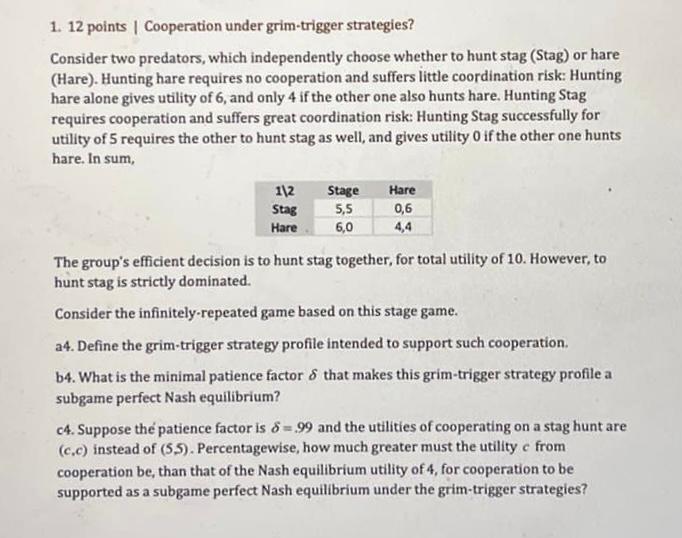
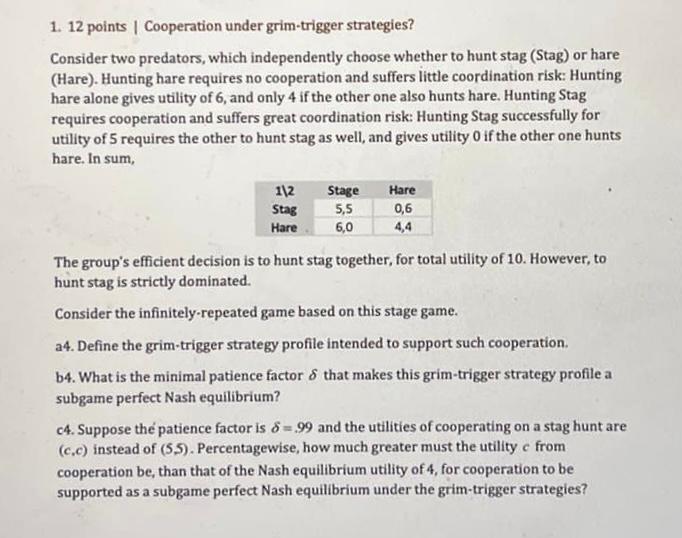
1. 12 points | Cooperation under grim-trigger strategies? Consider two predators, which independently choose whether to hunt stag (Stag) or hare (Hare). Hunting hare requires no cooperation and suffers little coordination risk: Hunting hare alone gives utility of 6, and only 4 if the other one also hunts hare. Hunting Stag requires cooperation and suffers great coordination risk: Hunting Stag successfully for utility of 5 requires the other to hunt stag as well, and gives utility 0 if the other one hunts hare. In sum, 1\\2 Stage Hare Stag 5,5 0,6 Hare 6.0 4,4 The group's efficient decision is to hunt stag together, for total utility of 10. However, to hunt stag is strictly dominated. Consider the infinitely-repeated game based on this stage game. a4. Define the grim-trigger strategy profile intended to support such cooperation. b4. What is the minimal patience factor & that makes this grim-trigger strategy profile a subgame perfect Nash equilibrium? c4. Suppose the patience factor is 6 =.99 and the utilities of cooperating on a stag hunt are (c.c) instead of (5.5). Percentagewise, how much greater must the utility c from cooperation be, than that of the Nash equilibrium utility of 4, for cooperation to be supported as a subgame perfect Nash equilibrium under the grim-trigger strategies
Step by Step Solution
There are 3 Steps involved in it

Get step-by-step solutions from verified subject matter experts
 Study Help