







Question: 1. (1-year) Prove that for every n E N there exists a unique t(n) > 0 such that (t (n) - 1) Int(n) = n.
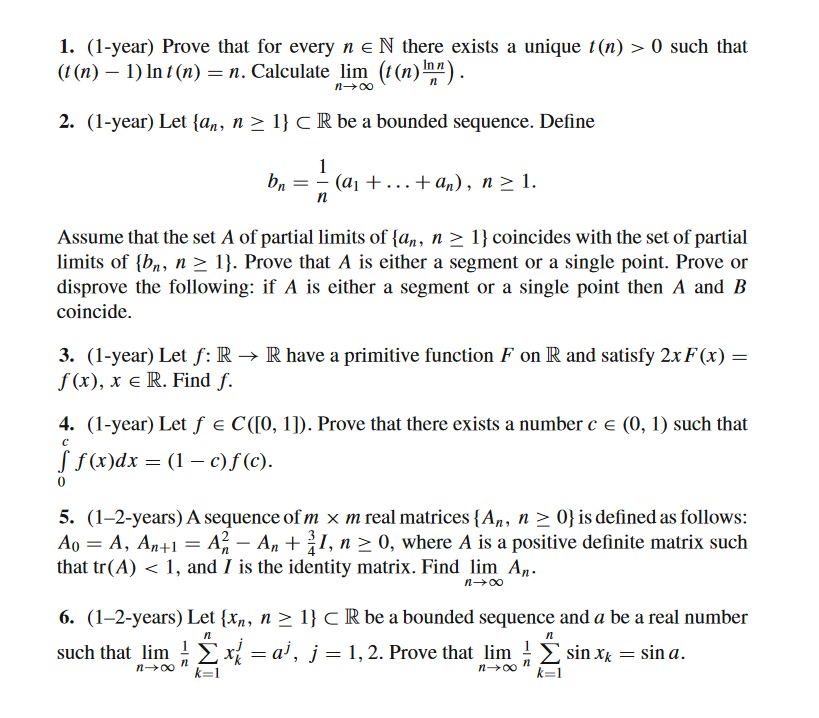
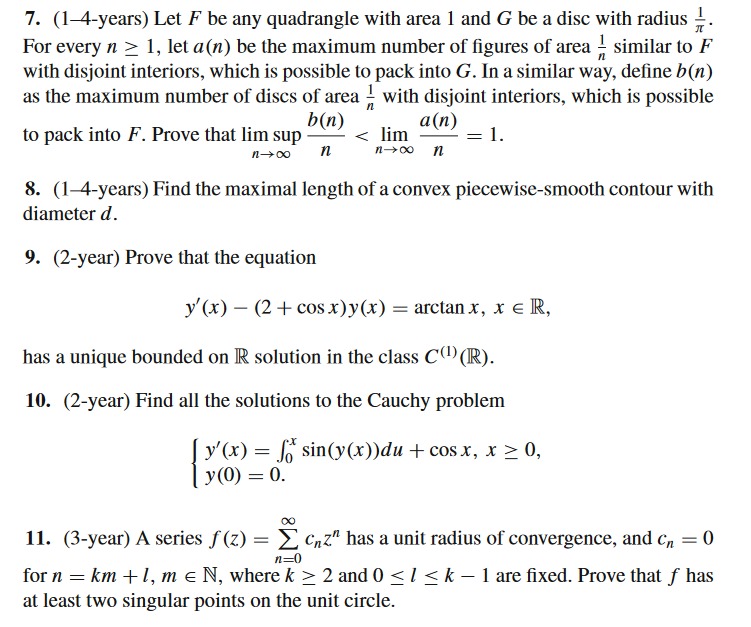
1. (1-year) Prove that for every n E N there exists a unique t(n) > 0 such that (t (n) - 1) Int(n) = n. Calculate lim (t(n) Inn ) . 1 - 00 2. (1-year) Let {an, n 2 1} C R be a bounded sequence. Define bn = = (alt . .. + an), n21. n Assume that the set A of partial limits of {d,, n 2 1} coincides with the set of partial limits of {bn, n 2 1}. Prove that A is either a segment or a single point. Prove or disprove the following: if A is either a segment or a single point then A and B coincide. 3. (1-year) Let f: R - R have a primitive function F on R and satisfy 2x F (x) = f(x), x E R. Find f. 4. (1-year) Let f E C([0, 1]). Prove that there exists a number c E (0, 1) such that I f (x)dx = (1 - c)f (c). o 5. (1-2-years) A sequence of m x m real matrices { An, n > 0) is defined as follows: Ao = A, Anti = A, - An + 2 1, n 2 0, where A is a positive definite matrix such that tr(A) 2 and 0
Step by Step Solution
There are 3 Steps involved in it

Get step-by-step solutions from verified subject matter experts
 Study Help