







Question: 1. 2. 3 4 5 please answer all the ielts questions 17 to 34 please answer all the questions answer as soon as possible Choose
1. 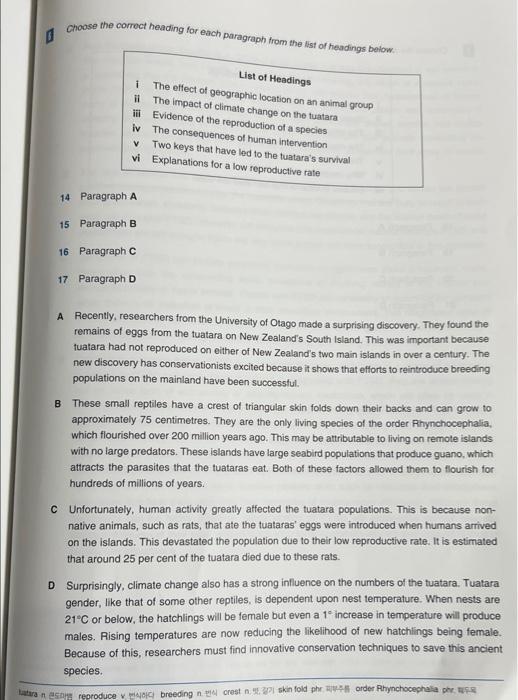
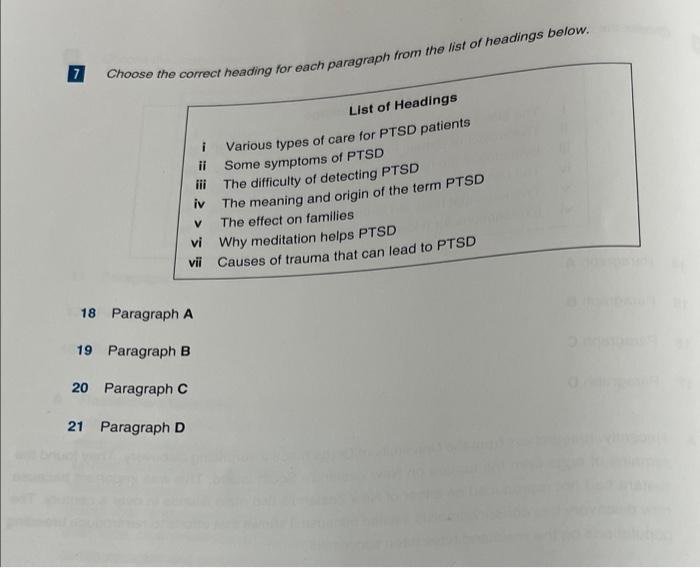
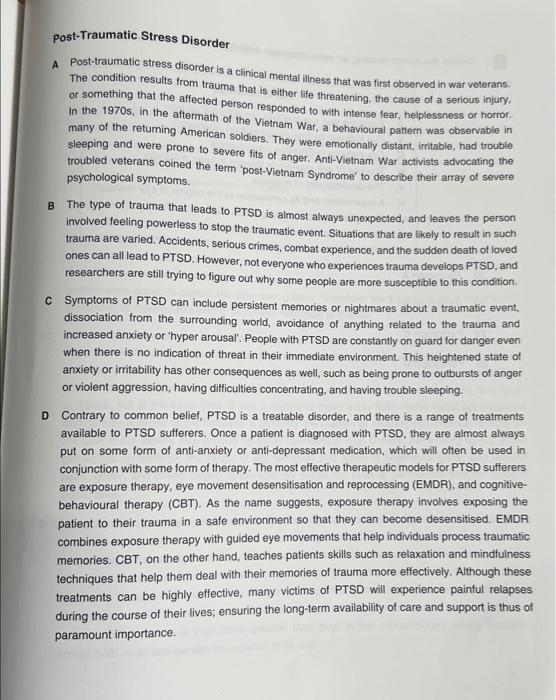
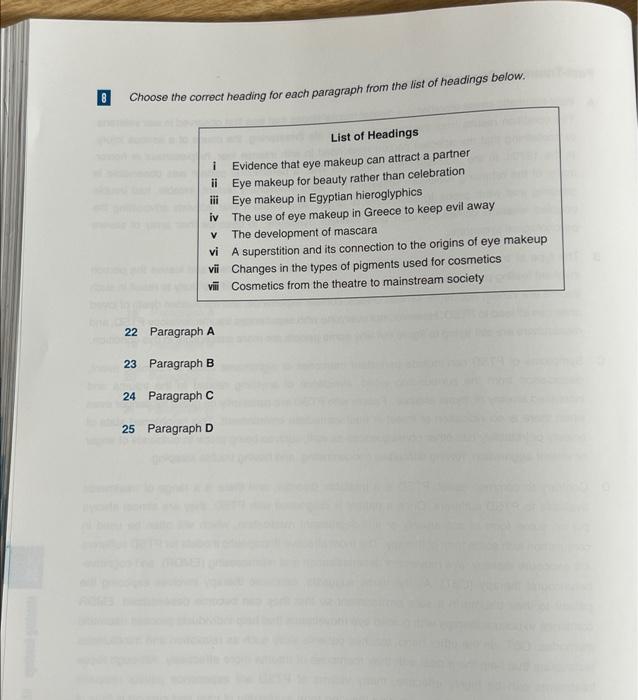
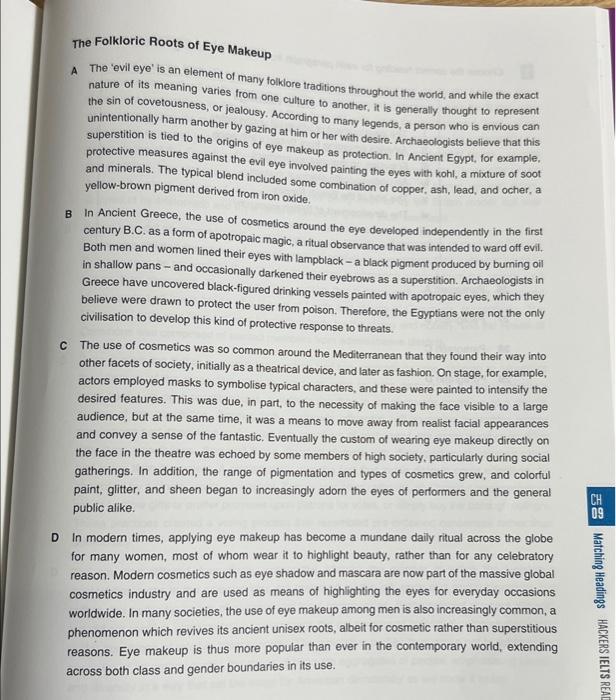
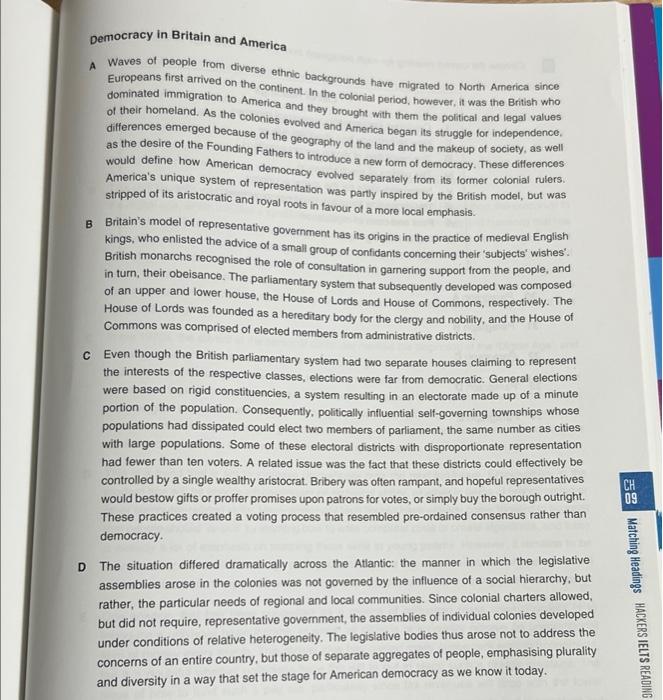
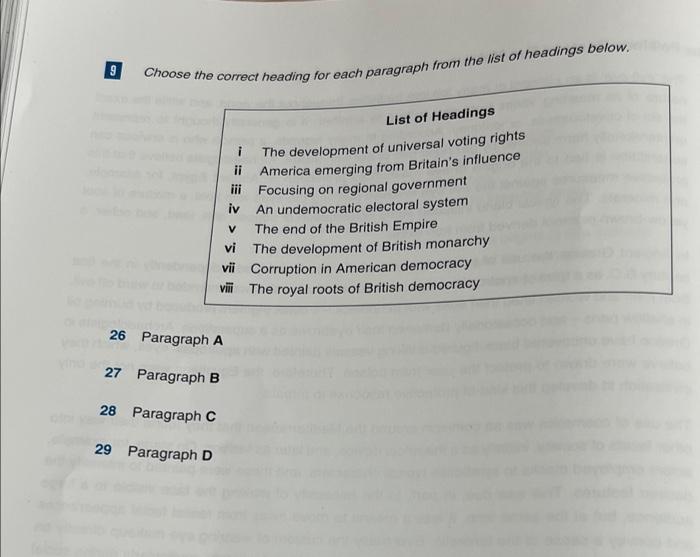
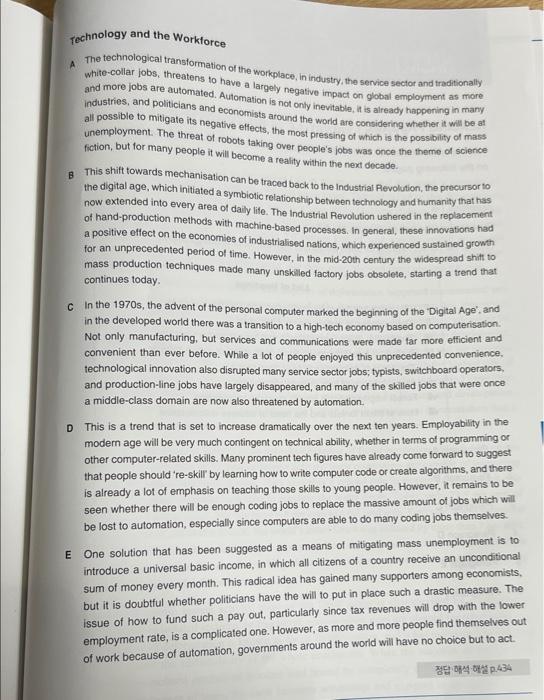
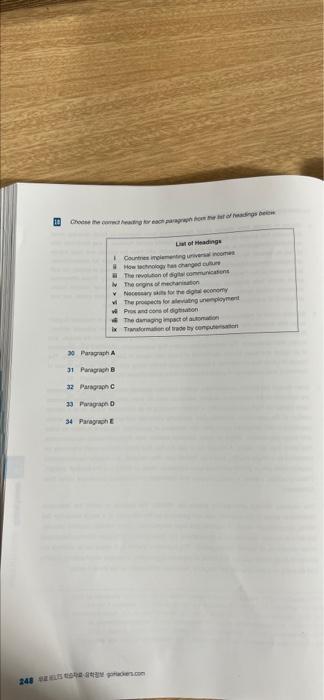
Choose the correct heading for each paragraph from the list of headings below. List of Headings i il iii The effect of geographic location on an animal group The impact of climate change on the tuatara Evidence of the reproduction of a species The consequences of human intervention iv V Two keys that have led to the tuatara's survival vi Explanations for a low reproductive rate 14 Paragraph A 15 Paragraph B 16 Paragraph C 17 Paragraph D A Recently, researchers from the University of Otago made a surprising discovery. They found the remains of eggs from the tuatara on New Zealand's South Island. This was important because tuatara had not reproduced on either of New Zealand's two main islands in over a century. The new discovery has conservationists excited because it shows that efforts to reintroduce breeding populations on the mainland have been successful. B These small reptiles have a crest of triangular skin folds down their backs and can grow to approximately 75 centimetres. They are the only living species of the order Rhynchocephalia, which flourished over 200 million years ago. This may be attributable to living on remote islands with no large predators. These islands have large seabird populations that produce guano, which attracts the parasites that the tuataras eat. Both of these factors allowed them to flourish for hundreds of millions of years. C Unfortunately, human activity greatly affected the tuatara populations. This is because non- native animals, such as rats, that ate the tuataras' eggs were introduced when humans arrived on the islands. This devastated the population due to their low reproductive rate. It is estimated that around 25 per cent of the tuatara died due to these rats. D Surprisingly, climate change also has a strong influence on the numbers of the tuatara. Tuatara gender, like that of some other reptiles, is dependent upon nest temperature. When nests are 21C or below, the hatchlings will be female but even a 1 increase in temperature will produce males. Rising temperatures are now reducing the likelihood of new hatchlings being female. Because of this, researchers must find innovative conservation techniques to save this ancient species. tataran es reproduce v nic breeding n 4 crest n. skin fold phr - order Rhynchocephalia phr. ER 7 Choose the correct heading for each paragraph from the list of headings below. List of Headings i Various types of care for PTSD patients Some symptoms of PTSD ii The difficulty of detecting PTSD iv The meaning and origin of the term PTSD The effect on families V vi Why meditation helps PTSD vii Causes of trauma that can lead to PTSD 18 Paragraph A 19 Paragraph B 20 Paragraph C 21 Paragraph D Post-Traumatic Stress Disorder A Post-traumatic stress disorder is a clinical mental illness that was first observed in war veterans The condition results from trauma that is either life threatening, the cause of a serious injury, or something that the affected person responded to with intense fear, helplessness or horror. In the 1970s, in the aftermath of the Vietnam War, a behavioural pattern was observable in many of the returning American soldiers. They were emotionally distant, irritable, had trouble sleeping and were prone to severe fits of anger. Anti-Vietnam War activists advocating the troubled veterans coined the term 'post-Vietnam Syndrome' to describe their array of severe psychological symptoms. B The type of trauma that leads to PTSD is almost always unexpected, and leaves the person involved feeling powerless to stop the traumatic event. Situations that are likely to result in such trauma are varied. Accidents, serious crimes, combat experience, and the sudden death of loved ones can all lead to PTSD. However, not everyone who experiences trauma develops PTSD, and researchers are still trying to figure out why some people are more susceptible to this condition. C Symptoms of PTSD can include persistent memories or nightmares about a traumatic event, dissociation from the surrounding world, avoidance of anything related to the trauma and increased anxiety or 'hyper arousal'. People with PTSD are constantly on guard for danger even when there is no indication of threat in their immediate environment. This heightened state of anxiety or irritability has other consequences as well, such as being prone to outbursts of anger or violent aggression, having difficulties concentrating, and having trouble sleeping. D Contrary to common belief, PTSD is a treatable disorder, and there is a range of treatments available to PTSD sufferers. Once a patient is diagnosed with PTSD, they are almost always put on some form of anti-anxiety or anti-depressant medication, which will often be used in conjunction with some form of therapy. The most effective therapeutic models for PTSD sufferers are exposure therapy, eye movement desensitisation and reprocessing (EMDR), and cognitive- behavioural therapy (CBT). As the name suggests, exposure therapy involves exposing the patient to their trauma in a safe environment so that they can become desensitised. EMDR combines exposure therapy with guided eye movements that help individuals process traumatic memories. CBT, on the other hand, teaches patients skills such as relaxation and mindfulness techniques that help them deal with their memories of trauma more effectively. Although these treatments can be highly effective, many victims of PTSD will experience painful relapses during the course of their lives; ensuring the long-term availability of care and support is thus of paramount importance. 8 Choose the correct heading for each paragraph from the list of headings below. List of Headings i ii Evidence that eye makeup can attract a partner Eye makeup for beauty rather than celebration Eye makeup in Egyptian hieroglyphics iii iv The use of eye makeup in Greece to keep evil away V The development of mascara vi A superstition and its connection to the origins of eye makeup vii Changes in the types of pigments used for cosmetics Cosmetics from the theatre to mainstream society vii 22 Paragraph A 23 Paragraph B 24 Paragraph C 25 Paragraph D The Folkloric Roots of Eye Makeup A The 'evil eye' is an element of many folklore traditions throughout the world, and while the exact nature of its meaning varies from one culture to another, it is generally thought to represent the sin of covetousness, or jealousy. According to many legends, a person who is envious can unintentionally harm another by gazing at him or her with desire. Archaeologists believe that this superstition is tied to the origins of eye makeup as protection. In Ancient Egypt, for example, protective measures against the evil eye involved painting the eyes with kohl, a mixture of soot and minerals. The typical blend included some combination of copper, ash, lead, and ocher, a yellow-brown pigment derived from iron oxide. B In Ancient Greece, the use of cosmetics around the eye developed independently in the first century B.C. as a form of apotropaic magic, a ritual observance that was intended to ward off evil. Both men and women lined their eyes with lampblack-a black pigment produced by burning oil in shallow pans - and occasionally darkened their eyebrows as a superstition. Archaeologists in Greece have uncovered black-figured drinking vessels painted with apotropaic eyes, which they believe were drawn to protect the user from poison. Therefore, the Egyptians were not the only civilisation to develop this kind of protective response to threats. C The use of cosmetics was so common around the Mediterranean that they found their way into other facets of society, initially as a theatrical device, and later as fashion. On stage, for example, actors employed masks to symbolise typical characters, and these were painted to intensify the desired features. This was due, in part, to the necessity of making the face visible to a large audience, but at the same time, it was a means to move away from realist facial appearances and convey a sense of the fantastic. Eventually the custom of wearing eye makeup directly on the face in the theatre was echoed by some members of high society, particularly during social gatherings. In addition, the range of pigmentation and types of cosmetics grew, and colorful paint, glitter, and sheen began to increasingly adorn the eyes of performers and the general public alike. D In modern times, applying eye makeup has become a mundane daily ritual across the globe for many women, most of whom wear it to highlight beauty, rather than for any celebratory reason. Modern cosmetics such as eye shadow and mascara are now part of the massive global cosmetics industry and are used as means of highlighting the eyes for everyday occasions worldwide. In many societies, the use of eye makeup among men is also increasingly common, a phenomenon which revives its ancient unisex roots, albeit for cosmetic rather than superstitious reasons. Eye makeup is thus more popular than ever in the contemporary world, extending across both class and gender boundaries in its use. CH 09 5 Matching Headings HACKERS IELTS REAL Democracy in Britain and America A Waves of people from diverse ethnic backgrounds have migrated to North America since Europeans first arrived on the continent. In the colonial period, however, it was the British who dominated immigration to America and they brought with them the political and legal values of their homeland. As the colonies evolved and America began its struggle for independence, differences emerged because of the geography of the land and the makeup of society, as well as the desire of the Founding Fathers to introduce a new form of democracy. These differences would define how American democracy evolved separately from its former colonial rulers. America's unique system of representation was partly inspired by the British model, but was stripped of its aristocratic and royal roots in favour of a more local emphasis. B Britain's model of representative government has its origins in the practice of medieval English kings, who enlisted the advice of a small group of confidants concerning their subjects' wishes. British monarchs recognised the role of consultation in garnering support from the people, and in turn, their obeisance. The parliamentary system that subsequently developed was composed of an upper and lower house, the House of Lords and House of Commons, respectively. The House of Lords was founded as a hereditary body for the clergy and nobility, and the House of Commons was comprised of elected members from administrative districts. C Even though the British parliamentary system had two separate houses claiming to represent the interests of the respective classes, elections were far from democratic. General elections were based on rigid constituencies, a system resulting in an electorate made up of a minute portion of the population. Consequently, politically influential self-governing townships whose populations had dissipated could elect two members of parliament, the same number as cities with large populations. Some of these electoral districts with disproportionate representation had fewer than ten voters. A related issue was the fact that these districts could effectively be controlled by a single wealthy aristocrat. Bribery was often rampant, and hopeful representatives would bestow gifts or proffer promises upon patrons for votes, or simply buy the borough outright. These practices created a voting process that resembled pre-ordained consensus rather than democracy. D The situation differed dramatically across the Atlantic: the manner in which the legislative assemblies arose in the colonies was not governed by the influence of a social hierarchy, but rather, the particular needs of regional and local communities. Since colonial charters allowed, but did not require, representative government, the assemblies of individual colonies developed under conditions of relative heterogeneity. The legislative bodies thus arose not to address the concerns of an entire country, but those of separate aggregates of people, emphasising plurality and diversity in a way that set the stage for American democracy as we know it today. CH 09 5 Matching Headings HACKERS IELTS READING 9 Choose the correct heading for each paragraph from the list of headings below. List of Headings i ii The development of universal voting rights America emerging from Britain's influence Focusing on regional government An undemocratic electoral system. iii iv V The end of the British Empire vii The development of British monarchy Corruption in American democracy The royal roots of British democracy viii 26 Paragraph A 27 Paragraph B 28 Paragraph C 29 Paragraph D Technology and the Workforce The technological transformation of the workplace, in industry, the service sector and traditionally white-collar jobs, threatens to have a largely negative impact on global employment as more and more jobs are automated. Automation is not only inevitable, it is already happening in many industries, and politicians and economists around the world are considering whether it will be at all possible to mitigate its negative effects, the most pressing of which is the possibility of mass unemployment. The threat of robots taking over people's jobs was once the theme of science fiction, but for many people it will become a reality within the next decade. BThis shift towards mechanisation can be traced back to the Industrial Revolution, the precursor to the digital age, which initiated a symbiotic relationship between technology and humanity that has now extended into every area of daily life. The Industrial Revolution ushered in the replacement of hand-production methods with machine-based processes. In general, these innovations had a positive effect on the economies of industrialised nations, which experienced sustained growth for an unprecedented period of time. However, in the mid-20th century the widespread shift to mass production techniques made many unskilled factory jobs obsolete, starting a trend that continues today. c In the 1970s, the advent of the personal computer marked the beginning of the Digital Age', and in the developed world there was a transition to a high-tech economy based on computerisation Not only manufacturing, but services and communications were made far more efficient and convenient than ever before. While a lot of people enjoyed this unprecedented convenience, technological innovation also disrupted many service sector jobs; typists, switchboard operators, and production-line jobs have largely disappeared, and many of the skilled jobs that were once a middle-class domain are now also threatened by automation. D This is a trend that is set to increase dramatically over the next ten years. Employability in the modern age will be very much contingent on technical ability, whether in terms of programming or other computer-related skills. Many prominent tech figures have already come forward to suggest that people should 're-skill' by learning how to write computer code or create algorithms, and there is already a lot of emphasis on teaching those skills to young people. However, it remains to be seen whether there will be enough coding jobs to replace the massive amount of jobs which will be lost to automation, especially since computers are able to do many coding jobs themselves. E One solution that has been suggested as a means of mitigating mass unemployment is to introduce a universal basic income, in which all citizens of a country receive an unconditional sum of money every month. This radical idea has gained many supporters among economists, but it is doubtful whether politicians have the will to put in place such a drastic measure. The issue of how to fund such a pay out, particularly since tax revenues will drop with the lower employment rate, is a complicated one. However, as more and more people find themselves out of work because of automation, governments around the world will have no choice but to act. p.434 10 Choose the come heading for each paragraph from the tofangsbe List of Headings Countries implementing universal income How technology has changed cultur The revolution of digital communications The ongins of mechanisation v Necessary skits for the digital economy The prospects for alleviating unemployment Pros and cons of digitisation The damaging impact of automation ix Transformation of trade by compute 30 Paragraph A 31 Paragraph B 32 Paragraph C 33 Paragraph D 34 Paragraph E 248 packers.com
2.
3
4
5
please answer all the ielts questions 17 to 34 please answer all the questions answer as soon as possible
Step by Step Solution
There are 3 Steps involved in it
1 Expert Approved Answer
Step: 1 Unlock

Question Has Been Solved by an Expert!
Get step-by-step solutions from verified subject matter experts
Step: 2 Unlock
Step: 3 Unlock
 Study Help