







Question: 1. 2. 3. For the interval [0, 1], superimpose the graph for the economized polynomial of degree-4 on the graph of the Maclaurin series of
1.![1. 2. 3. For the interval [0, 1], superimpose the graph for](https://s3.amazonaws.com/si.experts.images/answers/2024/09/66ddf6adca4c4_63766ddf6ad4a005.jpg)
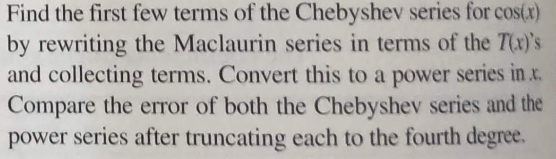
2.
3.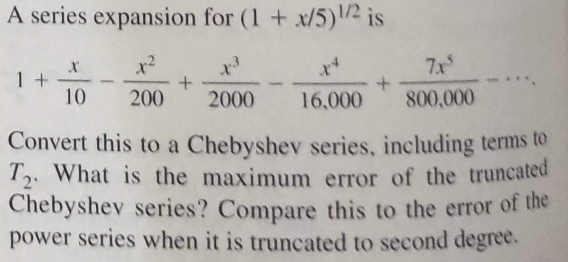
For the interval [0, 1], superimpose the graph for the economized polynomial of degree-4 on the graph of the Maclaurin series of the same degree for f(x) = el. Do it again for those of degree-5. Find the first few terms of the Chebyshev series for cos(x) by rewriting the Maclaurin series in terms of the T(x)'s and collecting terms. Convert this to a power series in ... Compare the error of both the Chebyshev series and the power series after truncating each to the fourth degree. A series expansion for (1 + x/5)1/2 is X 1 + x2 200 + + 10 2000 16,000 800,000 Convert this to a Chebyshev series, including terms to T, What is the maximum error of the truncated Chebyshev series? Compare this to the error of the power series when it is truncated to second degree. For the interval [0, 1], superimpose the graph for the economized polynomial of degree-4 on the graph of the Maclaurin series of the same degree for f(x) = el. Do it again for those of degree-5. Find the first few terms of the Chebyshev series for cos(x) by rewriting the Maclaurin series in terms of the T(x)'s and collecting terms. Convert this to a power series in ... Compare the error of both the Chebyshev series and the power series after truncating each to the fourth degree. A series expansion for (1 + x/5)1/2 is X 1 + x2 200 + + 10 2000 16,000 800,000 Convert this to a Chebyshev series, including terms to T, What is the maximum error of the truncated Chebyshev series? Compare this to the error of the power series when it is truncated to second degree
Step by Step Solution
There are 3 Steps involved in it

Get step-by-step solutions from verified subject matter experts
 Study Help