







Question: (1) (2) Mass from linear density. Given a rod whose density function p(:r:) (in mass per unit length) measures the density at the value :1:
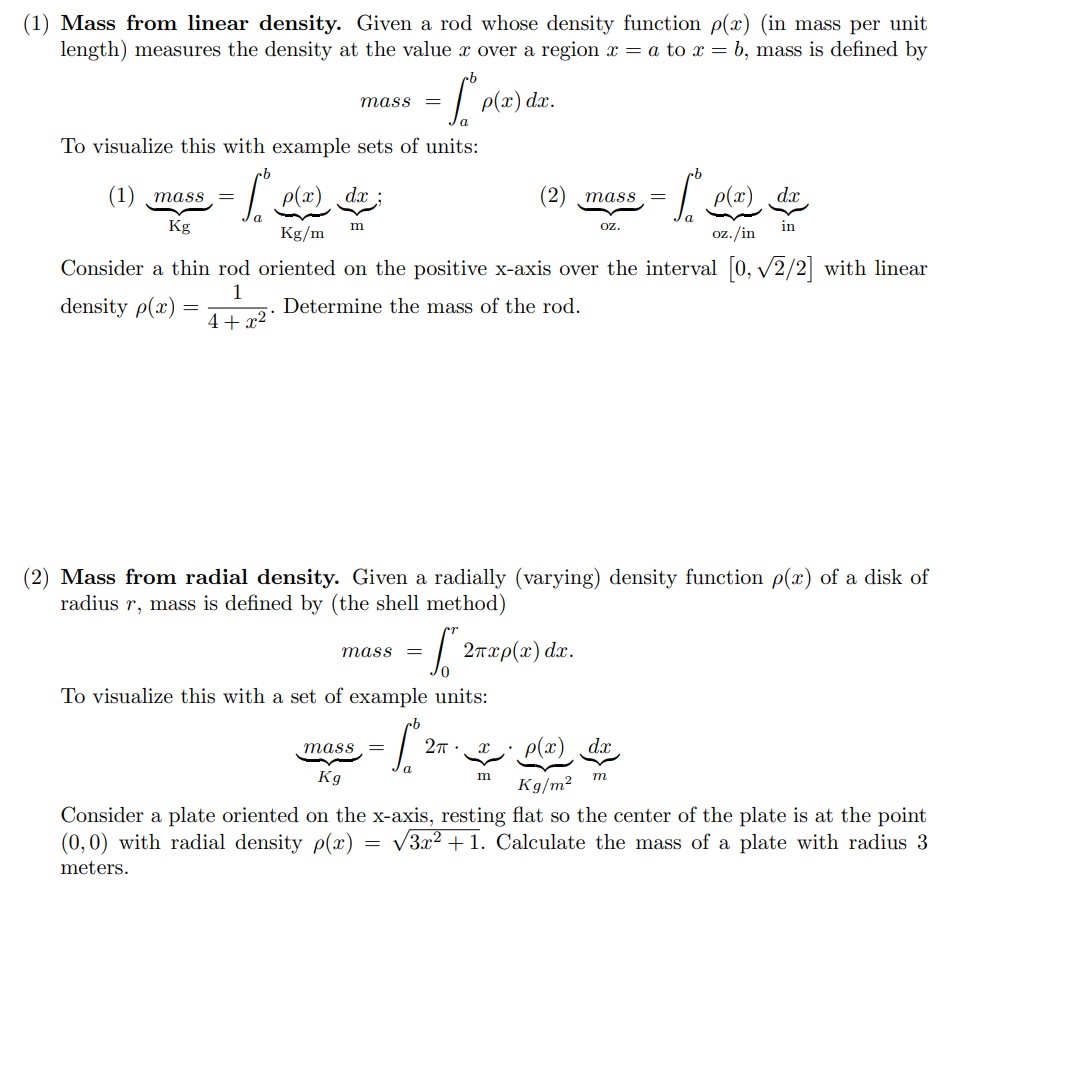
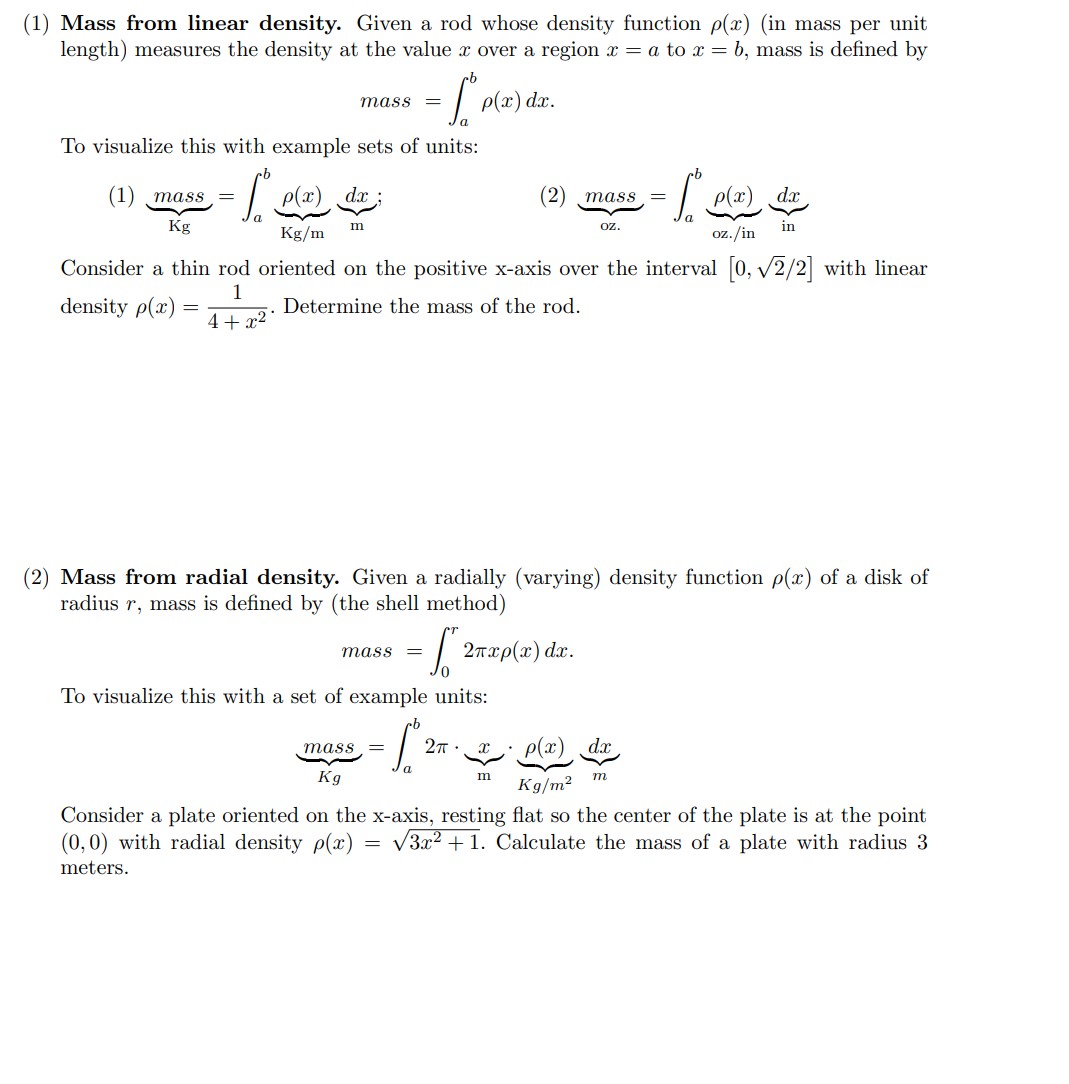
(1) (2) Mass from linear density. Given a rod whose density function p(:r:) (in mass per unit length) measures the density at the value :1: over a region 3: = a to a: = b, mass is dened by 1: mass 2/ p(a:)d3:. To visualize this with example sets of units: b b (1) mass = p(:r:) dzr ; (2) mass = p(:.-:) (13: Wl ' , Van. '1' 5. g/ . , 5-. ,J Kg (1 K 111 oz. (1 . in gfrn onln Consider a thin rod oriented on the positive x-axis over the interval [0, Vii/2] with linear density p(:r) = 1 , . Determine the mass of the rod. alien's:a Mass from radial density. Given a radially (varying) density function p(;r) of a disk of radius 1*, mass is defined by (the shell method) mass 2/ 2mp(m)d:r. 0 To visualize this with a set of example units: 6 mass = 2rr- a: p(:r) d3: W a \"v\" . "v' Kg m Ker/mg Consider a plate oriented on the x-axis, resting at so the center of the plate is at the point (0,0) with radial density p(:r:) = V3332 + 1. Calculate the mass of a plate with radius 3 meters
Step by Step Solution
There are 3 Steps involved in it

Get step-by-step solutions from verified subject matter experts
 Study Help