



Question: 1 2 question: what role does the 'stability of environment and technology' play at HP? application 9.2 change INSTITUTIONALIZING STRUCTURAL CHANGE AT HEWLETT-PACKARD n May
1
2
question:
what role does the 'stability of environment and technology' play at HP?
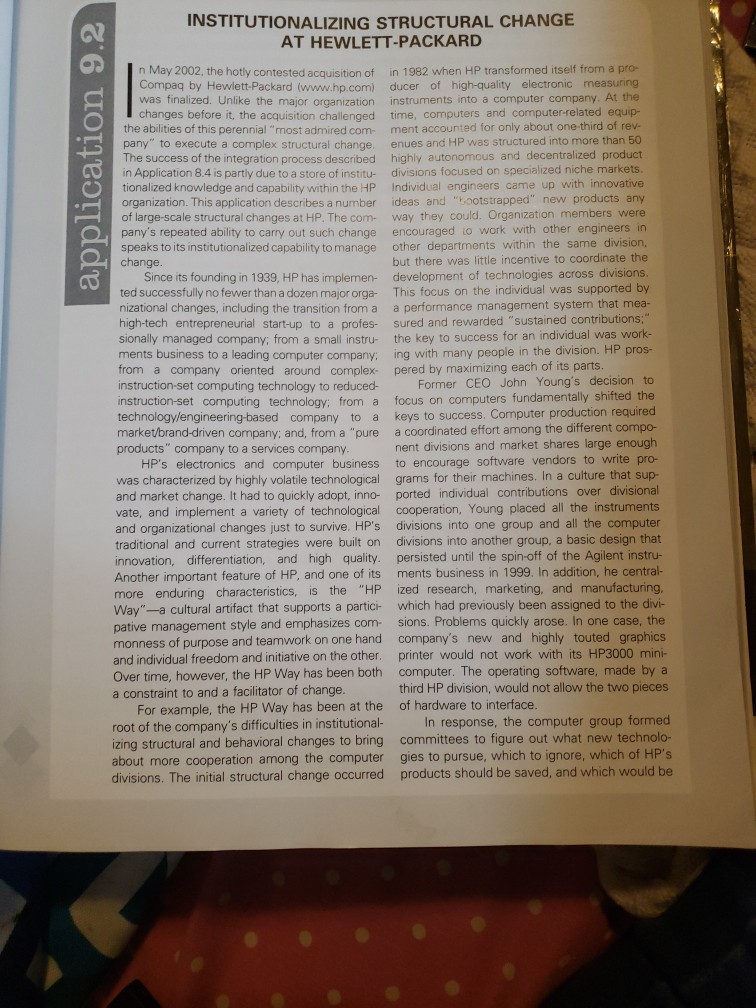
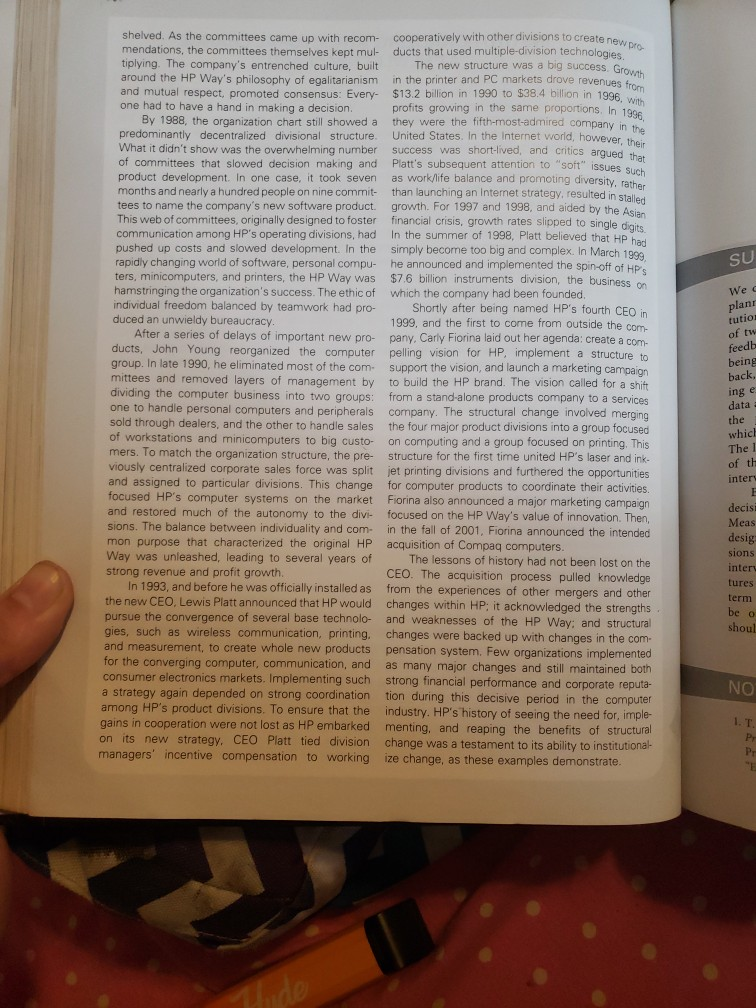
application 9.2 change INSTITUTIONALIZING STRUCTURAL CHANGE AT HEWLETT-PACKARD n May 2002, the hotly contested acquisition of in 1982 when HP transformed itself from a pro- Compaq by Hewlett-Packard (www.hp.com) ducer of high-quality electronic measuring was finalized. Unlike the major organization instruments into a computer company. At the changes before it, the acquisition challenged time, computers and computer-related equip the abilities of this perennial "most admired com ment accounted for only about one-third of rev- pany" to execute a complex structural change. enues and HP was structured into more than 50 The success of the integration process described highly autonomous and decentralized product in Application 8.4 is partly due to a store of institu divisions focused on specialized niche markets tionalized knowledge and capability within the HP Individual engineers came up with innovative organization. This application describes a number ideas and "bootstrapped" new products any of large-scale structural changes at HP. The com- way they could. Organization members were pany's repeated ability to carry out such change encouraged to work with other engineers in speaks to its institutionalized capability to manage other departments within the same division, but there was little incentive to coordinate the Since its founding in 1939, HP has implemen- development of technologies across divisions. ted successfully no fewer than a dozen majororga This focus on the individual was supported by nizational changes, including the transition from a a performance management system that mea- high-tech entrepreneurial start-up to a profes- sured and rewarded "sustained contributions;" sionally managed company: from a small instru the key to success for an individual was work- ments business to a leading computer company: from a company oriented around complex ing with many people in the division. HP pros- pered by maximizing each of its parts. instruction-set computing technology to reduced Former CEO John Young's decision to instruction-set computing technology: from a focus on computers fundamentally shifted the technology/engineering-based company to keys to success. Computer production required market/brand-driven company, and, from a "pure a coordinated effort t among the different compo- products" company to a services company. nent divisions and market shares large enough HP's electronics and computer business to encourage software vendors to write pro- was characterized by highly volatile technological grams for their machines. In a culture that sup- and market change. had to quickly adopt, inno- ported individual contributions over divisional vate, and implement a variety of technological cooperation, Young placed all the instruments and organizational changes just to survive. HP's into one group and all the computer traditional and current strategies were built on into another group, a basic design that innovation, differentiation, and high quality. persisted until the spin-off of the Agilent instru- Another important feature of HP, and one of its ments business in 1999. In addition, he central- haracteristics is more enduring characteristics, ized research, marketing, and manufacturing, Way"-a cultural artifact that supports partici which had previously been assigned to the divi- pative management style and emphasizes com sions. Problems quickly arose. In one case, the monness of purpose and teamwork on one hand company's new and highly touted graphics and individual freedom and initiative on the other. printer would not work with its HP3000 mini- Over time, however, the HP Way has been both computer. The operating software, made by a a constraint to and a facilitator of change. third HP division, would not allow the two pieces For example, the HP Way has been at the of hardware to interface. root of the company's difficulties in institutional In response, the computer group formed izing structural and behavioral changes to bring committees to figure out what new technolo- about more cooperation among the computer gies to pursue, which to ignore, which of HP's divisions. The initial structural change occurred products should be saved, and which would be divisions into the HP SU shelved. As the committees came up with recom- cooperatively with other divisions to create new pre mendations, the committees themselves kept mul- ducts that used multiple-division technologies tiplying. The company's entrenched culture, built The new structure was a big success. Growth around the HP Way's philosophy of egalitarianism in the printer and PC markets drove revenues from and mutual respect, promoted consensus: Every- $13.2 billion in 1990 to $38.4 billion in 1996, with one had to have a hand in making a decision profits growing in the same proportions. In 1996 By 1988, the organization chart still showed a they were the fifth-most-admired company in the predominantly decentralized divisional structure United States. In the Internet world, however, their What it didn't show was the overwhelming number Success was short-lived, and critics argued that of committees that slowed decision making and Platt's subsequent attention to "soft" issues such product development. In one case, it took seven as worklife balance and promoting diversity, rather months and nearly a hundred people on nine commit than launching an internet strategy, resulted in stalled tees to name the company's new software product. growth. For 1997 and 1998, and aided by the Asian This web of committees, originally designed to foster financial crisis, growth rates slipped to single digits. communication among HP's operating divisions, had In the summer of 1998, Platt believed that HP had pushed up costs and slowed development. In the simply become too big and complex. In March 1999 rapidly changing world of software, personal compu- he announced and implemented the spin-off of HP's ters, minicomputers, and printers, the HP Way was $7.6 billion instruments division, the business on hamstringing the organization's success. The ethic of which the company had been founded, individual freedom balanced by teamwork had pro Shortly after being named HP's fourth CEO in duced an unwieldy bureaucracy. 1999, and the first to come from outside the com- After a series of delays of important new pro pany, Carly Fiorina laid out her agenda: create a com- ducts, John Young reorganized the computer pelling vision for HP, implement a structure to group. In late 1990, he eliminated most of the com. support the vision, and launch a marketing campaign mittees and removed layers of management by to build the HP brand. The vision called for a shift dividing the computer business into two groups: from a stand-alone products company to a services one to handle personal computers and peripherals company. The structural change involved merging sold through dealers, and the other to handle sales the four major product divisions into a group focused of workstations and minicomputers to big custo on computing and a group focused on printing. This mers. To match the organization structure, the pre- structure for the first time united HP's laser and ink- viously centralized corporate sales force was split jet printing divisions and furthered the opportunities and assigned to particular divisions. This change for computer products to coordinate their activities. focused HP's computer systems on the market Fiorina also announced a major marketing campaign and restored much of the autonomy to the divi focused on the HP Way's value of innovation. Then, sions. The balance between individuality and com in the fall of 2001, Fiorina announced the intended mon purpose that characterized the original HP acquisition of Compaq computers Way was unleashed, leading to several years of The lessons of history had not been lost on the strong revenue profit growth. CEO. The acquisition process pulled knowledge In 1993, and before he was officially installed as from the experiences of other mergers and other the new CEO. Lewis Platt announced that HP would changes within HP, it acknowledged the strengths pursue the convergence of several base technolo and weaknesses of the HP Way: and structural gies, such as wireless communication, printing. changes were backed up with changes in the com- and measurement to create whole new products pensation system. Few organizations implemented for the converging computer, communication, and as many major changes and still maintained both consumer electronics markets. Implementing such strong financial performance and corporate reputa- a strategy again depended on strong coordination tion during this decisive period in the computer among HP's product divisions. To ensure that the industry. HP's history of seeing the need for, imple- gains in cooperation were not lost as HP embarked menting, and reaping the benefits of structural on its new strategy. CEO Platt tied division change was a testament to its ability to institutional- managers' incentive compensation to working ize change, as these examples demonstrate Wed plan tutio of tw feedb being back ing e data the which The of inter decisi Meas desig sions inter tures term be o shoul 1. T P: Pr Hide application 9.2 change INSTITUTIONALIZING STRUCTURAL CHANGE AT HEWLETT-PACKARD n May 2002, the hotly contested acquisition of in 1982 when HP transformed itself from a pro- Compaq by Hewlett-Packard (www.hp.com) ducer of high-quality electronic measuring was finalized. Unlike the major organization instruments into a computer company. At the changes before it, the acquisition challenged time, computers and computer-related equip the abilities of this perennial "most admired com ment accounted for only about one-third of rev- pany" to execute a complex structural change. enues and HP was structured into more than 50 The success of the integration process described highly autonomous and decentralized product in Application 8.4 is partly due to a store of institu divisions focused on specialized niche markets tionalized knowledge and capability within the HP Individual engineers came up with innovative organization. This application describes a number ideas and "bootstrapped" new products any of large-scale structural changes at HP. The com- way they could. Organization members were pany's repeated ability to carry out such change encouraged to work with other engineers in speaks to its institutionalized capability to manage other departments within the same division, but there was little incentive to coordinate the Since its founding in 1939, HP has implemen- development of technologies across divisions. ted successfully no fewer than a dozen majororga This focus on the individual was supported by nizational changes, including the transition from a a performance management system that mea- high-tech entrepreneurial start-up to a profes- sured and rewarded "sustained contributions;" sionally managed company: from a small instru the key to success for an individual was work- ments business to a leading computer company: from a company oriented around complex ing with many people in the division. HP pros- pered by maximizing each of its parts. instruction-set computing technology to reduced Former CEO John Young's decision to instruction-set computing technology: from a focus on computers fundamentally shifted the technology/engineering-based company to keys to success. Computer production required market/brand-driven company, and, from a "pure a coordinated effort t among the different compo- products" company to a services company. nent divisions and market shares large enough HP's electronics and computer business to encourage software vendors to write pro- was characterized by highly volatile technological grams for their machines. In a culture that sup- and market change. had to quickly adopt, inno- ported individual contributions over divisional vate, and implement a variety of technological cooperation, Young placed all the instruments and organizational changes just to survive. HP's into one group and all the computer traditional and current strategies were built on into another group, a basic design that innovation, differentiation, and high quality. persisted until the spin-off of the Agilent instru- Another important feature of HP, and one of its ments business in 1999. In addition, he central- haracteristics is more enduring characteristics, ized research, marketing, and manufacturing, Way"-a cultural artifact that supports partici which had previously been assigned to the divi- pative management style and emphasizes com sions. Problems quickly arose. In one case, the monness of purpose and teamwork on one hand company's new and highly touted graphics and individual freedom and initiative on the other. printer would not work with its HP3000 mini- Over time, however, the HP Way has been both computer. The operating software, made by a a constraint to and a facilitator of change. third HP division, would not allow the two pieces For example, the HP Way has been at the of hardware to interface. root of the company's difficulties in institutional In response, the computer group formed izing structural and behavioral changes to bring committees to figure out what new technolo- about more cooperation among the computer gies to pursue, which to ignore, which of HP's divisions. The initial structural change occurred products should be saved, and which would be divisions into the HP SU shelved. As the committees came up with recom- cooperatively with other divisions to create new pre mendations, the committees themselves kept mul- ducts that used multiple-division technologies tiplying. The company's entrenched culture, built The new structure was a big success. Growth around the HP Way's philosophy of egalitarianism in the printer and PC markets drove revenues from and mutual respect, promoted consensus: Every- $13.2 billion in 1990 to $38.4 billion in 1996, with one had to have a hand in making a decision profits growing in the same proportions. In 1996 By 1988, the organization chart still showed a they were the fifth-most-admired company in the predominantly decentralized divisional structure United States. In the Internet world, however, their What it didn't show was the overwhelming number Success was short-lived, and critics argued that of committees that slowed decision making and Platt's subsequent attention to "soft" issues such product development. In one case, it took seven as worklife balance and promoting diversity, rather months and nearly a hundred people on nine commit than launching an internet strategy, resulted in stalled tees to name the company's new software product. growth. For 1997 and 1998, and aided by the Asian This web of committees, originally designed to foster financial crisis, growth rates slipped to single digits. communication among HP's operating divisions, had In the summer of 1998, Platt believed that HP had pushed up costs and slowed development. In the simply become too big and complex. In March 1999 rapidly changing world of software, personal compu- he announced and implemented the spin-off of HP's ters, minicomputers, and printers, the HP Way was $7.6 billion instruments division, the business on hamstringing the organization's success. The ethic of which the company had been founded, individual freedom balanced by teamwork had pro Shortly after being named HP's fourth CEO in duced an unwieldy bureaucracy. 1999, and the first to come from outside the com- After a series of delays of important new pro pany, Carly Fiorina laid out her agenda: create a com- ducts, John Young reorganized the computer pelling vision for HP, implement a structure to group. In late 1990, he eliminated most of the com. support the vision, and launch a marketing campaign mittees and removed layers of management by to build the HP brand. The vision called for a shift dividing the computer business into two groups: from a stand-alone products company to a services one to handle personal computers and peripherals company. The structural change involved merging sold through dealers, and the other to handle sales the four major product divisions into a group focused of workstations and minicomputers to big custo on computing and a group focused on printing. This mers. To match the organization structure, the pre- structure for the first time united HP's laser and ink- viously centralized corporate sales force was split jet printing divisions and furthered the opportunities and assigned to particular divisions. This change for computer products to coordinate their activities. focused HP's computer systems on the market Fiorina also announced a major marketing campaign and restored much of the autonomy to the divi focused on the HP Way's value of innovation. Then, sions. The balance between individuality and com in the fall of 2001, Fiorina announced the intended mon purpose that characterized the original HP acquisition of Compaq computers Way was unleashed, leading to several years of The lessons of history had not been lost on the strong revenue profit growth. CEO. The acquisition process pulled knowledge In 1993, and before he was officially installed as from the experiences of other mergers and other the new CEO. Lewis Platt announced that HP would changes within HP, it acknowledged the strengths pursue the convergence of several base technolo and weaknesses of the HP Way: and structural gies, such as wireless communication, printing. changes were backed up with changes in the com- and measurement to create whole new products pensation system. Few organizations implemented for the converging computer, communication, and as many major changes and still maintained both consumer electronics markets. Implementing such strong financial performance and corporate reputa- a strategy again depended on strong coordination tion during this decisive period in the computer among HP's product divisions. To ensure that the industry. HP's history of seeing the need for, imple- gains in cooperation were not lost as HP embarked menting, and reaping the benefits of structural on its new strategy. CEO Platt tied division change was a testament to its ability to institutional- managers' incentive compensation to working ize change, as these examples demonstrate Wed plan tutio of tw feedb being back ing e data the which The of inter decisi Meas desig sions inter tures term be o shoul 1. T P: Pr HideStep by Step Solution
There are 3 Steps involved in it
1 Expert Approved Answer
Step: 1 Unlock

Question Has Been Solved by an Expert!
Get step-by-step solutions from verified subject matter experts
Step: 2 Unlock
Step: 3 Unlock