







Question: 1. 2. The sentence Chris opened a box with a hammer is ambiguous. Draw two phrase structure trees for this string of words, one for
1.
2. The sentence "Chris opened a box with a hammer" is ambiguous. Draw two phrase structure trees for this string of words, one for each meaning that the string can convey. Note that, in one meaning, the string of words conveys that Chris used a hammer to do what he did, while in the other meaning, the string of words means that the box has a certain tool in it. None of this information matters to what _words_ (lexical items) are in your two trees, this info is just to help you comprehend the ambiguity. To be explicit: Do NOT draw trees for the words in the two paraphrased meanings, but DO draw two trees that contain only the string of words above in quotes, which has two trees associated with it, one related to each meaning.
Reference:
For the other verb categories, they have their own patterns, with the corresponding patterns/rules. DTV regularly has two NPs after it ("DTV --> NP NP"), i.e. an "indirect" and a "direct" object, as in "Sally gave Fluffy a treat." (*Bob gave Sally, *Bob sent a new book.) The others are similar. Look at the rules, see the patterns. Look at the sentence, and figure out what pattern is exemplified in it.
Keep in mind that some verbs can occur in more than one pattern across different linguistic expressions. Because each tree will be for the particular linguistic expression that it represents, and unless a linguistic expression is ambiguous (which we deal with only after these more basic points are clear), then in that particular linguistic expression all words/categories will only be following one of their possible patterns. Look around that word/category, and you can determine which one. So, in "Sally ate lunch", ate is a TV, because it is occurring with an NP ("lunch") after it. But in "Sally ate already", ate is VP, because it doesn't have an NP after it. (It has an Adv , and the rule VP --> VP Adv captures the observation that Advs can come after a VP in order to "modify" that VP.) So, ate can be either TV or VP, our technical terms for "transitive" and "intransitive" verbs, but in each complex linguistic expression in which it occurs, it is only one of those. Likes, discussed at the beginning, seems to occur as a TV, but not as a VP. People know such differences, so we linguists need to describe them. Which we do, as part of the lexicon, which associates the proper syntactic types with each morpheme.
http://ironcreek.net/syntaxtree/
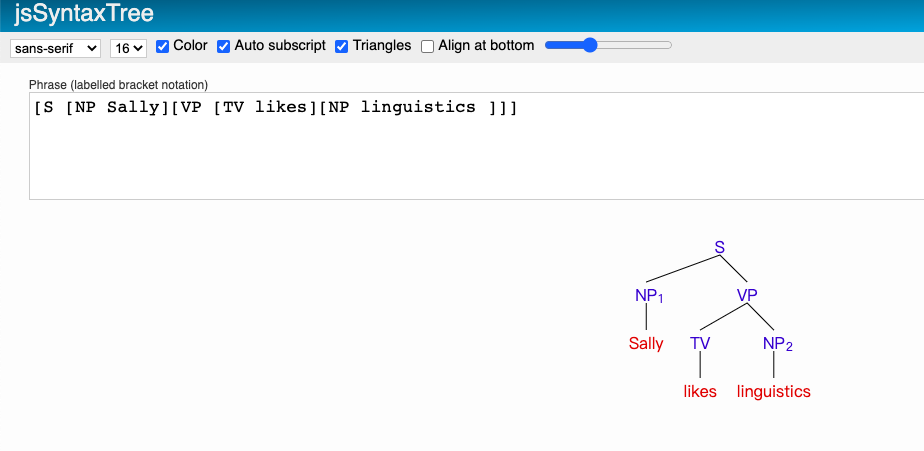
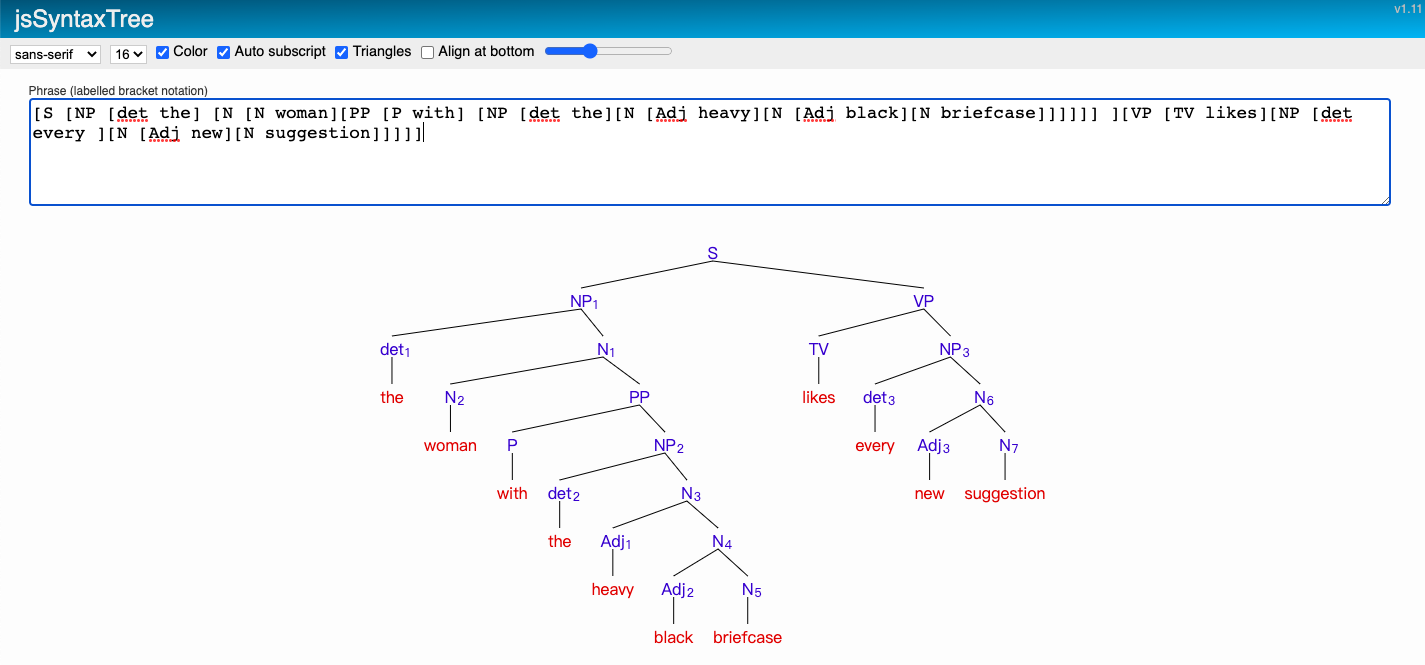
1 Copy/paste the following into (Links to an external site.) so you can see how they are both sentences with an NP subject, a TV, and an NP object.
[S [NP Sally][VP [TV likes][NP linguistics ]]]
[S [NP [det the] [N [N woman][PP [P with] [NP [det the][N [Adj heavy][N [Adj black][N briefcase]]]]]] ][VP [TV likes][NP [det every ][N [Adj new][N suggestion]]]]]
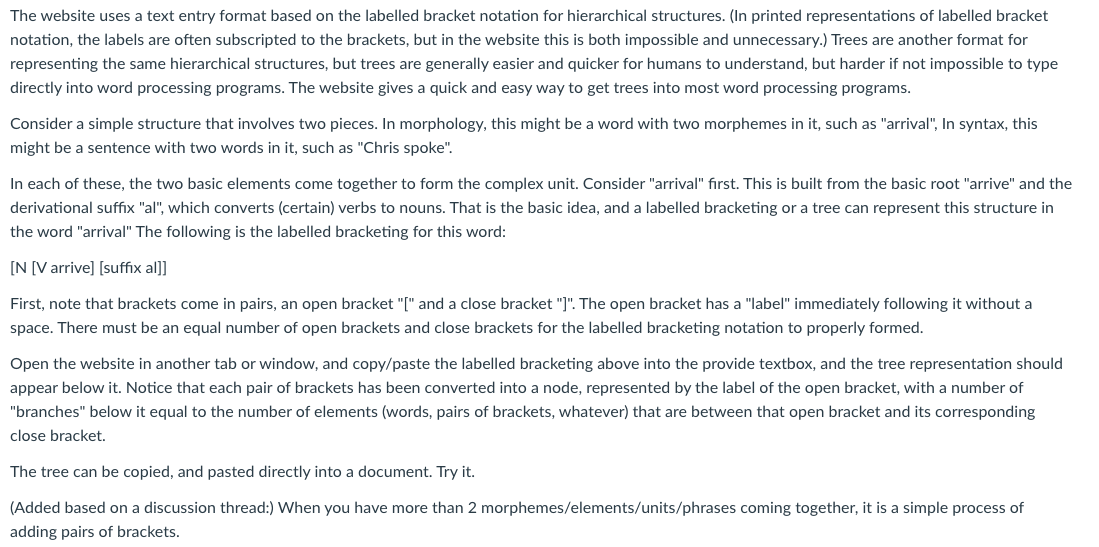
Structure tree making website: http://ironcreek.net/syntaxtree/
Reference: https://web.mit.eduorvin/www/24.902/phrasestructure.html#:~:text=Two%20nodes%20that%20have%20the,and%20NP%20are%20therefore%20sisters.&a

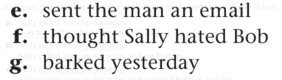
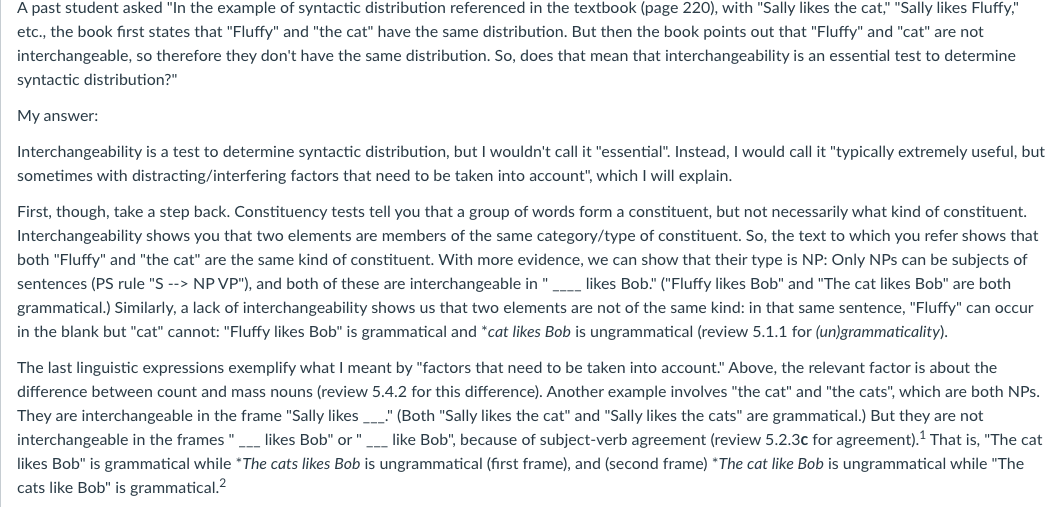
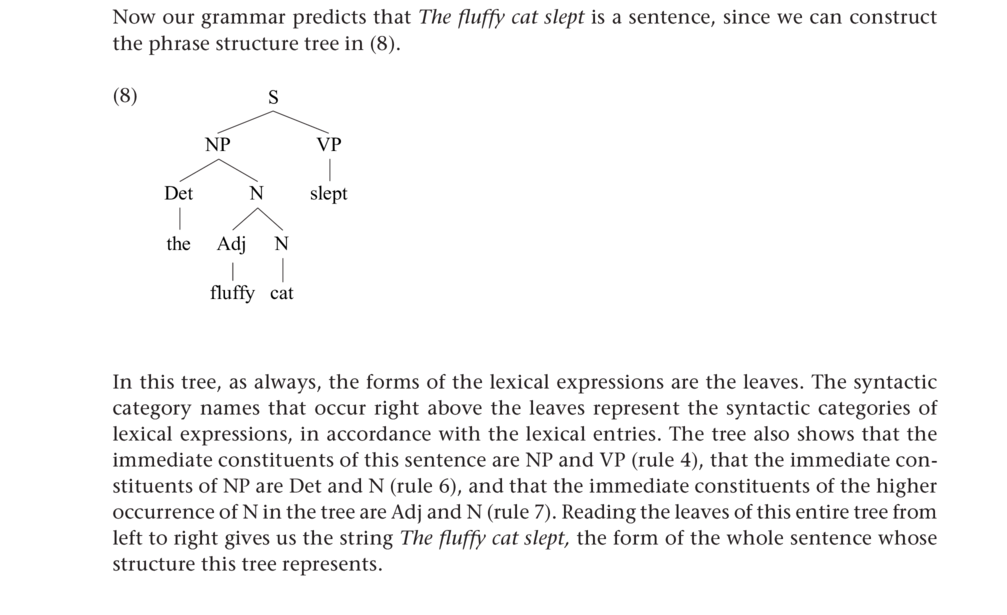
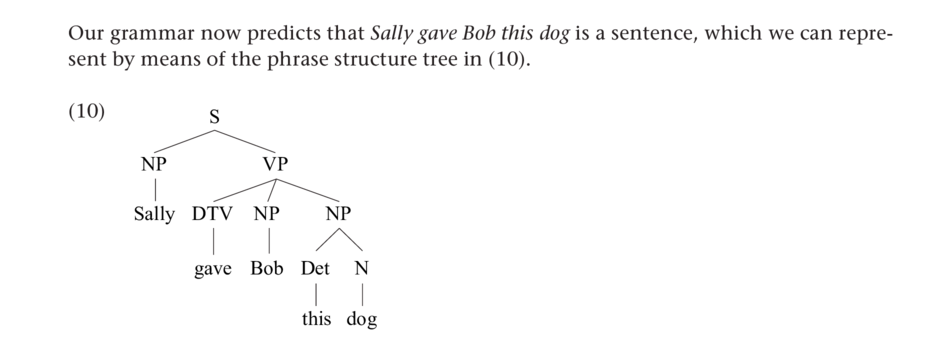
 Construct a phrase structure tree for each of the following expressions:e. sent the man an email ly calle f. thought Sally hated Bob g. barked yesterdayA past student asked "In the example of syntactic distribution referenced in the textbook l[page 220}. with "Sally likes the cat." "Sally likes Fluffy," etc.. the book rst states that "Fluffy" and "the cat" have the same distribution. But then the book points out that "Fluffy" and "cat" are not interchangeable so therefore they don't have the same distribution. 30, does that mean that interchangeability is an essential test to determine syntactic distribution?" My a nswer: Interchangeability is a test to determine syntactic distribution, but Iwouldn't call it "essential". Instead, I would call it "typically extremely useful, but sometimes with distracting/interfering factors that need to be taken into account", which I will explain. First, though, take a step back. Constituency tests tell you that a group of words form a constituent. but not necessarily what kind of constituent. Interchangeability shows you that two elements are members of the same category/type of constituent. So, the text to which you refer shows that both "Fluffy" and "the cat" are the same kind of constituent. With more evidence, we can show that their type is NP: Only NPs can be subjects of sentences {PS rule "5 > NP VP"), and both ofthese are interchangeable in " ____ likes Bob." l[\"Fluffy likes Bob" and "The cat likes Bob" are both grammatical.) Similarly, a lack of interchangeability shows us that two elements are not ofthe same kind: in that same sentence, "Fluffy" can occur in the blank but "cat" cannot: "Fluffy likes Bob" is grammatical and "cat likes Bob is ungrammatical {review 5.1.1 for [unlgrammaticality}. The last linguistic expressions exemplify what I meant by "factors that need to be taken into account." Above, the relevant factor is about the difference between count and mass nouns [review 5.4.2 for this difference). Another example involves "the cat" and "the cats", which are both NPs. They are interchangeable in the frame "Sally likes ___." (Both "Sally likes the cat" and "Sally likes the cats" are grammatical.) But they are not interchangeable in the frames " ___ likes Bob" or " ___ like Bob", because of subjectverb agreement {review 5.2.3: for agreement}.1 That is. "The cat likes Bob" is grammatical while "The cats likes Bob is ungrammatical l[first frame}, and (second frame} "The cat Iike Bob is ungrammatical while "The cats like Bob" is grammatical.2 Now our grammar predicts that The uffy cat slept is a sentence, since we can construct the phrase structure tree in (8). (3) S A NP VP A | De! N slept l /\\ the Adj N uffy cat In this tree, as always, the forms of the lexical expressions are the leaves. The syntactic category names that occur right above the leaves represent the syntactic categories of lexical expressions, in accordance with the lexical entries. The tree also shows that the immediate constituents of this sentence are NP and VP (rule 4), that the immediate con- stituents of NP are Det and N (rule 6}, and that the immediate constituents of the higher occurrence of N in the tree are Adj and N (rule 7). Reading the leaves of this entire tree from left to right gives us the string The uffv cat slept, the form of the whole sentence whose structure this tree represents. Our grammar now predicts that Sally gave Bob this dog is a sentence, which we can repre- sent by means of the phrase structure tree in (10). (10) S NP VP Sally DTV NP NP gave Bob Det N this dogjsSyntax Tree sans-serif v 16 Color Auto subscript _ Triangles ) Align at bottom Phrase (labelled bracket notation) [S [NP Sally] [VP [TV likes] [NP linguistics ]] ] S NP1 VP Sally TV NP 2 likes linguisticsv1.11 jsSyntax Tree sans-serif |16 Color Auto subscript _ Triangles Align at bottom Phrase (labelled bracket notation) [S [NP [det the] [N [N woman] [PP [P with] [NP [det the] [N [Adj heavy] [N [Adi black] [N briefcase] ]]]]] ][VP [TV likes][NP [det. every ][N [Adj new] [N suggestion] ]]]] S NP1 VP NP 3 det1 N1 TV the N2 PP likes det3 V6 P NP2 every Adj3 N7 woman with det2 N3 new suggestion the Adj1 heavy Adj2 N5 black briefcaseThe website uses a text entry format based on the labelled bracket notation for hierarchical structures. l[In printed representations of labelled bracket notation, the labels are often subscripted to the brackets, but in the website this is both impossible and unnecessary.}Trees are another format for representing the same hierarchical structures, but trees are generally easier and quicker for humans to understand, but harder if not impossible to type directly into word processing programs. The website gives a quick and easy way to get trees into most word processing programs. Consider a simple structure that involves two pieces. In morphology, this might be a word with two morphemes in it. such as "arrival", In syntax. this might be a sentence with two words in it, such as "Chris spoke". In each of these, the two basic elements come together to form the complex unit. Consider "arrival" rst.This is built from the basic root "arrive" and the derivational sufx "al", which converts {certain} verbs to nouns. That is the basic idea, and a labelled bracketing or a tree can represent this structure in the word "arrival" The following is the labelled bracketing for this word: [N [V arrive] [sufx all] First, note that brackets come in pairs, an open bracket "[" and a close bracket "]". The open bracket has a "label" immediately following it without a space. There must be an equal number of open brackets and close brackets for the labelled bracketing notation to properly formed. Open the website in another tab or window, and copy/paste the labelled bracketing above into the provide textbox. and the tree representation should appear below it. Notice that each pair of brackets has been converted into a node, represented by the label of the open bracket. with a number of "branches" below it equal to the number of elements (words, pairs of brackets. whatever} that are between that open bracket and its corresponding close bracket. The tree can be copied, and pasted directly into a document. Try it. (Added based on a discussion thread:) When you have more than 2 morphemesfelements/units/phrases coming together, it is a simple process of adding pairs of brackets
Step by Step Solution
There are 3 Steps involved in it

Get step-by-step solutions from verified subject matter experts
 Study Help