







Question: 1. (20 marks) Carry out a principal component analysis using all the suitable vari- ables. Do not include outcome. (a) Which variables have been selected
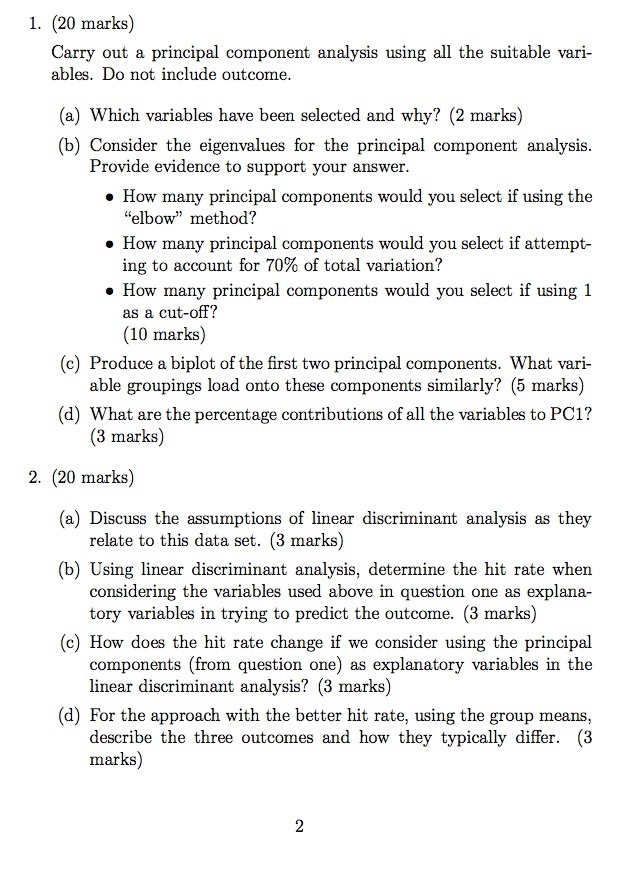
1. (20 marks) Carry out a principal component analysis using all the suitable vari- ables. Do not include outcome. (a) Which variables have been selected and why? (2 marks) (b) Consider the eigenvalues for the principal component analysis. Provide evidence to support your answer. . How many principal components would you select if using the "elbow" method? . How many principal components would you select if attempt- ing to account for 70% of total variation? . How many principal components would you select if using 1 as a cut-off? (10 marks) (c) Produce a biplot of the first two principal components. What vari- able groupings load onto these components similarly? (5 marks) (d) What are the percentage contributions of all the variables to PC1? (3 marks) 2. (20 marks) (a) Discuss the assumptions of linear discriminant analysis as they relate to this data set. (3 marks) (b) Using linear discriminant analysis, determine the hit rate when considering the variables used above in question one as explanat tory variables in trying to predict the outcome. (3 marks) (c) How does the hit rate change if we consider using the principal components (from question one) as explanatory variables in the linear discriminant analysis? (3 marks) (d) For the approach with the better hit rate, using the group means, describe the three outcomes and how they typically differ. (3 marks) 2
Step by Step Solution
There are 3 Steps involved in it

Get step-by-step solutions from verified subject matter experts
 Study Help