







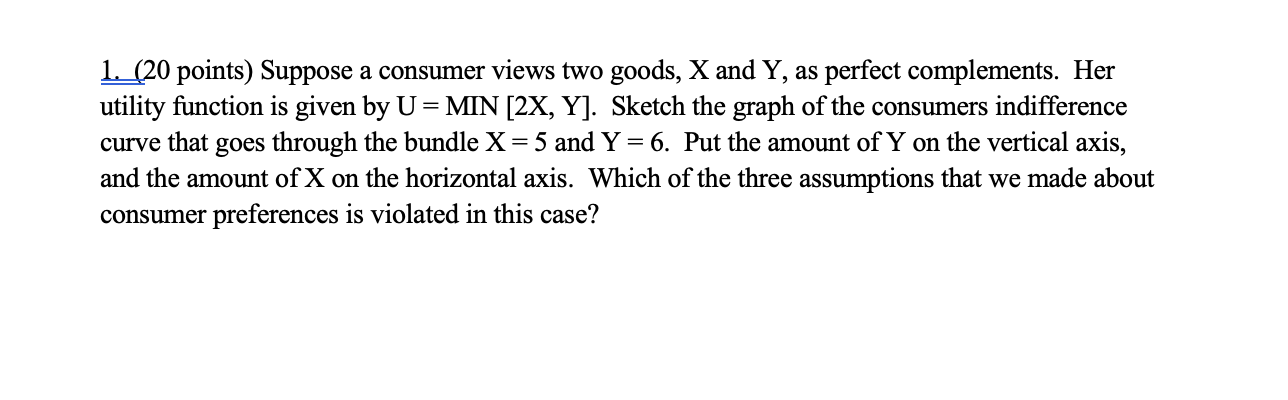
Question: 1. (20 points) Suppose a consumer views two goods, X and Y, as perfect complements. Her utility function is given by U MIN [2X,
![Y]. Sketch the graph of the consumers indifference curve that goes through](https://dsd5zvtm8ll6.cloudfront.net/si.experts.images/questions/2024/02/65bda95f6b257_47965bda95f487ee.jpg)
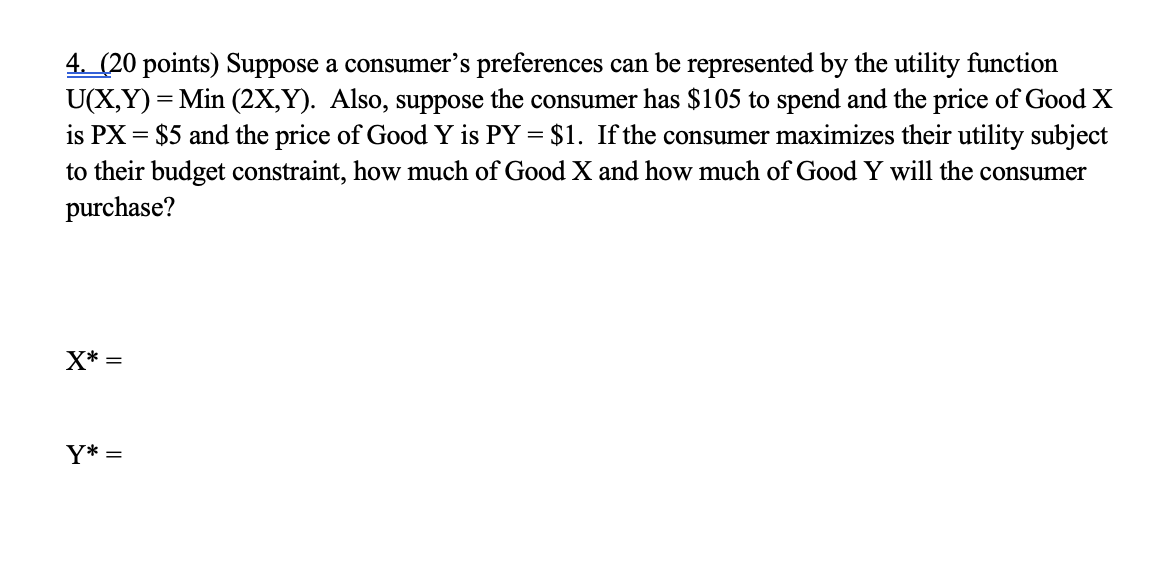
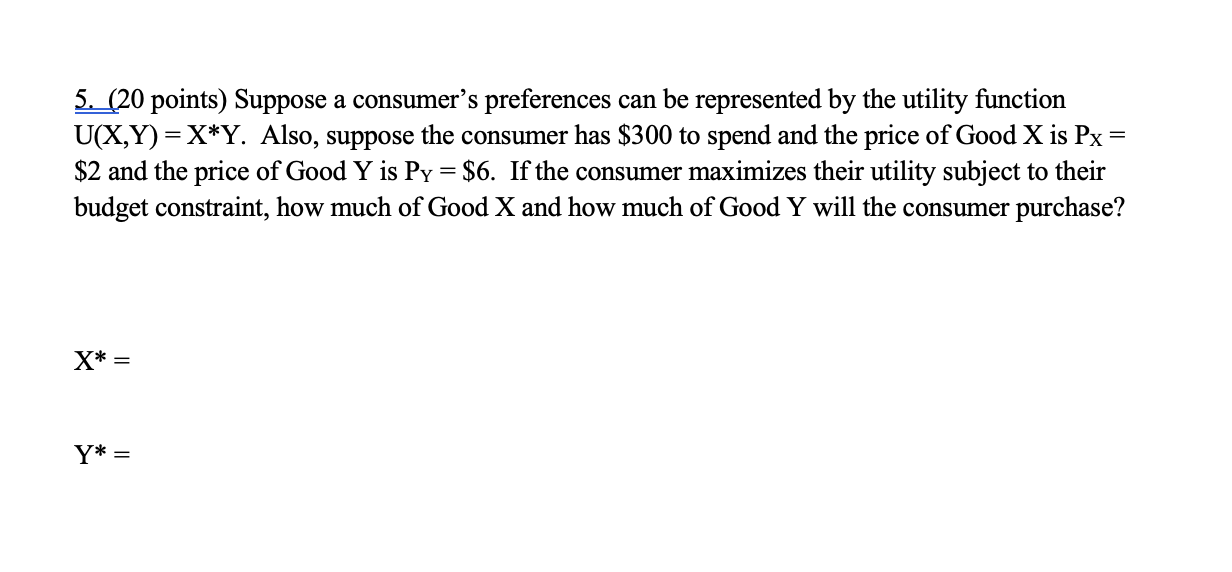
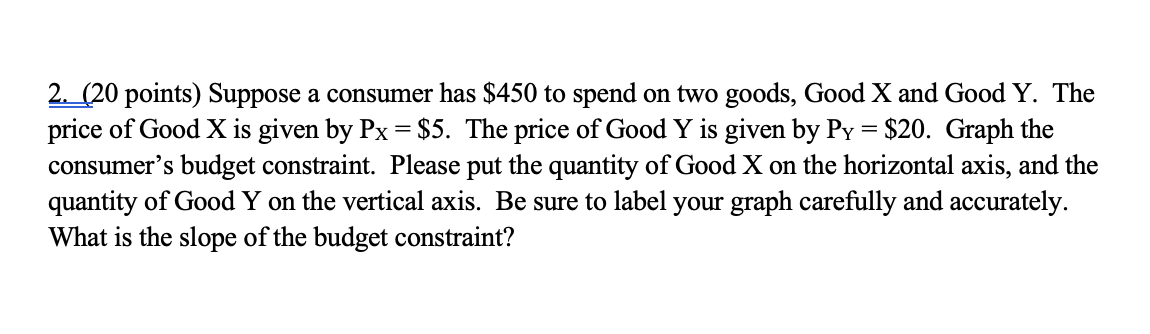
1. (20 points) Suppose a consumer views two goods, X and Y, as perfect complements. Her utility function is given by U MIN [2X, Y]. Sketch the graph of the consumers indifference curve that goes through the bundle X = 5 and Y=6. Put the amount of Y on the vertical axis, and the amount of X on the horizontal axis. Which of the three assumptions that we made about consumer preferences is violated in this case? 2. (20 points) Suppose a consumer has $450 to spend on two goods, Good X and Good Y. The price of Good X is given by Px = $5. The price of Good Y is given by Py = $20. Graph the consumer's budget constraint. Please put the quantity of Good X on the horizontal axis, and the quantity of Good Y on the vertical axis. Be sure to label your graph carefully and accurately. What is the slope of the budget constraint? 3. (20 points) Suppose a consumer's preferences can be represented by the utility function U(X,Y)= XY. In the table below, identify 4 points on the consumer's indifference curve where U = 60. X Y 4. (20 points) Suppose a consumer's preferences can be represented by the utility function U(X,Y) = Min (2X,Y). Also, suppose the consumer has $105 to spend and the price of Good X is PX = $5 and the price of Good Y is PY = $1. If the consumer maximizes their utility subject to their budget constraint, how much of Good X and how much of Good Y will the consumer purchase? X* = Y* = 5. (20 points) Suppose a consumer's preferences can be represented by the utility function U(X,Y)=X*Y. Also, suppose the consumer has $300 to spend and the price of Good X is Px = $2 and the price of Good Y is Py = $6. If the consumer maximizes their utility subject to their budget constraint, how much of Good X and how much of Good Y will the consumer purchase? X* = Y*=
Step by Step Solution
There are 3 Steps involved in it

Get step-by-step solutions from verified subject matter experts
 Study Help