







Question: 1 3 . 3 Reserve Prices ( Easier ) : Consider a seller who must sell a single private value good. There are two potential
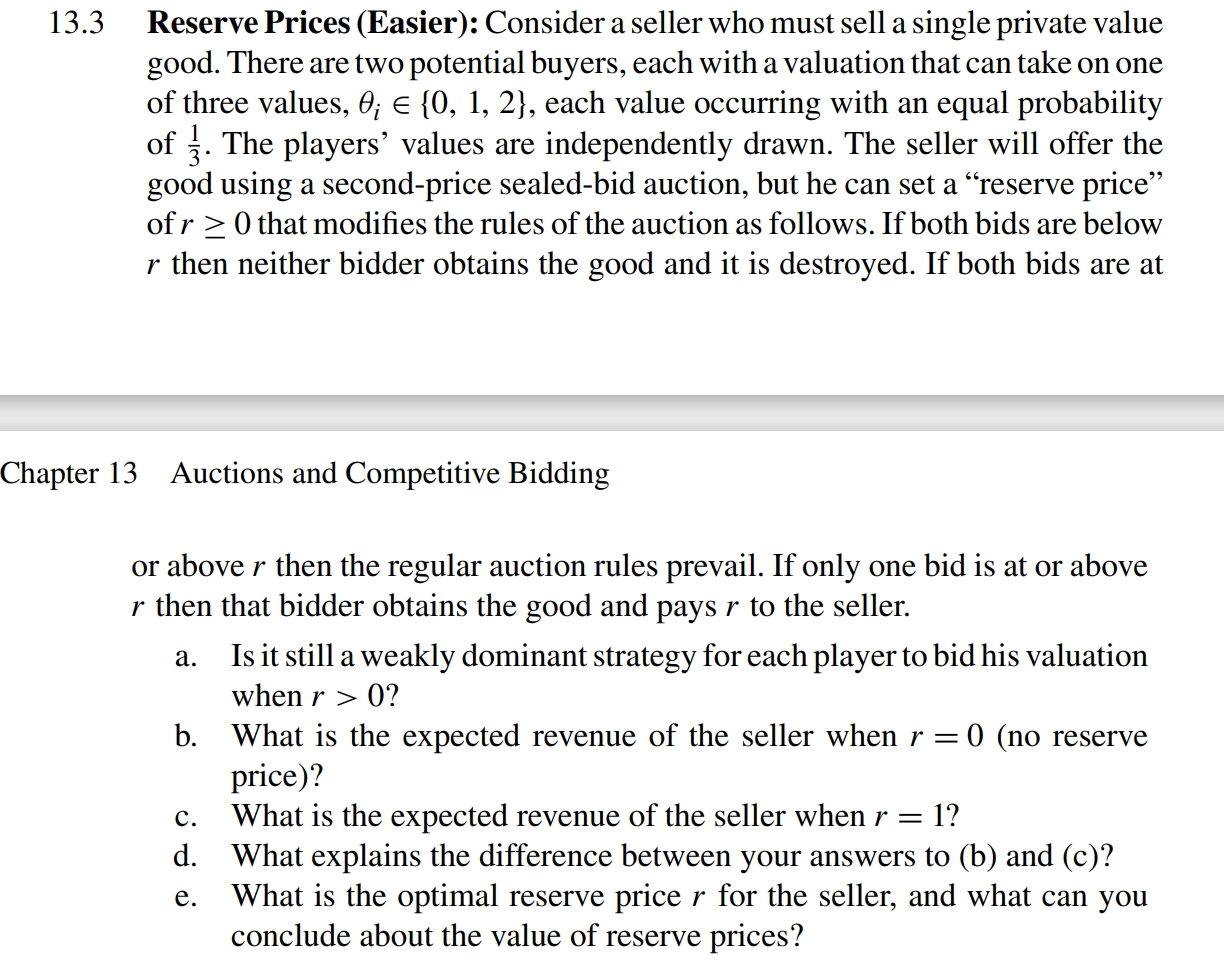
Reserve Prices Easier: Consider a seller who must sell a single private value
good. There are two potential buyers, each with a valuation that can take on one
of three values, thetaiin each value occurring with an equal probability
of The players' values are independently drawn. The seller will offer the
good using a secondprice sealedbid auction, but he can set a "reserve price"
of r that modifies the rules of the auction as follows. If both bids are below
r then neither bidder obtains the good and it is destroyed. If both bids are at
Chapter Auctions and Competitive Bidding
or above r then the regular auction rules prevail. If only one bid is at or above
r then that bidder obtains the good and pays r to the seller.
a Is it still a weakly dominant strategy for each player to bid his valuation
when r
b What is the expected revenue of the seller when rno reserve
price
c What is the expected revenue of the seller when r
d What explains the difference between your answers to b and c
e What is the optimal reserve price r for the seller, and what can you
conclude about the value of reserve prices?
Step by Step Solution
There are 3 Steps involved in it
1 Expert Approved Answer
Step: 1 Unlock

Question Has Been Solved by an Expert!
Get step-by-step solutions from verified subject matter experts
Step: 2 Unlock
Step: 3 Unlock
 Study Help