







Question: 1. 3. Determine the largest interval in which the given IVP is certain to have a unique twice differentiable solution. Do NOT attempt to find
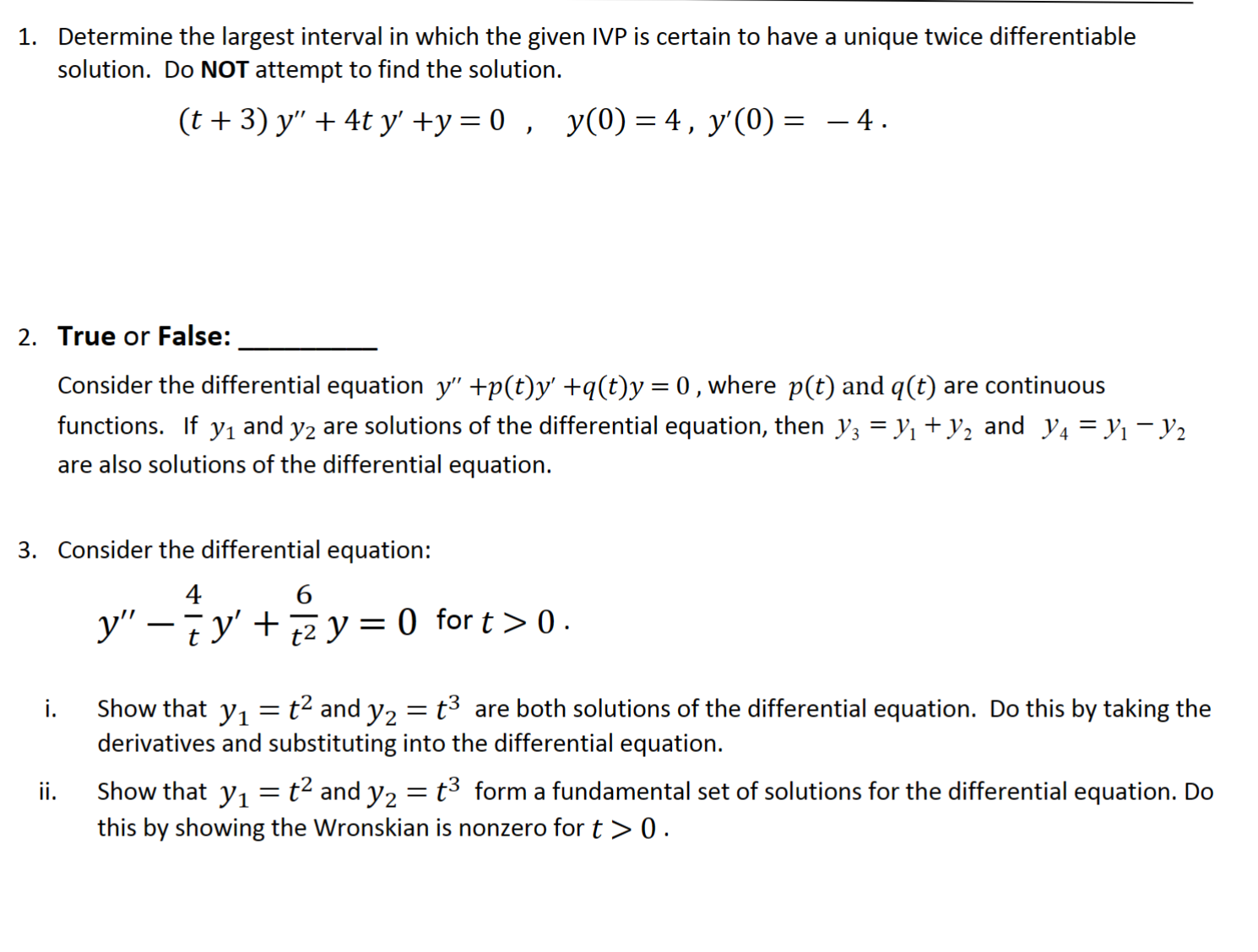
1. 3. Determine the largest interval in which the given IVP is certain to have a unique twice differentiable solution. Do NOT attempt to find the solution. E+3)y"+4ty +y=0, y0)=4, y(0)= 4. True or False: Consider the differential equation y\" 4+p(t)y' +q(t)y = 0, where p(t) and g(t) are continuous functions. If y; and y, are solutions of the differential equation, then yV; =y, +V, and V, =V, ), are also solutions of the differential equation. Consider the differential equation: 41 6 y' =3y +zy= 0 fort>0. Show that y, = t2 and Yo = t3 are both solutions of the differential equation. Do this by taking the derivatives and substituting into the differential equation. Show that y; = t? and y, =t form a fundamental set of solutions for the differential equation. Do this by showing the Wronskian is nonzero fort > (0
Step by Step Solution
There are 3 Steps involved in it

Get step-by-step solutions from verified subject matter experts
 Study Help