







Question: 1 . 3 Exercise 3 An excavation work between retaining walls for an underground passage project was carried out in a soil with an initial
Exercise
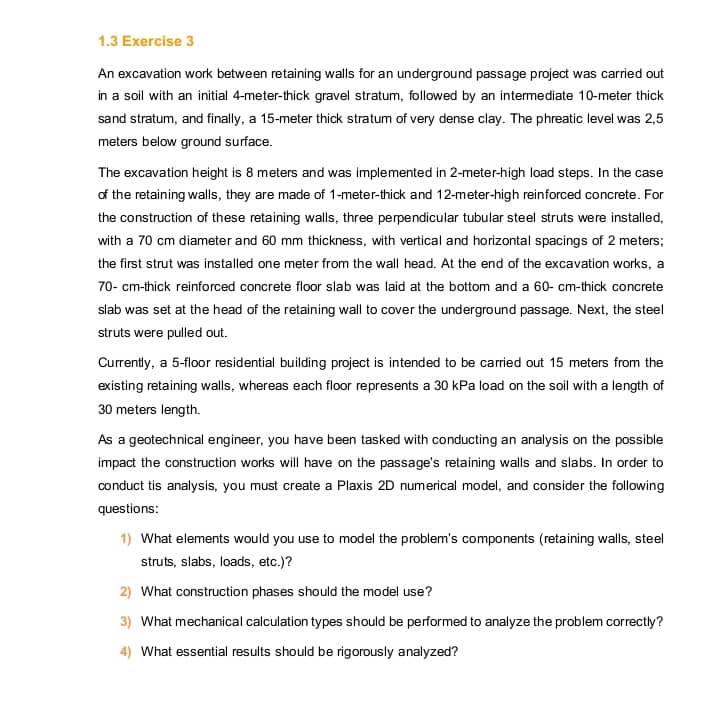
An excavation work between retaining walls for an underground passage project was carried out
in a soil with an initial meterthick gravel stratum, followed by an intermediate meter thick
sand stratum, and finally, a meter thick stratum of very dense clay. The phreatic level was
meters below ground surface.
The excavation height is meters and was implemented in meterhigh load steps. In the case
of the retaining walls, they are made of meterthick and meterhigh reinforced concrete. For
the construction of these retaining walls, three perpendicular tubular steel struts were installed,
with a diameter and thickness, with vertical and horizontal spacings of meters;
the first strut was installed one meter from the wall head. At the end of the excavation works, a
cmthick reinforced concrete floor slab was laid at the bottom and a cmthick concrete
slab was set at the head of the retaining wall to cover the underground passage. Next, the steel
struts were pulled out.
Currently, a floor residential building project is intended to be carried out meters from the
existing retaining walls, whereas each floor represents a kPa load on the soil with a length of
meters length.
As a geotechnical engineer, you have been tasked with conducting an analysis on the possible
impact the construction works will have on the passage's retaining walls and slabs. In order to
conduct tis analysis, you must create a Plaxis D numerical model, and consider the following
questions:
What elements would you use to model the problem's components retaining walls, steel
struts, slabs, loads, etc.
What construction phases should the model use?
What mechanical calculation types should be performed to analyze the problem correctly?
What essential results should be rigorously analyzed?
Step by Step Solution
There are 3 Steps involved in it
1 Expert Approved Answer
Step: 1 Unlock

Question Has Been Solved by an Expert!
Get step-by-step solutions from verified subject matter experts
Step: 2 Unlock
Step: 3 Unlock
 Study Help