







Question: 1) (30 pts) Write a numerical algorithm (computer code) that solves for the change in flow properties across a series of oblique shock waves
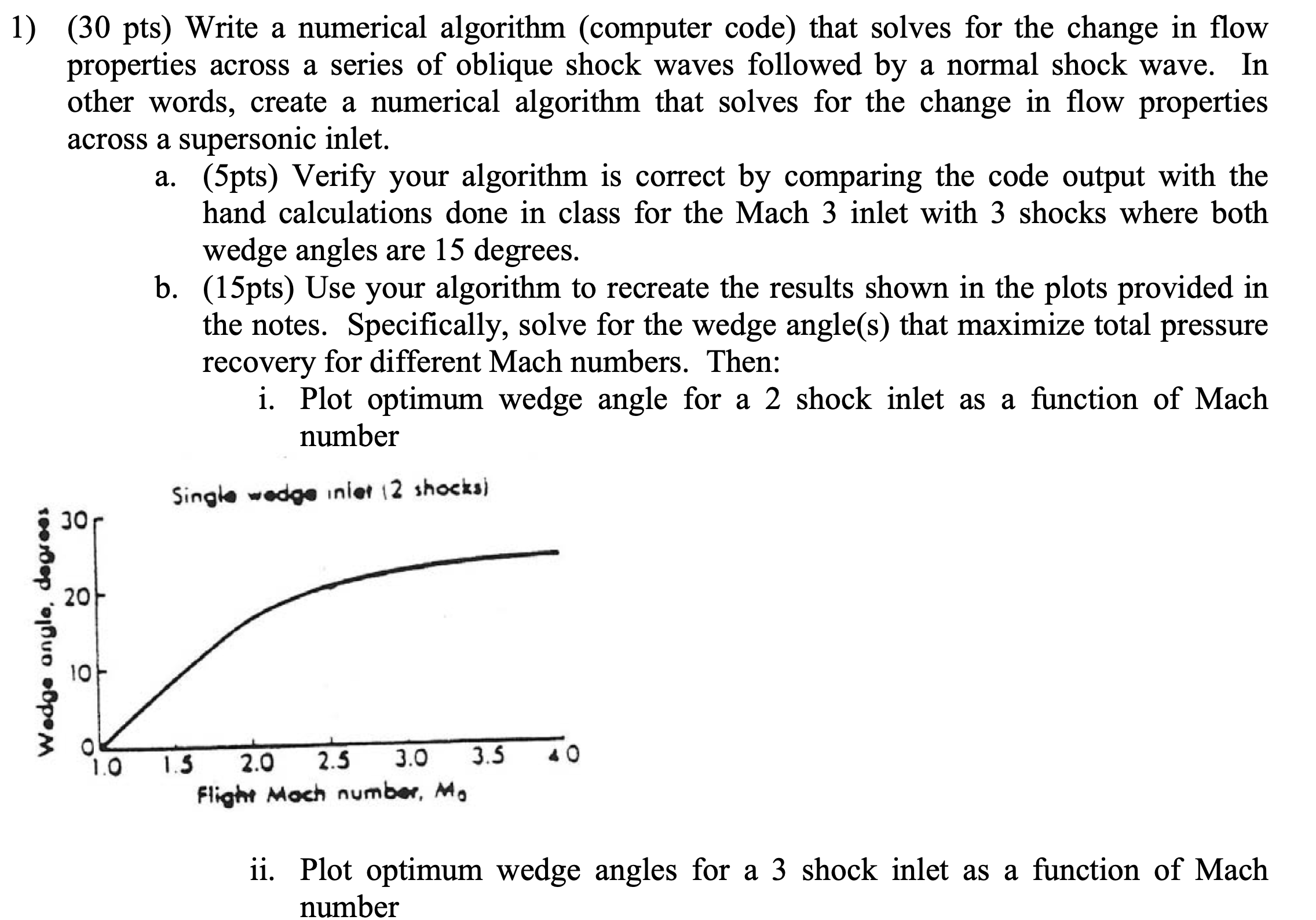
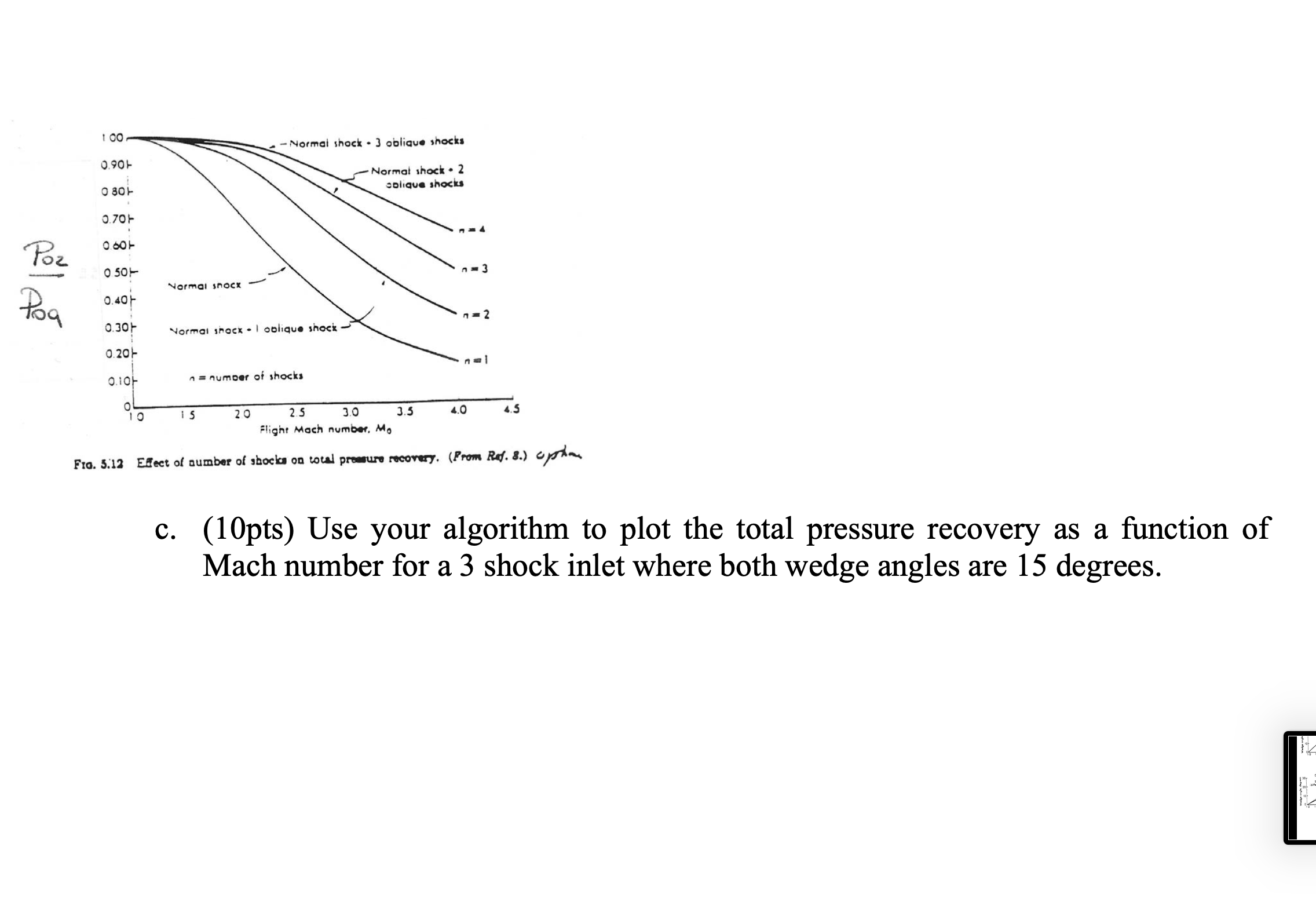
1) (30 pts) Write a numerical algorithm (computer code) that solves for the change in flow properties across a series of oblique shock waves followed by a normal shock wave. In other words, create a numerical algorithm that solves for the change in flow properties across a supersonic inlet. a. (5pts) Verify your algorithm is correct by comparing the code output with the hand calculations done in class for the Mach 3 inlet with 3 shocks where both wedge angles are 15 degrees. b. (15pts) Use your algorithm to recreate the results shown in the plots provided in the notes. Specifically, solve for the wedge angle(s) that maximize total pressure recovery for different Mach numbers. Then: i. Plot optimum wedge angle for a 2 shock inlet as a function of Mach number Single wedge iniet (2 shocks) Wedge angle, degrees 30 20 10 1.0 1.5 2.0 3.0 2.5 Flight Mach number, Mo 3.5 40 ii. Plot optimum wedge angles for a 3 shock inlet as a function of Mach number Poq 1:00 0.901 0 801 0.70 0.60T 0507 0.40 0.30 0.20 0.10 O Normal shock 10 Normal shock 1 oblique shock Normal shock 3 oblique shocks Normal shock - 2 colique shocks n = number of shocks 15 20 3.5 n=3 2.5 3.0 Flight Mach number, Mo FIG. 5:12 Effect of number of shocks on total pressure recovery. (From Ref. 8.) pho 4.0 = 2 4.5 c. (10pts) Use your algorithm to plot the total pressure recovery as a function of Mach number for a 3 shock inlet where both wedge angles are 15 degrees.
Step by Step Solution
There are 3 Steps involved in it
Our experts were un... View full answer

Get step-by-step solutions from verified subject matter experts
 Study Help