







Question: 1. (30%) True and False (1) If a function f can be expressed as fag*h, a multiplication of 2 functions, g and h, then D(f)=D(g*h)=
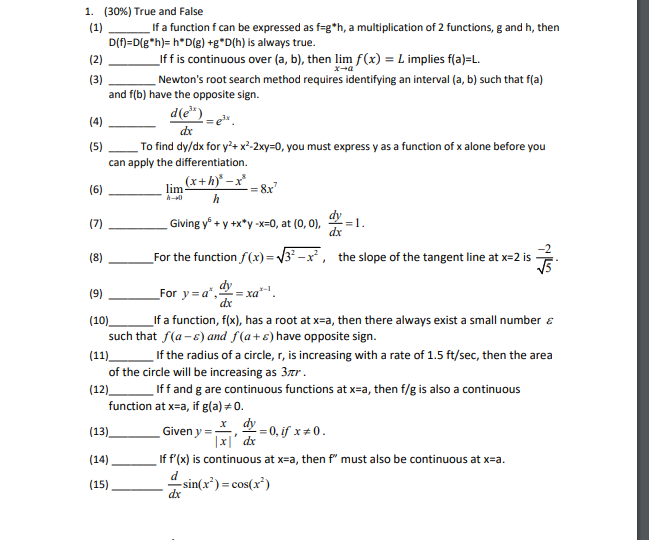
1. (30%) True and False (1) If a function f can be expressed as fag*h, a multiplication of 2 functions, g and h, then D(f)=D(g*h)= h*D(g) +g"D(h) is always true. (2) If f is continuous over (a, b), then lim f(x) = L implies f(a)=L. x-a (3) Newton's root search method requires identifying an interval (a, b) such that f(a) and f(b) have the opposite sign. (4) d(e") dx (5) To find dy/dx for y+ x3-2xy=0, you must express y as a function of x alone before you can apply the differentiation. (6) lim - ( xth)- x =8x h (7) Giving y + y +x*y -x=0, at (0, 0), " (8) For the function f(x) =
Step by Step Solution
There are 3 Steps involved in it
1 Expert Approved Answer
Step: 1 Unlock

Question Has Been Solved by an Expert!
Get step-by-step solutions from verified subject matter experts
Step: 2 Unlock
Step: 3 Unlock
 Study Help