







Question: 1 . 4 - 0 5 b . Performance: End - to - end Delay. Consider again the network shown above. Assume that the propagation
b Performance: Endtoend Delay. Consider again the network shown above. Assume that the propagation delay is ms per link. Note that each of the two sessions has a hop path from source to destination.
Suppose Sender B is idle and only Sender A is active. What is the endtoend delay of a packet from when it first begins transmission at Sender A until it is received in full by Receiver C Assume storeand forward packet transmission. You can assume the queueing delays are zero.
msec
msec
msec
msec
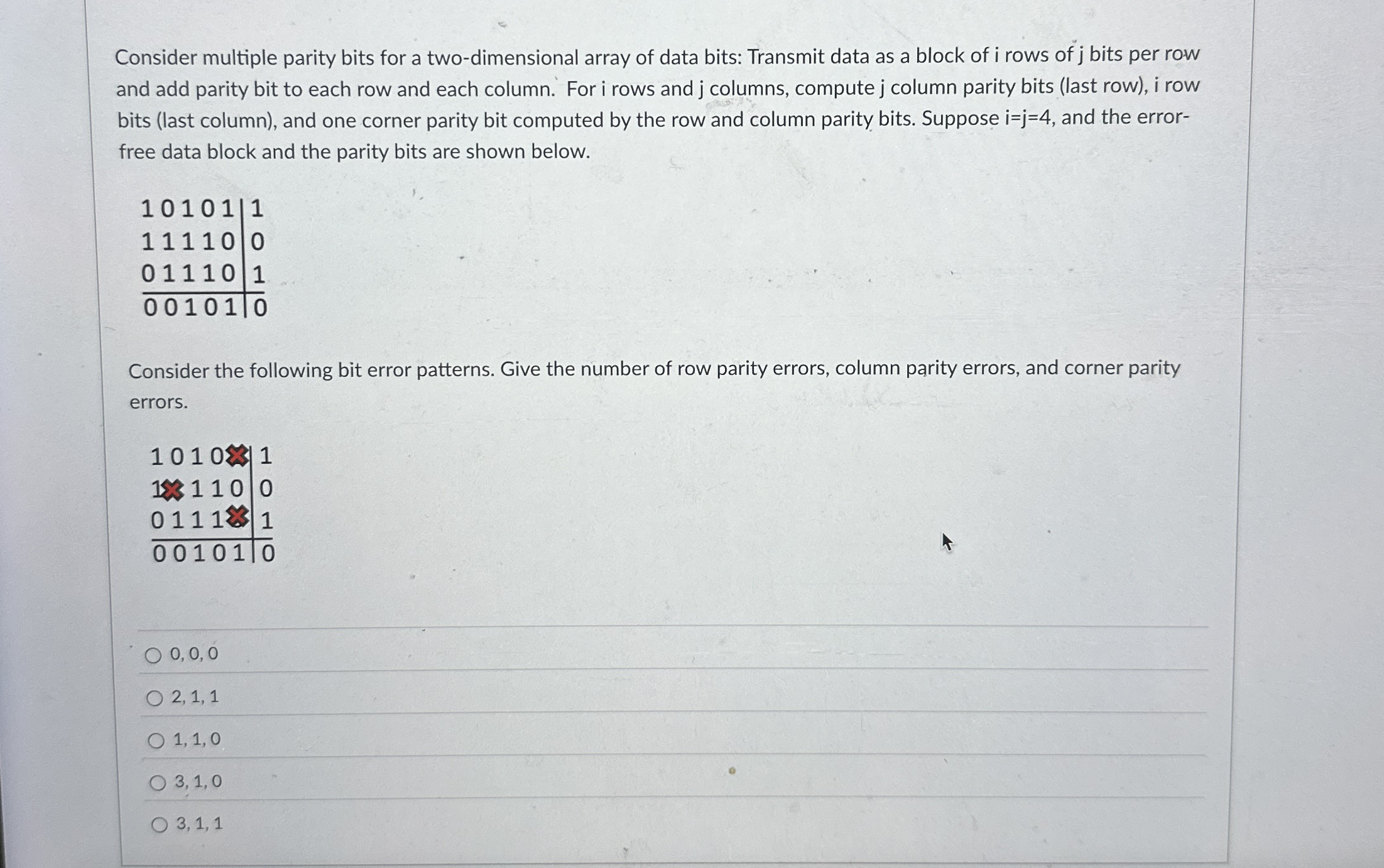
msecConsider multiple parity bits for a twodimensional array of data bits: Transmit data as a block of i rows of bits per row and add parity bit to each row and each column. For i rows and j columns, compute j column parity bits last row i row bits last column and one corner parity bit computed by the row and column parity bits. Suppose and the errorfree data block and the parity bits are shown below.
Consider the following bit error patterns. Give the number of row parity errors, column parity errors, and corner parity errors.
Consider multiple parity bits for a twodimensional array of data bits: Transmit data as a block of i rows of bits per row and add parity bit to each row and each column. For i rows and j columns, compute j column parity bits last row i row bits last column and one corner parity bit computed by the row and column parity bits. Suppose and the errorfree data block and the parity bits are shown below.
Consider the following bit error patterns. Give the number of row parity errors, column parity errors, and corner parity errors.
Step by Step Solution
There are 3 Steps involved in it
1 Expert Approved Answer
Step: 1 Unlock

Question Has Been Solved by an Expert!
Get step-by-step solutions from verified subject matter experts
Step: 2 Unlock
Step: 3 Unlock
 Study Help