







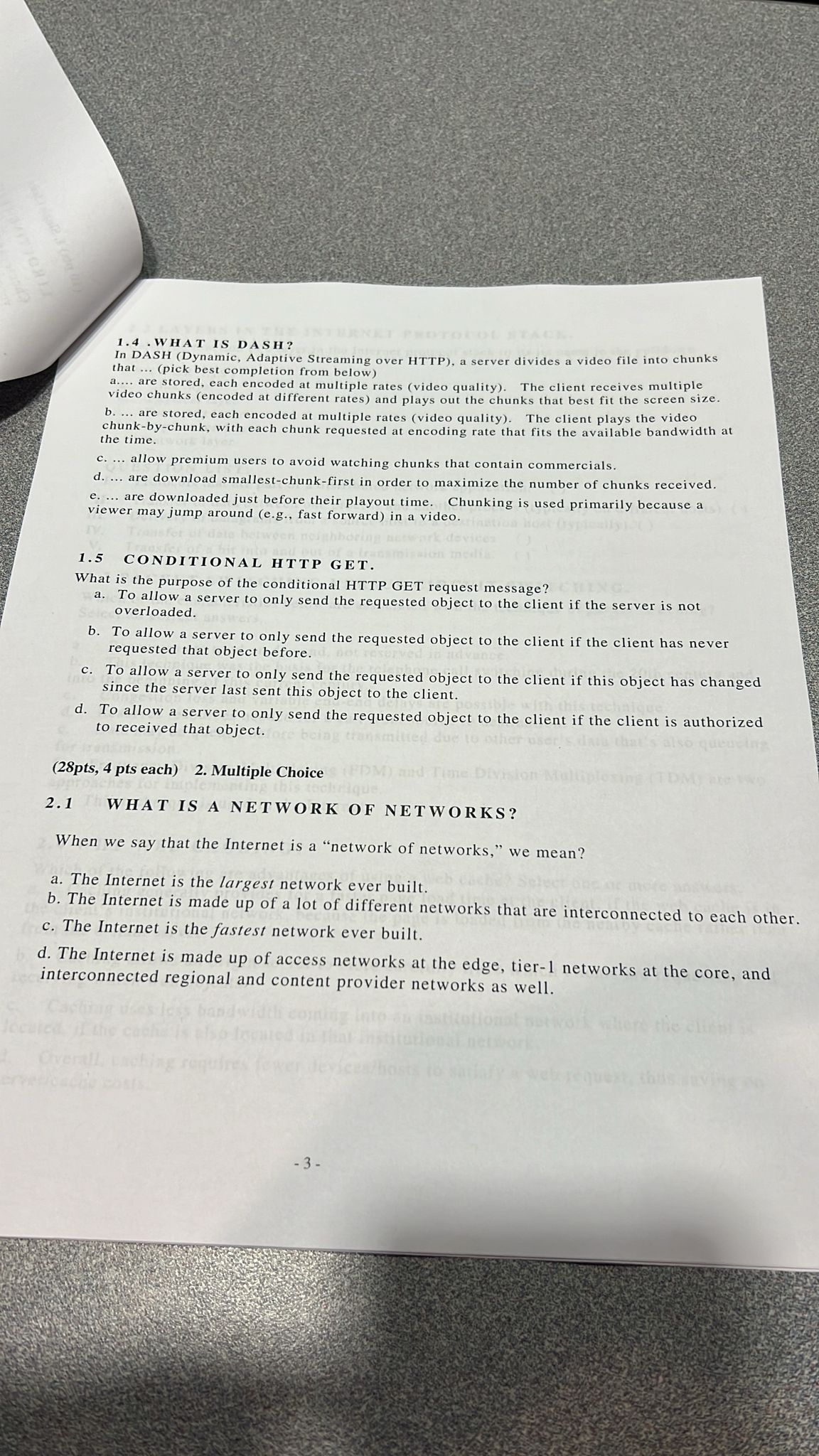
Question: 1 . 4 . WHAT IS DASH? In DASH ( Dynamic , Adaptive Streaming over HTTP ) , a server divides a video file into
WHAT IS DASH?
In DASH Dynamic Adaptive Streaming over HTTP a server divides a video file into chunks
that pick best completion from below
a are stored, each encoded at multiple rates video quality The client receives multiple
video chunks encoded at different rates and plays out the chunks that best fit the screen size.
b are stored, each encoded at multiple rates video quality The client plays the video
chunkbychunk, with each chunk requested at encoding rate that fits the available bandwidth at
the time.
c allow premium users to avoid watching chunks that contain commercials.
d are download smallestchunkfirst in order to maximize the number of chunks received.
e are downloaded just before their playout time. Chunking is used primarily because a
viewer may jump around eg fast forward in a video.
CONDITIONAL HTTP GET.
What is the purpose of the conditional HTTP GET request message?
a To allow a server to only send the requested object to the client if the server is not
overloaded.
b To allow a server to only send the requested object to the client if the client has never
requested that object before.
c To allow a server to only send the requested object to the client if this object has changed
since the server last sent this object to the client.
d To allow a server to only send the requested object to the client if the client is authorized
to received that object.
pts pts each Multiple Choice
WHAT IS A NETWORK OF NETWORKS?
When we say that the Internet is a "network of networks," we mean?
a The Internet is the largest network ever built.
b The Internet is made up of a lot of different networks that are interconnected to each other.
c The Internet is the fastest network ever built.
d The Internet is made up of access networks at the edge, tier networks at the core, and
interconnected regional and content provider networks as well.
Step by Step Solution
There are 3 Steps involved in it
1 Expert Approved Answer
Step: 1 Unlock

Question Has Been Solved by an Expert!
Get step-by-step solutions from verified subject matter experts
Step: 2 Unlock
Step: 3 Unlock
 Study Help