



Question: 1. [4] What is the runtime complexity (Big-0) of the pow() method show below? public static long pow( long x, int n ) { if
![1. [4] What is the runtime complexity (Big-0) of the pow()](https://s3.amazonaws.com/si.experts.images/answers/2024/09/66e08bca95ae0_88266e08bca37428.jpg)
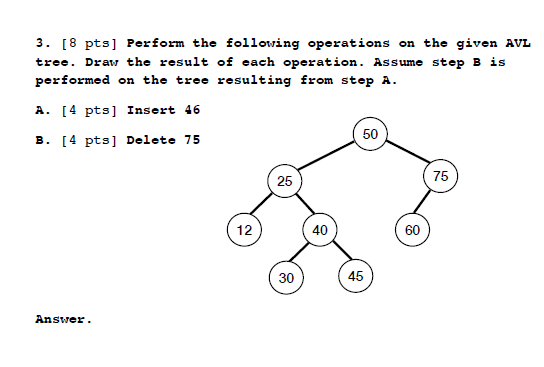
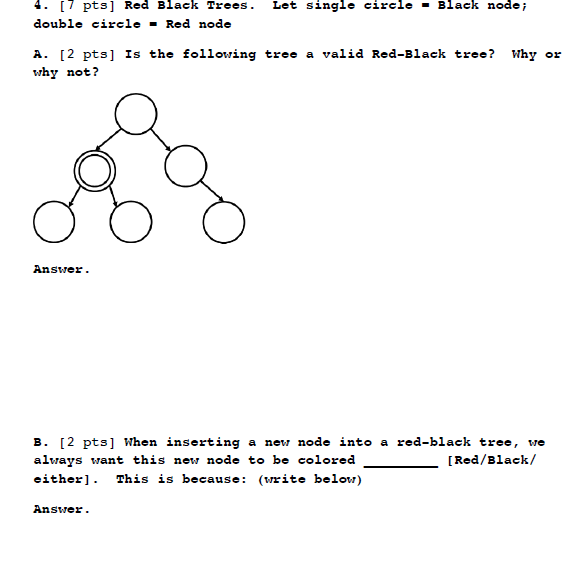
1. [4] What is the runtime complexity (Big-0) of the pow() method show below? public static long pow( long x, int n ) \{ if (n==0) return 1 ; if (n==1) return xi if (isEven(n)) return pow (xx,n/2); else return pow (xx,n/2)x; \} public static boolean isEven(int n ) \{ return (n82==0); \} Answer. 3. [ 8 pts] Perform the following operations on the given AvL tree. Draw the result of each operation. Assume step B is performed on the tree resulting from step A. A. [ 4 pts] Insert 46 B. [4 pts] Delete 75 4. [7 pts] Red Black Trees. Let single eirele = Black node; double eirele = Red node A. [2 pts] Is the following tree a valid Red-Black tree? Why or why not? Answer: B. [ 2 pts] When inserting a new node into a red-black tree, we always want this new node to be colored [Red/Black/ either]. This is because: (write below)
Step by Step Solution
There are 3 Steps involved in it

Get step-by-step solutions from verified subject matter experts