







Question: 1. [40 pts] Consider we have a database with 7 relations whose schema is shown as below: Customer = {customerID, first Name, last Name, birthDate,
![1. [40 pts] Consider we have a database with 7 relations](https://dsd5zvtm8ll6.cloudfront.net/si.experts.images/questions/2024/09/66f537063c407_43766f53705a3eea.jpg)
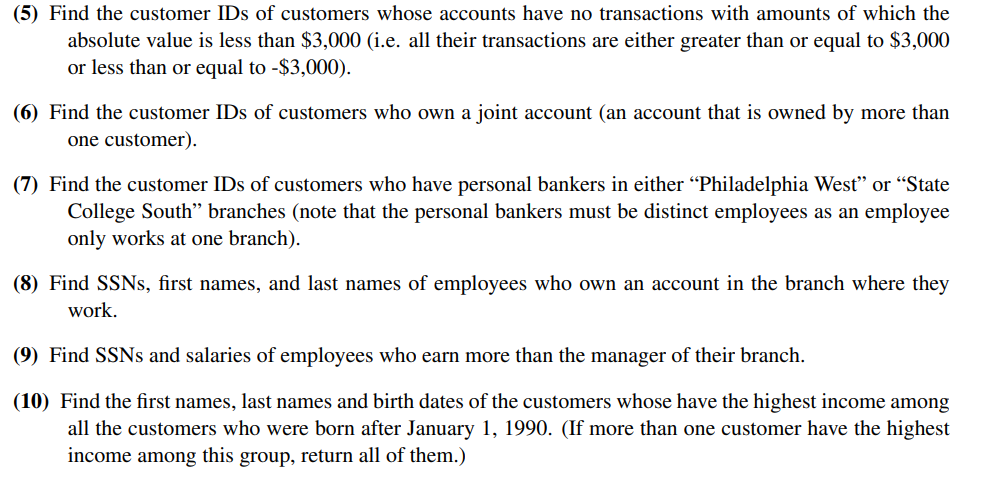
1. [40 pts] Consider we have a database with 7 relations whose schema is shown as below: Customer = {customerID, first Name, last Name, birthDate, income} Account = {accNumber, type, balance, branchNumber} Owns = {customerID, accNumber} Transactions = {transNumber, accNumber, amount ,date,description} Employee = {ssn, first Name, lastName, salary, startDate, branchNumber} PersonalBanker = {customerID, ssn} Branch= {branchNumber, branchName, street, numberEmployees, managerSSN, budget} Write a relational algebra query and a tuple relational calculus (TRC) query to answer each of the following questions. You may use input relation names to differentiate between attributes with the same name in the results of a join or Cartesian product (such as referring to Employee.firstName or Customer.firstName in the results of the Cartesian product of Employee and Customer). Note that you can use comparison operators (e.g. , ,
Step by Step Solution
There are 3 Steps involved in it

Get step-by-step solutions from verified subject matter experts
 Study Help