







Question: Q1 Processes (20%) Suppose we are dealing with a system of 4 processes with a set of constraints that are expressed by the following precedence
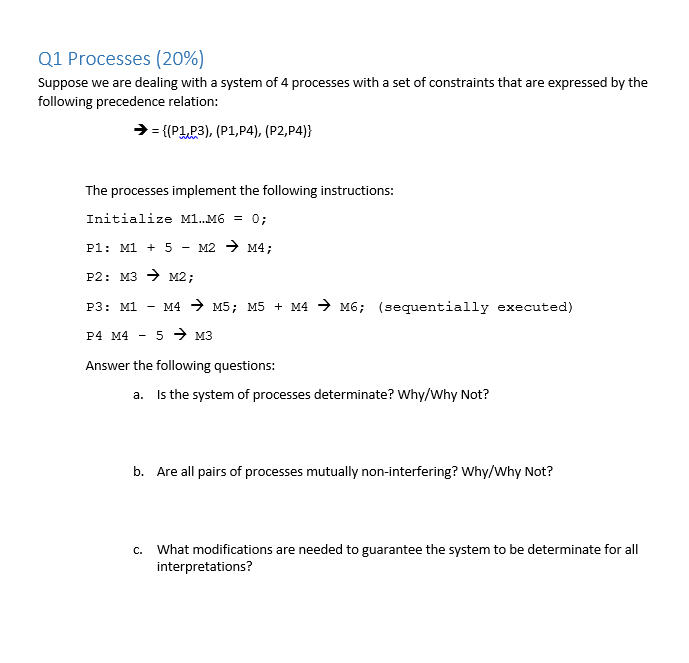
Q1 Processes (20%) Suppose we are dealing with a system of 4 processes with a set of constraints that are expressed by the following precedence relation: = {(P1.23), (P1,P4), (P2,P4)} The processes implement the following instructions: Initialize M1...M6 = 0; P1: M1 + 5 - M2 M4; P2: M3 M2; P3: M1 M4 M5; M5 + M4 M6; (sequentially executed) P4 M4 5 M3 Answer the following questions: a. Is the system of processes determinate? Why/Why Not? b. Are all pairs of processes mutually non-interfering? Why/Why Not? C. What modifications are needed to guarantee the system to be determinate for all interpretations? Q1 Processes (20%) Suppose we are dealing with a system of 4 processes with a set of constraints that are expressed by the following precedence relation: = {(P1.23), (P1,P4), (P2,P4)} The processes implement the following instructions: Initialize M1...M6 = 0; P1: M1 + 5 - M2 M4; P2: M3 M2; P3: M1 M4 M5; M5 + M4 M6; (sequentially executed) P4 M4 5 M3 Answer the following questions: a. Is the system of processes determinate? Why/Why Not? b. Are all pairs of processes mutually non-interfering? Why/Why Not? C. What modifications are needed to guarantee the system to be determinate for all interpretations
Step by Step Solution
There are 3 Steps involved in it

Get step-by-step solutions from verified subject matter experts
 Study Help