



Question: 1. (40%) Suppose that the consumer in a continuous-time life-cycle model chooses the consumption path and retirement age to maximize R e-In (e(x)) dr
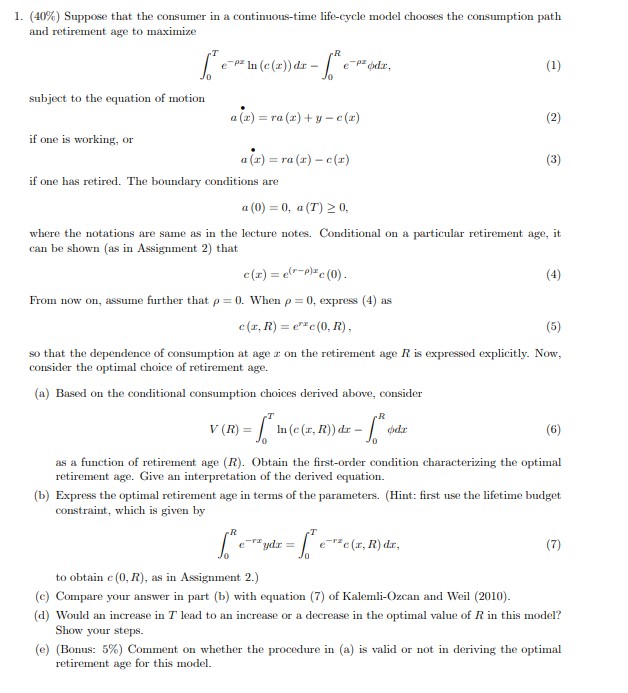
1. (40%) Suppose that the consumer in a continuous-time life-cycle model chooses the consumption path and retirement age to maximize R e-In (e(x)) dr - e-podz, subject to the equation of motion a(z) = ra (x)+y=c(a) if one is working, or a (x)=ra (x)-c(x) if one has retired. The boundary conditions are a (0) = 0, a (T) 0, (1) (2) (3) where the notations are same as in the lecture notes. Conditional on a particular retirement age, it can be shown (as in Assignment 2) that c(x) = (-) c (0). (4) From now on, assume further that p=0. When p=0, express (4) as c(x, R) ec(0, R), (5) so that the dependence of consumption at age z on the retirement age R is expressed explicitly. Now, consider the optimal choice of retirement age. (a) Based on the conditional consumption choices derived above, consider R V (R) = -In In (c (r, R)) dr = - Sdr (6) as a function of retirement age (R). Obtain the first-order condition characterizing the optimal retirement age. Give an interpretation of the derived equation. (b) Express the optimal retirement age in terms of the parameters. (Hint: first use the lifetime budget constraint, which is given by R eydr = fec (r, R) dr, (7) to obtain c (0, R), as in Assignment 2.) (e) Compare your answer in part (b) with equation (7) of Kalemli-Ozcan and Weil (2010). (d) Would an increase in T lead to an increase or a decrease in the optimal value of R in this model? Show your steps. (e) (Bonus: 5%) Comment on whether the procedure in (a) is valid or not in deriving the optimal retirement age for this model.
Step by Step Solution
There are 3 Steps involved in it

Get step-by-step solutions from verified subject matter experts